Gato Jorge, Leal Daniela, Coimbra Susana, Tasker Fiona
Faculty of Psychology and Education Sciences, University of Porto, Porto, Portugal.
Department of Psychological Sciences, Birkbeck, University of London, London, United Kingdom.
Front Psychol. 2020 Jun 10;11:1058. doi: 10.3389/fpsyg.2020.01058. eCollection 2020.
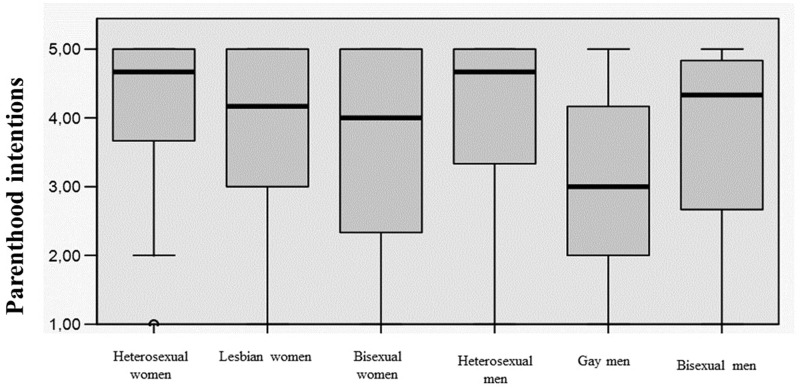
Parenthood is a highly valued life goal, independent of one's sexual orientation. However, the majority of studies exploring young adults' parenthood plans have relied exclusively on samples of heterosexual individuals. This study aimed (i) to explore differences in parenthood intentions as a function of sexual orientation, (ii) to investigate to what extent sociodemographic and psychological characteristics predict parenthood intentions of lesbian, gay, bisexual (LGB), and heterosexual individuals, (iii) to test the mediating effect of stigma between sexual orientation and parenthood intentions, and (iv) to identify and characterize profiles of prospective parenthood (through cluster analysis). Data were gathered using an online survey from 375 self-identified LGB and heterosexual young adults without children in Portugal, with a mean age of 25.83 years old ( = 4.49). Findings indicated that LGB individuals were less likely to intend to have children than heterosexual individuals; furthermore, among LGB individuals, lesbian women expressed stronger intentions to have children than did gay men. Similarities between heterosexual and LGB young adults were observed concerning the psychological determinants of parenthood intentions. Four distinctive profiles of prospective parenthood were identified: aspiring parents not anticipating stigma, aspiring parents anticipating stigma, childfree intent, and childfree ambivalent. Lesbian and bisexual women mostly populated the childfree ambivalent cluster; in contrast, the aspiring parents anticipating stigma cluster contained an overrepresentation of men, including sexual minority men. Professionals may want to attend to communalities and specificities of prospective parenthood as a function of sexual orientation, in order to provide unbiased and culturally competent support to sexual minority individuals.
为人父母是一个备受重视的人生目标,与一个人的性取向无关。然而,大多数探索年轻人为人父母计划的研究仅依赖于异性恋个体样本。本研究旨在:(i)探讨为人父母意愿随性取向的差异;(ii)调查社会人口学和心理特征在多大程度上预测女同性恋、男同性恋、双性恋(LGB)和异性恋个体的为人父母意愿;(iii)检验污名在性取向和为人父母意愿之间的中介作用;(iv)识别并描述准父母的特征(通过聚类分析)。通过在线调查收集了来自葡萄牙375名自称LGB和异性恋的无子女年轻人的数据,他们的平均年龄为25.83岁(标准差 = 4.49)。研究结果表明,LGB个体比异性恋个体更不太可能打算要孩子;此外,在LGB个体中,女同性恋者比男同性恋者表达了更强的要孩子意愿。在为人父母意愿的心理决定因素方面,观察到异性恋和LGB年轻人之间存在相似之处。识别出了四种不同的准父母特征:不预期污名的有抱负的父母、预期污名的有抱负的父母、无子女意愿和无子女矛盾心理。女同性恋和双性恋女性大多集中在无子女矛盾心理类别中;相比之下,预期污名的有抱负的父母类别中男性比例过高,包括性少数群体男性。专业人员可能需要关注准父母特征随性取向的共性和特殊性,以便为性少数群体个体提供无偏见且具有文化胜任力的支持。