Batista Marina Ferreira, Nájera Carlos Alcides, Meneghelli Isabela, Bahia Diana
Departamento de Genética, Ecologia e Evolução, Instituto de Ciências Biológicas, Universidade Federal de Minas Gerais, Belo Horizonte, Brazil.
Front Cell Dev Biol. 2020 Jun 10;8:396. doi: 10.3389/fcell.2020.00396. eCollection 2020.
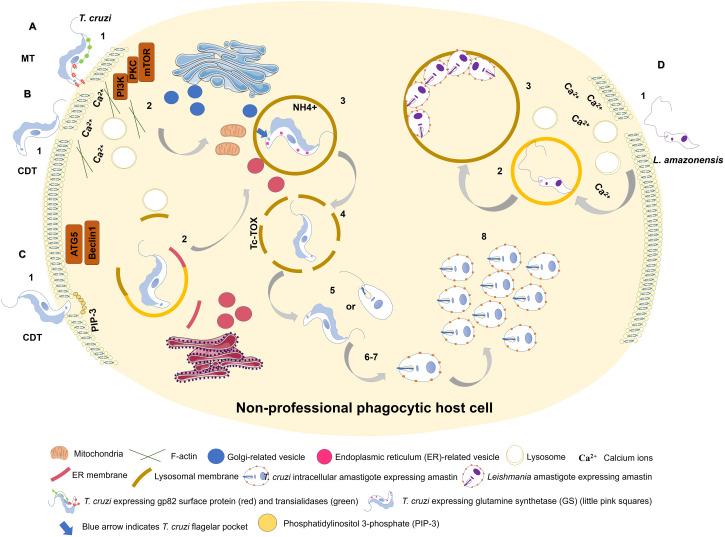
The trypanosomatid (protozoan) parasites and spp. are causative agents of Chagas disease and , respectively. They display high morphological plasticity, are capable of developing in both invertebrate and vertebrate hosts, and are the only trypanosomatids that can survive and multiply inside mammalian host cells. During internalization by host cells, these parasites are lodged in "parasitophorous vacuoles" (PVs) comprised of host cell endolysosomal system components. PVs effectively shelter parasites within the host cell. PV development and maturation (acidification, acquisition of membrane markers, and/or volumetric expansion) precede parasite escape from the vacuole and ultimately from the host cell, which are key determinants of infective burden and persistence. PV biogenesis varies, depending on trypanosomatid species, in terms of morphology (e.g., size), biochemical composition, and parasite-mediated processes that coopt host cell machinery. PVs play essential roles in the intracellular development (i.e., morphological differentiation and/or multiplication) of and spp. They are of great research interest as potential gateways for drug delivery systems and other therapeutic strategies for suppression of parasite multiplication and control of the large spectrum of diseases caused by these trypanosomatids. This mini-review focuses on mechanisms of PV biogenesis, and processes whereby PVs of and spp. promote parasite persistence within and dissemination among mammalian host cells.
Front Cell Dev Biol. 2020-6-10
Front Immunol. 2013-8-1
Front Cell Infect Microbiol. 2022
J Eukaryot Microbiol. 2025
PLoS Pathog. 2025-3-31
Front Cell Infect Microbiol. 2023
PLoS Pathog. 2022-12
Antibiotics (Basel). 2022-12-8
Front Cell Infect Microbiol. 2022
Life Sci. 2020-2-20
Front Immunol. 2019-11-1
Front Cell Infect Microbiol. 2019-9-6
Proc Natl Acad Sci U S A. 2019-4-12

 Zotero 插件