Department of Experimental Trauma Surgery, Klinikum rechts der Isar, Technical University Munich, Munich, Germany.
University Clinic of Orthopedics and Trauma Surgery, Department of Trauma Surgery, Medical University of Vienna, Vienna, Austria.
Sci Rep. 2020 Jun 26;10(1):10408. doi: 10.1038/s41598-020-67254-5.
Age and co-morbidities compromise healing tendencies of traumatic fractures in geriatric patients. Non-healing fractures may need regenerative medicine techniques involving autologous mesenchymal stem cells (MSCs). Donor age may affect the viability and differentiation capacity of MSCs. We investigated age-related differences in adipose-derived MSCs (AMSCs) concerning osteogenic potential in 2D and 3D cultivation.
AMSCs were harvested from young (mean age: 37.5 ± 8.6 years) and old (mean age: 75.8 ± 9.2 years) patients. Cells were induced to osteogenic differentiation and cultivated in 2D and 3D for 14 days. Alkaline phosphatase (ALP) activity, mineralization and gene expression were investigated.
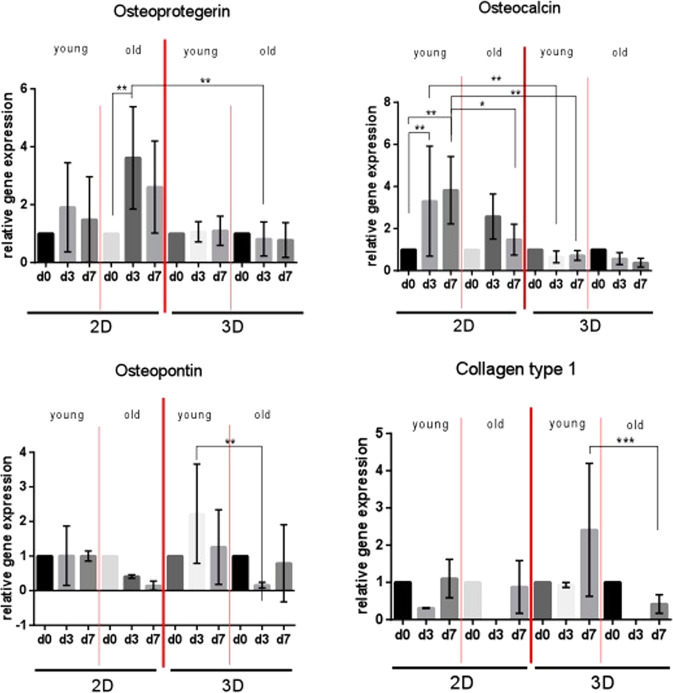
ALP activity revealed highest levels in 3D of old AMSCs after 14 days. ALP expression showed significant rises in old vs. young cells in 2D (p = 0.0024). Osteoprotegerin revealed the highest levels in old AMSCs in 2D. Highest osteocalcin levels presented in young cells compared to old cells in 2D (p = 0.0258) and young cells in 3D (p = 0.0014).
3D arrangement of old AMSCs without growth factors is not ensuring superior osteogenesis in vitro. AMSCs, especially cells from older patients, reveal higher osteogenic potential in 2D than in 3D. 3D arrangement favors osteogenic potential of young cells.
年龄和合并症会影响老年患者创伤性骨折的愈合趋势。未愈合的骨折可能需要再生医学技术,包括自体间充质干细胞(MSCs)。供体年龄可能会影响 MSCs 的活力和分化能力。我们研究了与二维和三维培养中的成骨潜能相关的脂肪来源间充质干细胞(AMSCs)的年龄相关性差异。
从年轻(平均年龄:37.5±8.6 岁)和老年(平均年龄:75.8±9.2 岁)患者中采集 AMSCs。将细胞诱导为成骨分化,并在二维和三维条件下培养 14 天。检测碱性磷酸酶(ALP)活性、矿化和基因表达。
14 天后,老年 AMSCs 在三维培养中显示出最高的 ALP 活性。与年轻细胞相比,二维培养中老年细胞的 ALP 表达显著升高(p=0.0024)。骨保护素在二维培养中在老年 AMSCs 中表达最高。与老年细胞相比,二维和三维培养中的年轻细胞的骨钙素水平更高(p=0.0258 和 p=0.0014)。
无生长因子的老年 AMSCs 的三维排列并不能确保体外更好的成骨作用。AMSCs,尤其是来自老年患者的细胞,在二维培养中比在三维培养中具有更高的成骨潜能。三维排列有利于年轻细胞的成骨潜能。