Loeffler Tina, Schilcher Irene, Flunkert Stefanie, Hutter-Paier Birgit
Neuropharmacology, QPS Austria GmbH, Grambach, Austria.
Front Neurosci. 2020 Jun 11;14:579. doi: 10.3389/fnins.2020.00579. eCollection 2020.
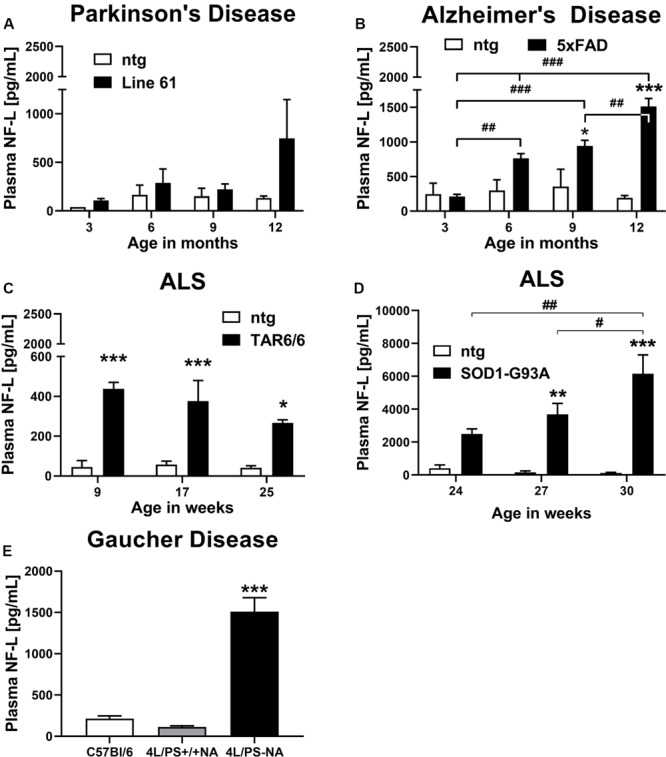
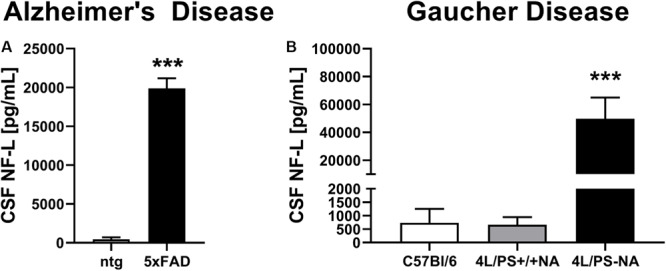
Neurofilament-light chain (NF-L) is a well-known clinical biomarker of many neurodegenerative diseases. By analyzing amyotrophic lateral sclerosis (ALS) patients cerebrospinal fluid (CSF) or plasma, progression of NF-L levels can forecast conversion from the presymptomatic to symptomatic stage and time of survival. The use of plasma for NF-L measurement makes this biomarker exceptionally valuable for clinical studies since sample collection can be performed repeatedly without causing much harm. Detailed analyses of NF-L expression in neurodegenerative disease patient's samples were already performed, while NF-L levels of preclinical models of ALS, Alzheimer's and Parkinson's disease as well as lysosomal storage diseases are still widely unknown. We therefore evaluated NF-L levels in the plasma of the ALS models SOD1-G93A low expressor and TAR6/6 mice, the Alzheimer's disease (AD) model 5xFAD, the Parkinson's disease model Line 61 and the Gaucher disease (GD) model 4L/PS-NA and the CSF of selected models. Our results show that NF-L levels are highly increased in the plasma of ALS, Alzheimer's and GD models, while in the analyzed Parkinson's disease model NF-L plasma levels barely changed. Most analyzed models show a progressive increase of NF-L levels. NF-L measurements in the plasma of the neurodegenerative disease mouse models of ALS and AD are thus a good tool to evaluate disease progression. Compared to analyses in human tissues, our results suggest a high translation value of murine NF-L levels and their progression. Furthermore, our data indicate that NF-L might also be a good biomarker for disorders with a neuronal component like some lysosomal storage diseases.
神经丝轻链(NF-L)是许多神经退行性疾病中广为人知的临床生物标志物。通过分析肌萎缩侧索硬化症(ALS)患者的脑脊液(CSF)或血浆,NF-L水平的变化可以预测从症状前阶段到症状阶段的转变以及生存时间。使用血浆来测量NF-L使得这种生物标志物在临床研究中具有极高的价值,因为可以反复采集样本而不会造成太大伤害。虽然已经对神经退行性疾病患者样本中的NF-L表达进行了详细分析,但ALS、阿尔茨海默病和帕金森病以及溶酶体贮积病临床前模型的NF-L水平仍然鲜为人知。因此,我们评估了ALS模型SOD1-G93A低表达小鼠和TAR6/6小鼠、阿尔茨海默病(AD)模型5xFAD、帕金森病模型Line 61和戈谢病(GD)模型4L/PS-NA血浆中的NF-L水平以及部分选定模型的脑脊液中的NF-L水平。我们的结果表明,ALS、阿尔茨海默病和GD模型的血浆中NF-L水平显著升高,而在分析的帕金森病模型中,血浆NF-L水平几乎没有变化。大多数分析模型显示NF-L水平呈逐渐升高趋势。因此,测量ALS和AD神经退行性疾病小鼠模型血浆中的NF-L是评估疾病进展的良好工具。与人体组织分析相比,我们的结果表明小鼠NF-L水平及其变化具有较高的转化价值。此外,我们的数据表明,NF-L可能也是一些具有神经元成分的疾病(如某些溶酶体贮积病)的良好生物标志物。