Center for Nanotechnology in Drug Delivery and Division of Pharmacoengineering and Molecular Pharmaceutics, Eshelman School of Pharmacy, University of North Carolina at Chapel Hill, NC 27599, USA.
Joint UNC/NC State Department of Biomedical Engineering, University of North Carolina, Chapel Hill, NC 27599-7575, USA.
Sci Adv. 2020 Jun 17;6(25):eaba5542. doi: 10.1126/sciadv.aba5542. eCollection 2020 Jun.
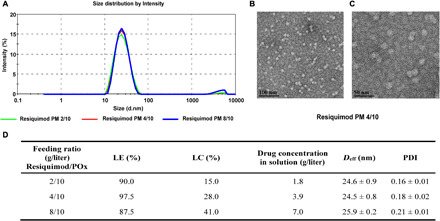
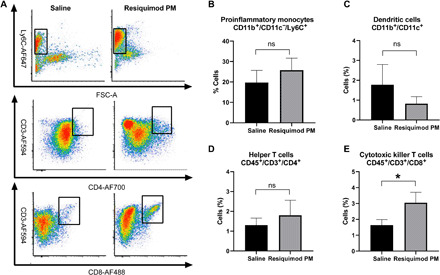
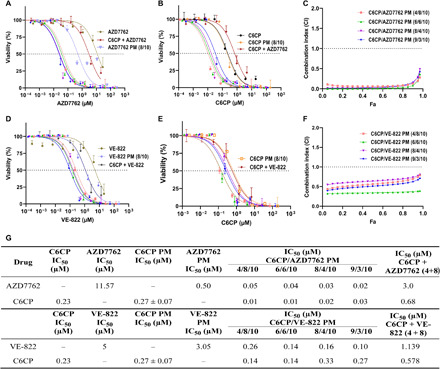
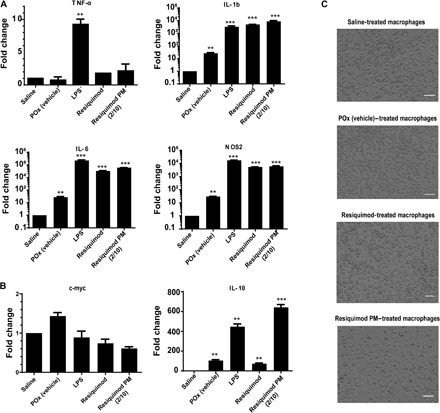
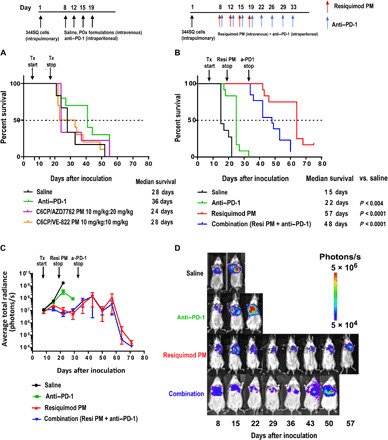
About 40% of patients with non-small cell lung cancer (NSCLC) have stage IV cancer at the time of diagnosis. The only viable treatment options for metastatic disease are systemic chemotherapy and immunotherapy. Nonetheless, chemoresistance remains a major cause of chemotherapy failure. New immunotherapeutic modalities such as anti-PD-1 immune checkpoint blockade have shown promise; however, response to such strategies is highly variable across patients. Here, we show that our unique poly(2-oxazoline)-based nanomicellar formulation (PM) of Resiquimod, an imidazoquinoline Toll-like receptor (TLR) 7/8 agonist, had a superior tumor inhibitory effect in a metastatic model of lung adenocarcinoma, relative to anti-PD-1 therapy or platinum-based chemotherapy. Investigation of the in vivo immune status following Resiquimod PM treatment showed that Resiquimod-based stimulation of antigen-presenting cells in the tumor microenvironment resulted in the mobilization of an antitumor CD8 immune response. Our study demonstrates the promise of poly(2-oxazoline)-formulated Resiquimod for treating metastatic NSCLC.
大约 40%的非小细胞肺癌(NSCLC)患者在诊断时已处于 IV 期癌症。转移性疾病唯一可行的治疗选择是系统化疗和免疫疗法。尽管如此,化疗耐药仍然是化疗失败的主要原因。新型免疫治疗方法,如抗 PD-1 免疫检查点阻断,已显示出前景;然而,这些策略在患者中的反应差异很大。在这里,我们表明,我们独特的基于聚(2-恶唑啉)的瑞喹莫德纳米胶束制剂(PM),一种咪唑并喹啉 Toll 样受体(TLR)7/8 激动剂,在肺腺癌的转移性模型中具有优于抗 PD-1 治疗或铂类化疗的肿瘤抑制作用。对瑞喹莫德 PM 治疗后体内免疫状态的研究表明,瑞喹莫德在肿瘤微环境中刺激抗原呈递细胞,导致抗肿瘤 CD8 免疫反应的动员。我们的研究证明了聚(2-恶唑啉)配方瑞喹莫德治疗转移性 NSCLC 的前景。