Liang Xiao, Yang Qiya, Wang Wanchun, Liu Tang, Hu Jinyue
Department of Orthopaedics, The Second Xiangya Hospital, Central South University, Changsha, Hunan 410011, People's Republic of China.
Chengnan Academy, Hunan First Normal University, Changsha, Hunan 410002, People's Republic of China.
Onco Targets Ther. 2019 Jul 30;12:6083-6092. doi: 10.2147/OTT.S211560. eCollection 2019.
Cisplatin has been reported to elicit the DNA damage response (DDR) via activation of the ATR-Chk1 pathway, which in turn contributes to the induction of cisplatin resistance. Inhibition of ATR-Chk1 signaling reverses cisplatin resistance in some cancers. However, the influence of inhibiting ATR-Chk1 signaling on cisplatin resistance in chondrosarcoma cancer has not been reported.
We compared the expression levels of ATR kinases in human nasopharyngeal carcinoma, choriocarcinoma and chondrosarcoma cell lines. We inhibited ATR kinase function with VE-822, a selective ATR inhibitor, and suppressed ATR kinase expression with shRNA. Western blotting, the CCK-8 assay, cell cycle distribution assay and apoptosis analysis were used to study the influence of inhibiting ATR-Chk1 signaling on reversing cisplatin resistance in chondrosarcoma cell lines.
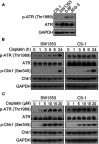
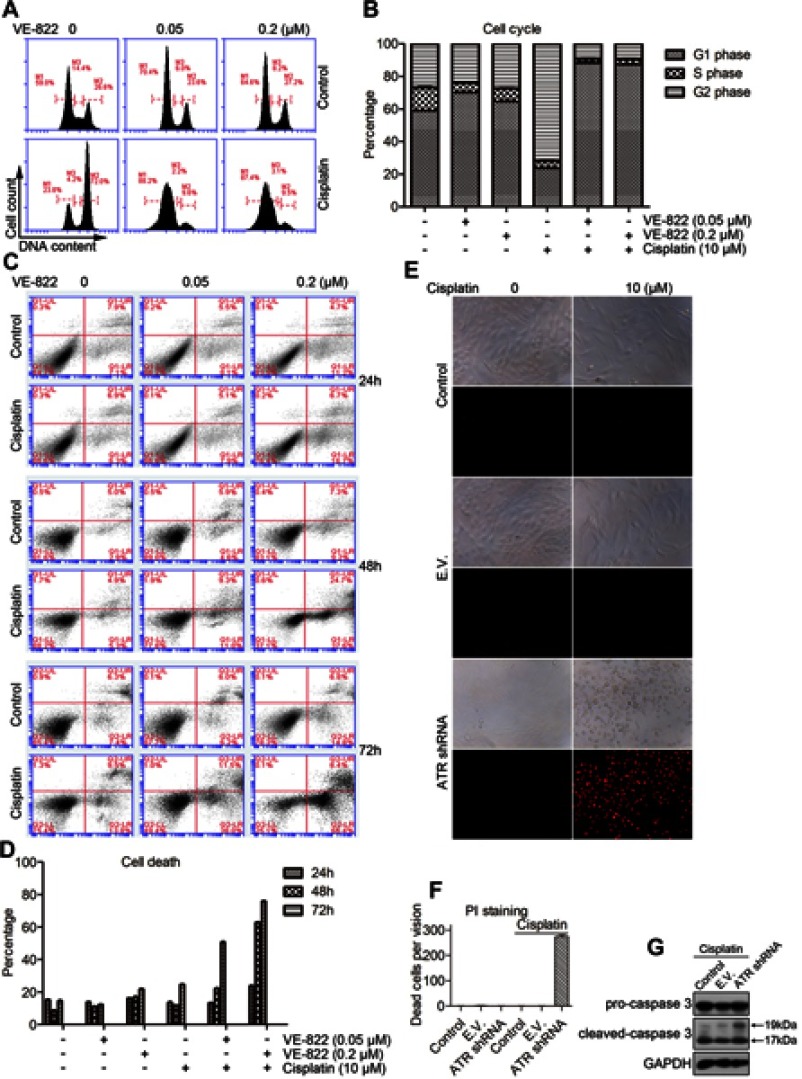
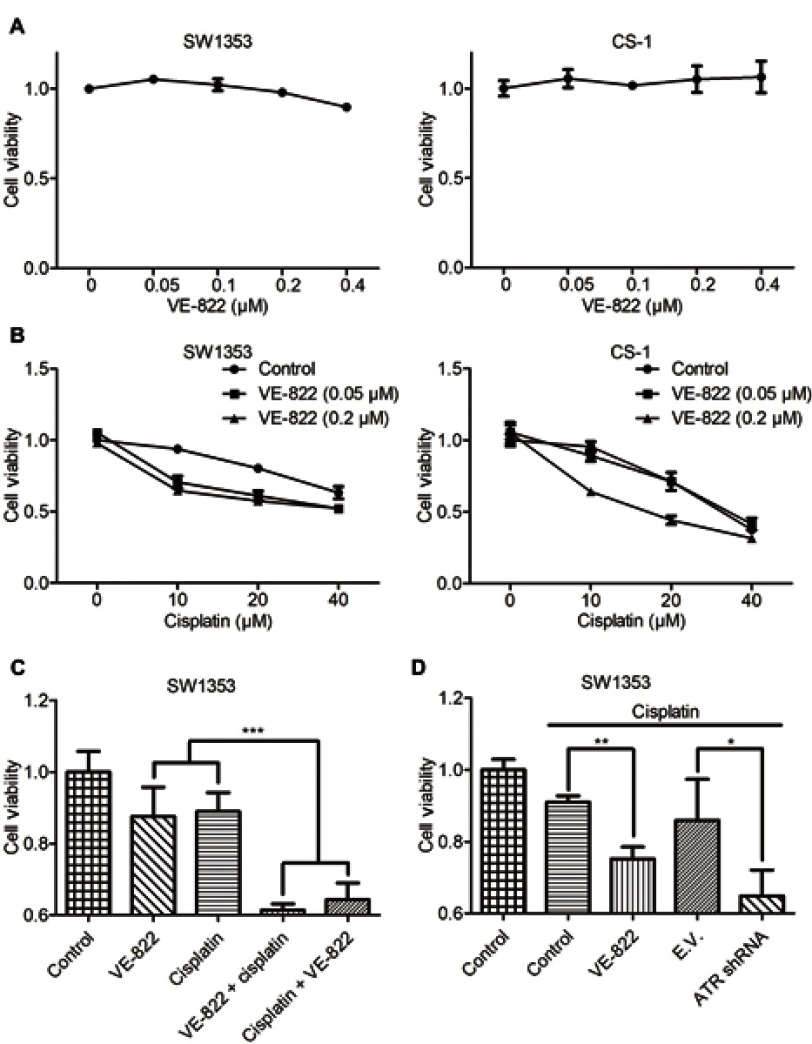
We found that chondrosarcoma cells expressed very low basal levels of phosphorylated ATR, but cisplatin treatment induced the activation of ATR-Chk1 signaling in a dose- and time-dependent manner, suggesting the induction of DDR. As expected, ATR inhibition with VE-822 reversed cisplatin-induced DDR and enhanced cisplatin-induced activation of H2AX, which is an important marker of DNA damage. Meanwhile, ATR inhibition by RNA interference also reversed DDR and promoted DNA damage. Furthermore, both pharmacological and molecular inhibition of ATR accelerated cisplatin-induced inhibition of cell proliferation and cell death.
Our results suggested that inhibiting ATR activation promoted cisplatin-induced cell death via reversion of DDR, and VE-822 may be a valuable strategy for the prevention of cisplatin resistance in chondrosarcoma.
据报道,顺铂可通过激活ATR-Chk1通路引发DNA损伤反应(DDR),进而导致顺铂耐药。抑制ATR-Chk1信号传导可逆转某些癌症中的顺铂耐药性。然而,抑制ATR-Chk1信号传导对软骨肉瘤中顺铂耐药性的影响尚未见报道。
我们比较了人鼻咽癌、绒毛膜癌和软骨肉瘤细胞系中ATR激酶的表达水平。我们使用选择性ATR抑制剂VE-822抑制ATR激酶功能,并用shRNA抑制ATR激酶表达。采用蛋白质免疫印迹法、CCK-8法、细胞周期分布分析和凋亡分析来研究抑制ATR-Chk1信号传导对逆转软骨肉瘤细胞系中顺铂耐药性的影响。
我们发现软骨肉瘤细胞中磷酸化ATR的基础水平非常低,但顺铂处理以剂量和时间依赖性方式诱导ATR-Chk1信号传导激活,提示DDR的诱导。正如预期的那样,用VE-822抑制ATR可逆转顺铂诱导的DDR,并增强顺铂诱导的H2AX激活,H2AX是DNA损伤的重要标志物。同时,RNA干扰抑制ATR也可逆转DDR并促进DNA损伤。此外,ATR的药理学和分子抑制均加速了顺铂诱导的细胞增殖抑制和细胞死亡。
我们的结果表明,抑制ATR激活可通过逆转DDR促进顺铂诱导的细胞死亡,并且VE-822可能是预防软骨肉瘤中顺铂耐药性的一种有价值的策略。