Dupesh Shah, Pandiyan Natarajan, Pandiyan Radha, Kartheeswaran Jeeva, Prakash Bhaskar
VRR Institute of Biomedical Sciences, University of Madras, 1/7, MRB Avenue, Bhajanai Koil Street, Kattupakkam, Chennai 600056, India.
Department of Reproductive Medicine, Chettinad Hospital & Research Institute, Chennai, India.
Ther Adv Reprod Health. 2020 Jun 15;14:2633494120906882. doi: 10.1177/2633494120906882. eCollection 2020 Jan-Dec.
The precise effect of ejaculatory abstinence on semen parameters is highly debatable, especially among subfertile men. Previous studies on effect of abstinence time on different semen parameters have reported controversial results. The aim of this study was to retrospectively assess the variance of semen parameters with different periods of ejaculatory abstinence among both a population of normozoospermic ( = 1621) and oligozoospermic ( = 416) Tamil men, presenting to a fertility clinic for an infertility evaluation ( = 2037).
A retrospective analysis of 2037 semen analysis reports involved grouping patients based on their ejaculatory abstinence, that is, <24 h, 1 to 2 days, 3 to 7 days, 8 to 15 days, 16 to 30 days, and >30 days. All semen parameters were assessed as per the World Health Organization (WHO, 2010) recommended guidelines. The unpaired two-tailed -test and Welch's analysis of variance (ANOVA) combined with Games-Howell post hoc test were used for statistical analysis. A value <0.05 was considered to be statistically significant.
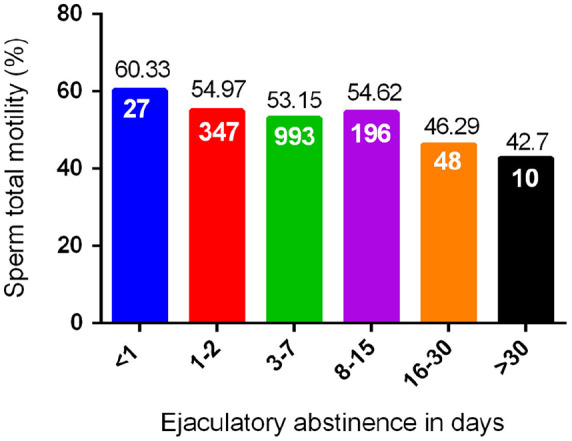
A retrospective analysis of data ( = 2037) identified no statistically significant differences in semen parameters of sperm concentration, percentage of progressively motile sperm, and normal sperm morphology in both normozoospermic and oligozoospermic individuals across different groups of abstinence. Semen volume was the only parameter that showed a statistically significant difference in both groups ( < 0.0001). In both normozoospermic and oligozoospermic men, the group with <24 h abstinence had the highest mean percentage of progressively motile sperm and normal sperm morphology.
The findings of this study suggest that ejaculatory abstinence may be highly arbitrary, and the recommendation of a strict 2- to 7-day abstinence per the WHO may be liberalized. In both normozoospermic and oligozoospermic men, semen parameters associated with an abstinence of <24 h were found to be noninferior as compared to longer ejaculatory abstinence intervals. These findings support in eliminating conservative recommendations as far as abstinence is concerned and suggest that patients may be asked to collect a semen sample on the day they present for an infertility evaluation, regardless of abstinence.
射精禁欲对精液参数的确切影响极具争议,尤其是在亚生育男性中。以往关于禁欲时间对不同精液参数影响的研究报告了相互矛盾的结果。本研究的目的是回顾性评估在一家生育诊所接受不育评估的2037名正常精子数(n = 1621)和少精子症(n = 416)的泰米尔男性中,不同射精禁欲期精液参数的差异。
对2037份精液分析报告进行回顾性分析,根据射精禁欲情况对患者进行分组,即<24小时、1至2天、3至7天、8至15天、16至30天和>30天。所有精液参数均按照世界卫生组织(WHO,2010)推荐的指南进行评估。采用非配对双尾t检验和韦尔奇方差分析(ANOVA)并结合Games-Howell事后检验进行统计分析。P值<0.0 < 5被认为具有统计学意义。
对2037例数据的回顾性分析发现,在不同禁欲组中,正常精子数和少精子症个体的精子浓度、进行性运动精子百分比和正常精子形态等精液参数均无统计学显著差异。精液量是两组中唯一显示出统计学显著差异的参数(P < 0.0001)。在正常精子数和少精子症男性中,禁欲<24小时的组进行性运动精子和正常精子形态的平均百分比最高。
本研究结果表明,射精禁欲可能具有很大的随意性,世界卫生组织建议的严格2至7天禁欲可能需要放宽。在正常精子数和少精子症男性中,发现禁欲<24小时的精液参数与较长射精禁欲间隔相比并不逊色。这些发现支持在禁欲方面消除保守建议,并表明无论禁欲情况如何,患者在就诊进行不育评估当天即可被要求采集精液样本。