Chung Young Shin, Kim Hyun-Soo, Lee Jung-Yun, Kang Won Jun, Nam Eun Ji, Kim Sunghoon, Kim Sang Wun, Kim Young Tae
Department of Obstetrics and Gynecology, Institute of Women's Life Medical Science, Yonsei University College of Medicine, Seoul, Korea.
Department of Pathology and Translational Genomics, Samsung Medical Center, Sungkyunkwan University School of Medicine, Seoul, Korea.
Cancer Res Treat. 2020 Oct;52(4):1211-1218. doi: 10.4143/crt.2019.506. Epub 2020 Apr 28.
The aim of this study was to evaluate the ability of sequential 18F-fluorodeoxyglucose positron emission tomography/computed tomography (18F-FDG-PET/CT) after one cycle of neoadjuvant chemotherapy (NAC) to predict chemotherapy response before interval debulking surgery (IDS) in advanced-stage ovarian cancer patients.
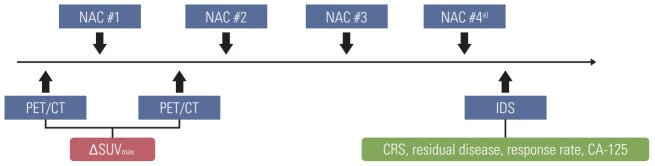
Forty consecutive patients underwent 18F-FDG-PET/CT at baseline and after one cycle of NAC. Metabolic responses were assessed by quantitative decrease in the maximum standardized uptake value (SUVmax) with PET/CT. Decreases in SUVmax were compared with cancer antigen 125 (CA-125) level before IDS, response rate by Response Evaluation Criteria in Solid Tumors criteria before IDS, residual tumor at IDS, and I chemotherapy response score (CRS) at IDS.
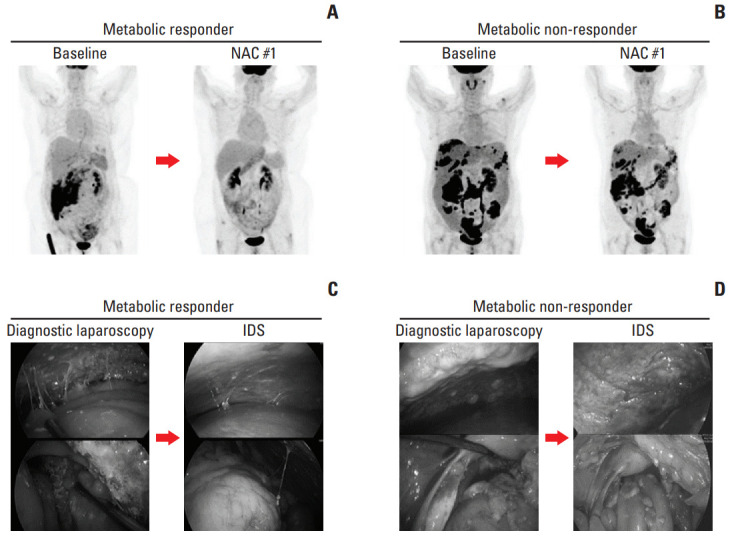
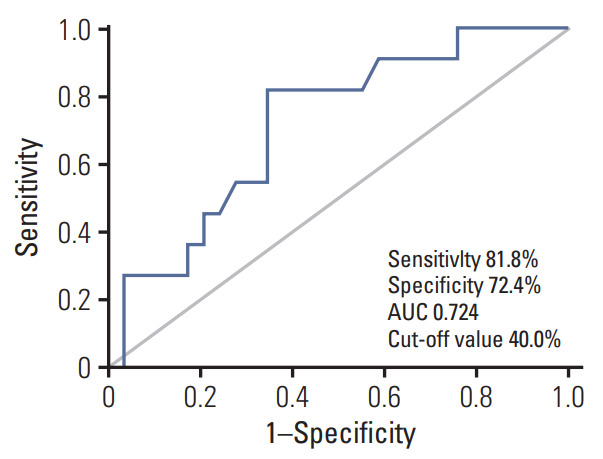
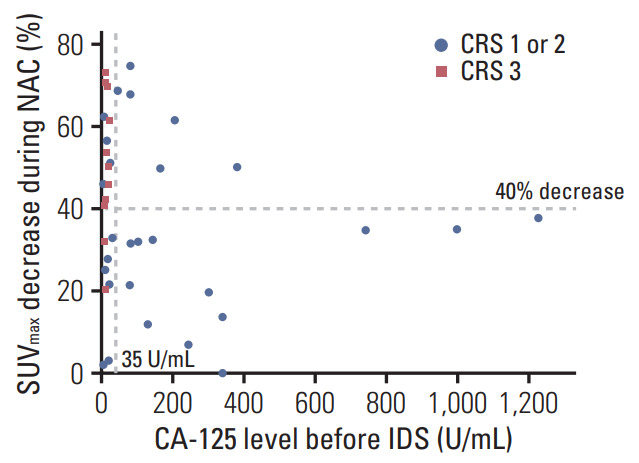
A 40% cut-off for the decrease in SUVmax provided the best performance to predict CRS 3 (compete or near-complete pathologic response), with sensitivity, specificity, and accuracy of 81.8%, 72.4%, and 72.4%, respectively. According to this 40% cut-off, there were 17 (42.5%) metabolic responders (≥ 40%) and 23 (57.5%) metabolic non-responders (< 40%). Metabolic responders had higher rate of CRS 3 (52.9% vs. 8.7%, p=0.003), CA-125 normalization (< 35 U/mL) before IDS (76.5% vs. 39.1%, p=0.019), and no residual tumor at IDS (70.6% vs. 31.8%, p=0.025) compared with metabolic non-responders. There were significant associations with progression-free survival (p=0.021) between metabolic responders and non-responders, but not overall survival (p=0.335).
Early assessment with 18F-FDG-PET/CT after one cycle of NAC can be useful to predic response to chemotherapy before IDS in patients with advanced-stage ovarian cancer.
本研究旨在评估新辅助化疗(NAC)一个周期后序贯进行18F-氟脱氧葡萄糖正电子发射断层扫描/计算机断层扫描(18F-FDG-PET/CT)预测晚期卵巢癌患者在间隔减瘤手术(IDS)前化疗反应的能力。
40例连续患者在基线时及NAC一个周期后接受18F-FDG-PET/CT检查。通过PET/CT测量最大标准化摄取值(SUVmax)的定量下降来评估代谢反应。将SUVmax的下降与IDS前的癌抗原125(CA-125)水平、IDS前实体瘤疗效评价标准的缓解率、IDS时的残留肿瘤以及IDS时的I化疗反应评分(CRS)进行比较。
SUVmax下降40%的截断值在预测CRS 3(完全或接近完全病理缓解)方面表现最佳,敏感性、特异性和准确性分别为81.8%、72.4%和72.4%。根据这个40%的截断值,有17例(42.5%)代谢反应者(≥40%)和23例(57.5%)代谢无反应者(<40%)。与代谢无反应者相比,代谢反应者的CRS 3发生率更高(52.9%对8.7%,p = 0.003),IDS前CA-125正常化(<35 U/mL)的比例更高(76.5%对39.1%,p = 0.019),且IDS时无残留肿瘤的比例更高(70.6%对31.8%,p = 0.025)。代谢反应者和无反应者之间的无进展生存期存在显著关联(p = 0.021),但总生存期无显著关联(p = 0.335)。
NAC一个周期后用18F-FDG-PET/CT进行早期评估有助于预测晚期卵巢癌患者在IDS前对化疗的反应。