Diabetes and Vascular Medicine, University of Exeter Medical School, Barrack Road, Exeter, EX2 5AX, UK.
NIHR Exeter Clinical Research Facility, Royal Devon and Exeter NHS Foundation Trust, Exeter, UK.
BMC Nephrol. 2020 Jun 29;21(1):242. doi: 10.1186/s12882-020-01901-x.
Diabetic kidney disease (DKD) remains one of the leading causes of premature death in diabetes. DKD is classified on albuminuria and reduced kidney function (estimated glomerular filtration rate (eGFR)) but these have modest value for predicting future renal status. There is an unmet need for biomarkers that can be used in clinical settings which also improve prediction of renal decline on top of routinely available data, particularly in the early stages. The iBEAt study of the BEAt-DKD project aims to determine whether renal imaging biomarkers (magnetic resonance imaging (MRI) and ultrasound (US)) provide insight into the pathogenesis and heterogeneity of DKD (primary aim) and whether they have potential as prognostic biomarkers in DKD (secondary aim).
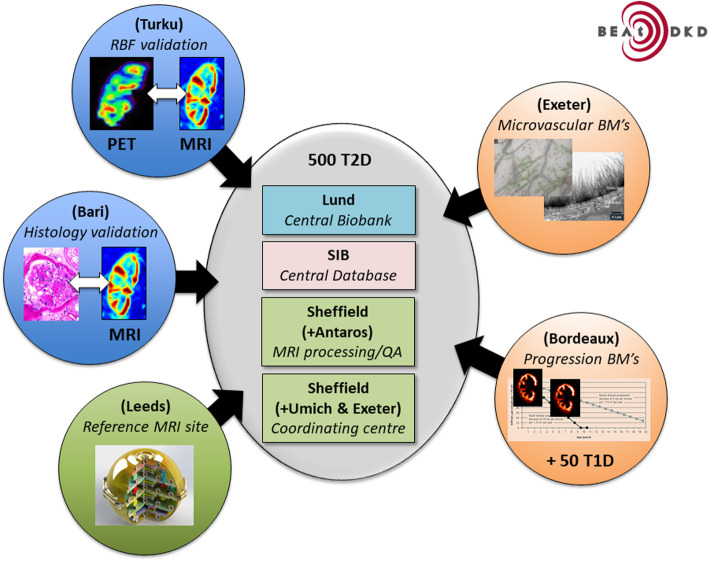
iBEAt is a prospective multi-centre observational cohort study recruiting 500 patients with type 2 diabetes (T2D) and eGFR ≥30 ml/min/1.73m. At baseline, blood and urine will be collected, clinical examinations will be performed, and medical history will be obtained. These assessments will be repeated annually for 3 years. At baseline each participant will also undergo quantitative renal MRI and US with central processing of MRI images. Biological samples will be stored in a central laboratory for biomarker and validation studies, and data in a central data depository. Data analysis will explore the potential associations between imaging biomarkers and renal function, and whether the imaging biomarkers improve the prediction of DKD progression. Ancillary substudies will: (1) validate imaging biomarkers against renal histopathology; (2) validate MRI based renal blood flow measurements against HO positron-emission tomography (PET); (3) validate methods for (semi-)automated processing of renal MRI; (4) examine longitudinal changes in imaging biomarkers; (5) examine whether glycocalyx and microvascular measures are associated with imaging biomarkers and eGFR decline; (6) explore whether the findings in T2D can be extrapolated to type 1 diabetes.
iBEAt is the largest DKD imaging study to date and will provide valuable insights into the progression and heterogeneity of DKD. The results may contribute to a more personalised approach to DKD management in patients with T2D.
Clinicaltrials.gov ( NCT03716401 ).
糖尿病肾病(DKD)仍是糖尿病患者过早死亡的主要原因之一。DKD 根据蛋白尿和肾功能降低(估算肾小球滤过率(eGFR))进行分类,但这些对于预测未来的肾脏状况的价值有限。临床需要能够改善基于常规数据的肾功能下降预测的生物标志物,特别是在早期阶段。BEAt-DKD 项目的 iBEAt 研究旨在确定肾脏成像生物标志物(磁共振成像(MRI)和超声(US))是否能够深入了解 DKD 的发病机制和异质性(主要目标),以及它们是否具有作为 DKD 的预后生物标志物的潜力(次要目标)。
iBEAt 是一项前瞻性多中心观察性队列研究,招募了 500 名 2 型糖尿病(T2D)和 eGFR≥30ml/min/1.73m 的患者。基线时,将采集血液和尿液样本,进行临床检查,并获取病史。这些评估将在 3 年内每年重复一次。基线时,每位参与者还将接受定量肾脏 MRI 和 US,并进行中央 MRI 图像处理。生物样本将储存在中央实验室进行生物标志物和验证研究,数据将储存在中央数据存储库中。数据分析将探索成像生物标志物与肾功能之间的潜在关联,以及成像生物标志物是否改善 DKD 进展的预测。辅助子研究将:(1)验证成像生物标志物与肾脏组织病理学的相关性;(2)验证基于 MRI 的肾血流测量与 HO 正电子发射断层扫描(PET)的相关性;(3)验证肾脏 MRI 半自动处理方法的准确性;(4)研究成像生物标志物的纵向变化;(5)研究糖萼和微血管测量是否与成像生物标志物和 eGFR 下降相关;(6)探索 T2D 中的发现是否可以外推到 1 型糖尿病。
iBEAt 是迄今为止最大的 DKD 成像研究,将为 DKD 的进展和异质性提供有价值的见解。研究结果可能有助于为 T2D 患者的 DKD 管理提供更个性化的方法。
Clinicaltrials.gov(NCT03716401)。