Department of Biopharmaceutics and Pharmacodynamics, Medical University of Gdańsk, Gdańsk, Poland.
2nd Department of Anaesthesiology and Intensive Therapy, Medical University of Lublin, Lublin, Poland.
Antimicrob Agents Chemother. 2020 Aug 20;64(9). doi: 10.1128/AAC.00345-20.
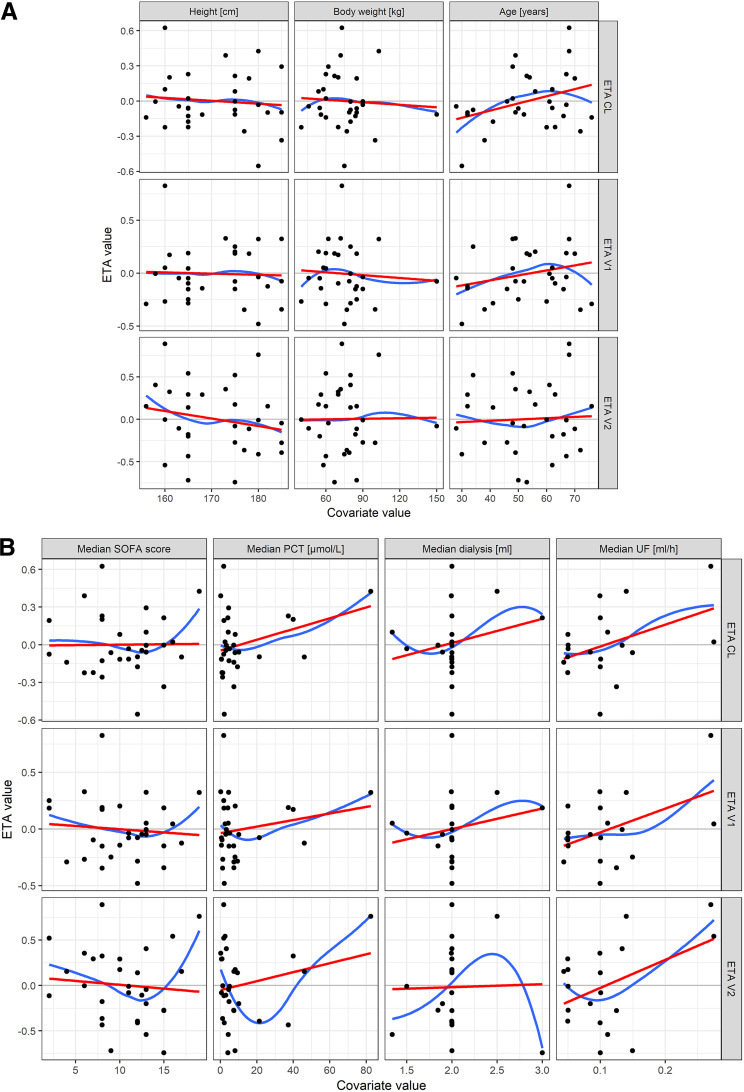
Standard dosing of caspofungin in critically ill patients has been reported to result in lower drug exposure, which can lead to subtherapeutic 24-h area under the curve to MIC (AUC/MIC) ratios. The aim of the study was to investigate the population pharmacokinetics of caspofungin in a cohort of 30 intensive care unit patients with a suspected invasive fungal infection, with a large proportion of patients requiring extracorporeal therapies, including extracorporeal membrane oxygenation (ECMO) and continuous renal replacement therapy (CRRT). Caspofungin was administered as empirical 70 mg antifungal therapy administered intravenously (i.v.) on the first day and at 50 mg i.v. on the consecutive days once daily, and the concentrations were measured after three subsequent doses. Population pharmacokinetic data were analyzed by nonlinear mixed-effects modeling. The pharmacokinetics of caspofungin was described by two-compartment model. A particular drift of the individual clearance (CL) and the volume of distribution of the central compartment () with time was discovered and described by including three separate typical values of CL and in the final model. The typical CL values at days 1, 2, and 3 were 0.563 liters/h (6.7% relative standard error [6.7%RSE]), 0.737 liters/h (6.1%RSE), and 1.01 liters/h (9.1%RSE), respectively. The change in parameters with time was not explained by any of the recorded covariates. Increasing clearance with subsequent doses was associated with a clinically relevant decrease in caspofungin exposure (>20%). The use of ECMO, CRRT, albumin concentration, and other covariates did not significantly affect caspofungin pharmacokinetics. Additional pharmacokinetic studies are urgently required to assess the possible lack of acquiring steady-state and suboptimal concentrations of the drug in critically ill patients. (This study has been registered at ClinicalTrials.gov under identifier NCT03399032.).
已有报道称,在危重症患者中标准剂量的卡泊芬净会导致药物暴露水平降低,从而导致治疗 24 小时 AUC/MIC(AUC/MIC)比值低于治疗范围。本研究旨在调查在一个疑似侵袭性真菌感染的 30 例重症监护病房患者队列中卡泊芬净的群体药代动力学,其中很大一部分患者需要体外治疗,包括体外膜氧合(ECMO)和连续肾脏替代治疗(CRRT)。卡泊芬净作为经验性抗真菌治疗药物,首剂 70mg 静脉内(i.v.)给药,随后连续天每日 50mg 静脉内给药,在随后的 3 剂后测量浓度。通过非线性混合效应模型分析群体药代动力学数据。卡泊芬净的药代动力学采用双室模型描述。发现并描述了个体清除率(CL)和中央隔室分布容积(V)随时间的特定漂移,方法是在最终模型中包含 CL 和 V 的三个单独典型值。第 1、2 和 3 天的典型 CL 值分别为 0.563 升/小时(6.7%相对标准误差[6.7%RSE])、0.737 升/小时(6.1%RSE)和 1.01 升/小时(9.1%RSE)。参数随时间的变化不能用记录的任何协变量来解释。随着后续剂量的增加,清除率增加与卡泊芬净暴露量的临床相关降低(>20%)相关。ECMO、CRRT、白蛋白浓度和其他协变量的使用并未显著影响卡泊芬净的药代动力学。迫切需要进行额外的药代动力学研究,以评估危重症患者是否可能无法获得药物的稳态和最佳浓度。(本研究已在 ClinicalTrials.gov 注册,标识符为 NCT03399032。)