Laboratoire Ecologie et Biologie des Interactions - UMR CNRS 7267 - Equipe Ecologie, Evolution, Symbiose - Université de Poitiers, 5 rue Albert Turpain, TSA 51106, 86073, Poitiers Cedex 9, France.
New England Biolabs, Inc., 240 County Road, Ipswich, MA, USA.
Sci Rep. 2020 Jun 29;10(1):10551. doi: 10.1038/s41598-020-67428-1.
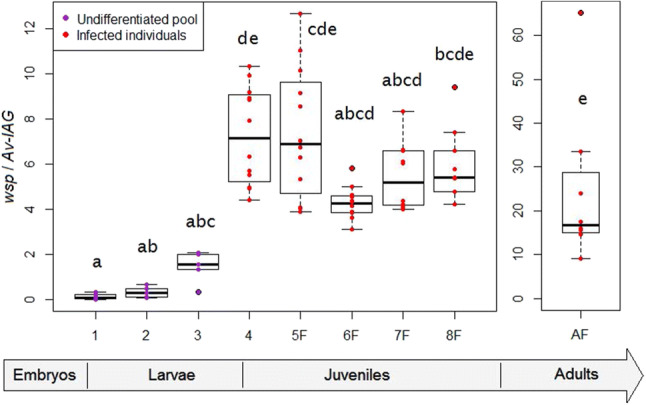
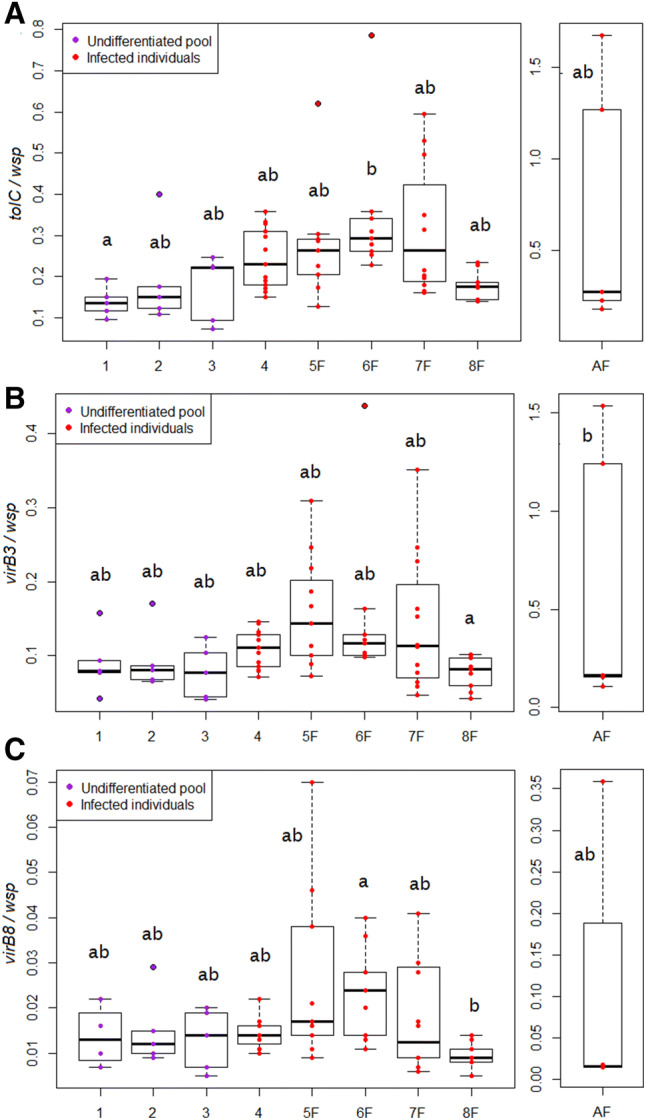
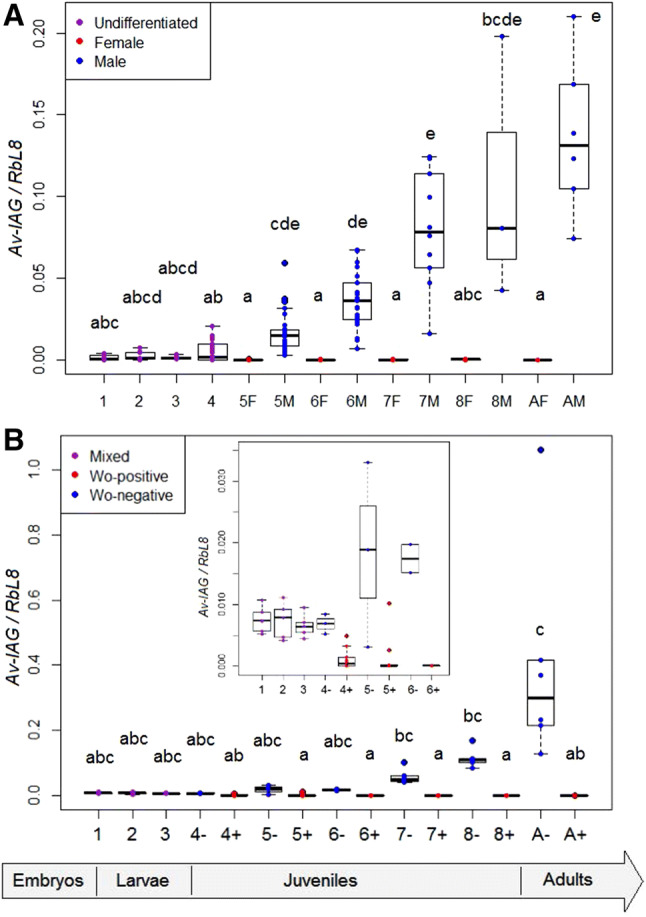
Using the isopod Armadillidium vulgare as a case study, we review the significance of the "bacterial dosage model", which connects the expression of the extended phenotype to the rise of the Wolbachia load. In isopods, the Insulin-like Androgenic Gland hormone (IAG) induces male differentiation: Wolbachia feminizes males through insulin resistance, presumably through defunct insulin receptors. This should prevent an autocrine development of the androgenic glands so that females differentiate instead: feminization should translate as IAG silencing and increased Wolbachia load in the same developmental window. In line with the autocrine model, uninfected males expressed IAG from the first larval stage on, long before the androgenic gland primordia begin to differentiate, and exponentially throughout development. In contrast in infected males, expression fully stopped at stage 4 (juvenile), when male differentiation begins. This co-occurred with the only significant rise in the Wolbachia load throughout the life-stages. Concurrently, the raw expression of the bacterial Secretion Systems co-increased, but they were not over-expressed relative to the number of bacteria. The isopod model leads to formulate the "bacterial dosage model" throughout extended phenotypes as the conjunction between bacterial load as the mode of action, timing of multiplication (pre/post-zygotic), and site of action (soma vs. germen).
以等足目动物 Armadillidium vulgare 为案例研究,我们回顾了“细菌剂量模型”的意义,该模型将表型的表达与沃尔巴克氏体负荷的上升联系起来。在等足目动物中,胰岛素样雄激素腺激素(IAG)诱导雄性分化:沃尔巴克氏体通过胰岛素抵抗使雄性雌性化,推测是通过失效的胰岛素受体。这应该防止雄激素腺的自分泌发育,从而使雌性分化:雌性化应该转化为 IAG 沉默和在相同的发育窗口中增加沃尔巴克氏体负荷。与自分泌模型一致,未感染的雄性从第一幼虫阶段开始表达 IAG,远早于雄激素腺原基开始分化,并且在整个发育过程中呈指数增长。相比之下,在感染的雄性中,表达在第 4 阶段(幼体)完全停止,此时雄性开始分化。这与整个生命阶段中沃尔巴克氏体负荷的唯一显著上升同时发生。同时,细菌分泌系统的原始表达也随之增加,但相对于细菌数量并未过度表达。该等足目动物模型导致在整个扩展表型中提出“细菌剂量模型”,将细菌负荷作为作用模式、增殖时间(合子前/后)和作用部位(体躯与生殖细胞)的结合。