Cell Surface Signalling Laboratory, Wellcome Sanger Institute, Cambridge, UK.
Sci Rep. 2020 Jun 29;10(1):10522. doi: 10.1038/s41598-020-67468-7.
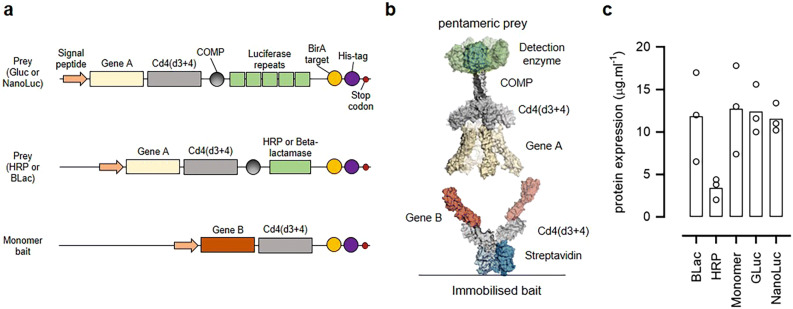
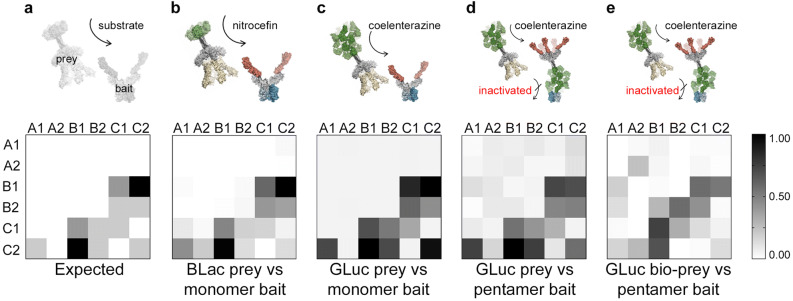
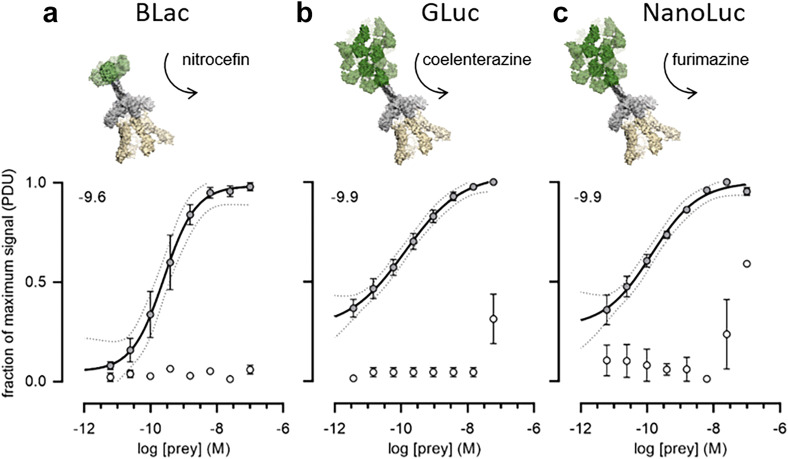
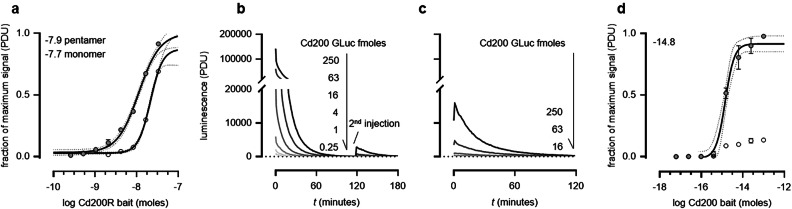
Extracellular protein interactions mediated by cell surface receptors are essential for intercellular communication in multicellular organisms. Assays to detect extracellular interactions must account for their often weak binding affinities and also the biochemical challenges in solubilising membrane-embedded receptors in an active form. Methods based on detecting direct binding of soluble recombinant receptor ectodomains have been successful, but genome-scale screening is limited by the usual requirement of producing sufficient amounts of each protein in two different forms, usually a "bait" and "prey". Here, we show that oligomeric receptor ectodomains coupled to concatenated units of the light-generating Gaussia luciferase enzyme robustly detected low affinity interactions and reduced the amount of protein required by several orders of magnitude compared to other reporter enzymes. Importantly, we discovered that this flash-type luciferase exhibited a reaction-induced inhibition that permitted the use of a single protein preparation as both bait and prey thereby halving the number of expression plasmids and recombinant proteins required for screening. This approach was tested against a benchmarked set of quantified extracellular interactions and shown to detect extremely weak interactions (Ks ≥ μM). This method will facilitate large-scale receptor interaction screening and contribute to the goal of mapping networks of cellular communication.
细胞表面受体介导的细胞外蛋白相互作用对于多细胞生物中的细胞间通讯至关重要。检测细胞外相互作用的测定法必须考虑到它们通常较弱的结合亲和力,以及在可溶性形式中使膜嵌入受体溶解的生化挑战。基于检测可溶性重组受体胞外结构域直接结合的方法已经取得成功,但基于基因组规模的筛选受到通常需要产生每种蛋白质两种不同形式(通常是“诱饵”和“猎物”)的大量蛋白质的限制。在这里,我们表明,连接串联的发光酶单位的寡聚体受体胞外结构域可以强大地检测低亲和力相互作用,并使所需的蛋白质量减少几个数量级,与其他报告酶相比。重要的是,我们发现这种闪光型荧光素酶表现出反应诱导的抑制作用,从而可以使用单个蛋白质制剂作为诱饵和猎物,从而将筛选所需的表达质粒和重组蛋白的数量减少一半。该方法针对经过基准测试的定量细胞外相互作用集进行了测试,并显示可检测到极其微弱的相互作用(Ks≥μM)。该方法将有助于大规模的受体相互作用筛选,并有助于实现细胞通讯网络映射的目标。