Department of Cardiology, Ambroise Paré Hospital (AP-HP), ACTION Study Group, Université de Versailles-Saint Quentin, Boulogne, France.
INSERM U-1018, CESP, Épidémiologie clinique, Villejuif, France.
J Thromb Thrombolysis. 2021 Jan;51(1):31-32. doi: 10.1007/s11239-020-02201-9.
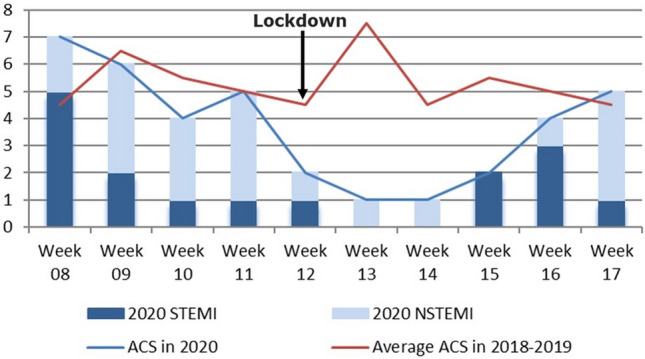
Data whether the COVID-19 outbreak impacts the acute coronary syndromes (ACS) admissions and the time required to reverse the downward curve are scarce. We included all consecutive patients referred for an ACS who underwent PCI from February 17, 2020 to April 26, 2020 in a high-volume PCI coronary care unit. We compared the number of ACS patients in 2020 to the same period in 2018 and 2019. Predictors of adverse outcome in ST-elevation myocardial infarction (STEMI) patients were recorded: symptom-onset-to-first medical contact (FMC), and FMC-to-sheath insertion times. During the studied period (calendar weeks 8-17, 2018-2020), 144 ACS patients were included. In 2020, we observed two distinct phases in the ACS admissions: a first significant fall, with a relative reduction of 73%, from the week of lockdown (week 12) to 3 weeks later and then an increase of ACS. Median symptom-onset-to-FMC time was significantly higher in 2020 than in the two previous years (600 min [298-632] versus 121 min [55-291], p < 0.001). Median FMC-to-sheath insertion did not differ significantly (93 min [81-131] in 2020 versus 90 min [67-137] in 2018-2019, p = 0.57). The main findings are (1) a pattern of a U-curve in ACS admissions, with a first decrease in ACS admissions and a return to "normality" 4 weeks after; (2) a significant increase in the total ischemic time exclusively due to an increase in the symptom-onset-to-first-medical-contact time.
数据表明,COVID-19 疫情是否会影响急性冠脉综合征(ACS)的入院人数,以及扭转下降趋势所需的时间还很缺乏。我们纳入了 2020 年 2 月 17 日至 4 月 26 日在一个高容量 PCI 冠心病监护病房因 ACS 而行 PCI 的所有连续患者。我们比较了 2020 年和 2018 年、2019 年同期 ACS 患者的数量。记录了 ST 段抬高型心肌梗死(STEMI)患者不良预后的预测因素:症状发作至首次医疗接触(FMC)时间,以及 FMC 至鞘管插入时间。在研究期间(2018-2020 年的第 8-17 周),共纳入 144 例 ACS 患者。2020 年,我们观察到 ACS 入院人数有两个明显的阶段:第一阶段是显著下降,与封锁周(第 12 周)相比下降了 73%,3 周后入院人数再次增加。2020 年症状发作至 FMC 时间中位数显著长于前两年(600 分钟[298-632]比 121 分钟[55-291],p<0.001)。FMC 至鞘管插入时间中位数无显著差异(2020 年 93 分钟[81-131],2018-2019 年 90 分钟[67-137],p=0.57)。主要发现包括:(1)ACS 入院人数呈 U 型模式,ACS 入院人数先下降,4 周后恢复“正常”;(2)总缺血时间显著增加,仅因症状发作至首次医疗接触时间增加所致。