Daga Shruti, Rosenberger Angelika, Kashofer Karl, Heitzer Ellen, Quehenberger Franz, Halbwedl Iris, Graf Ricarda, Krisper Nina, Prietl Barbara, Höfler Gerald, Reinisch Andreas, Zebisch Armin, Sill Heinz, Wölfler Albert
Division of Hematology, Medical University of Graz, Graz, Austria.
CBmed Center of Biomarker Research in Medicine, Graz, Austria.
Am J Hematol. 2020 Oct;95(10):1148-1157. doi: 10.1002/ajh.25918. Epub 2020 Aug 10.
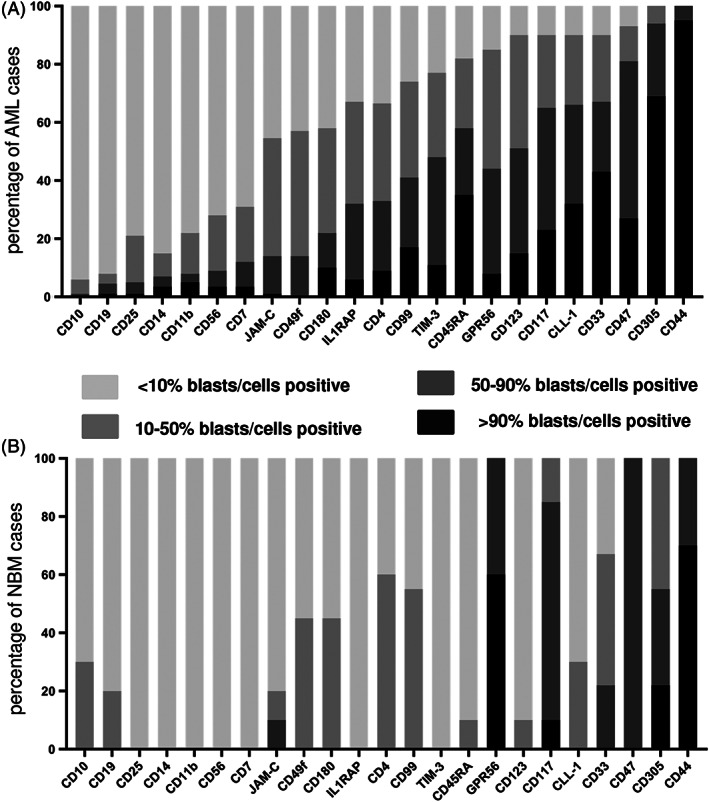
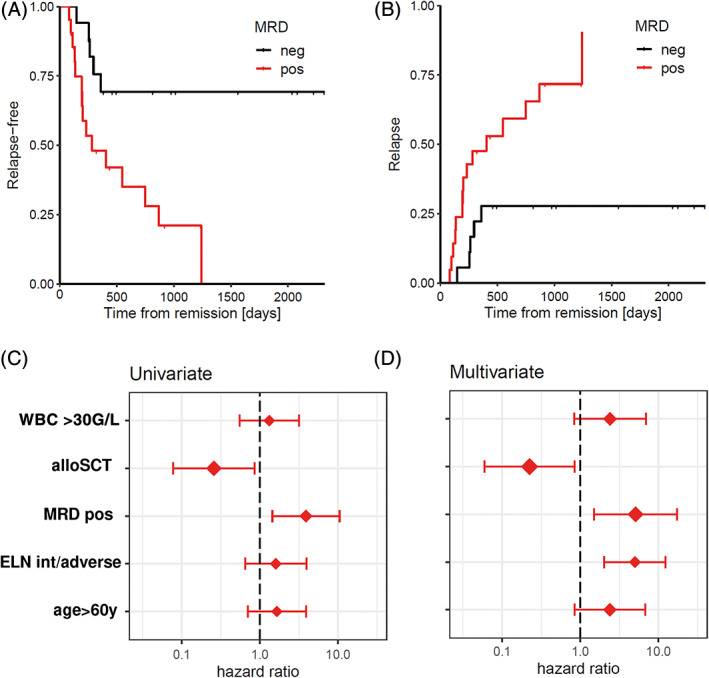
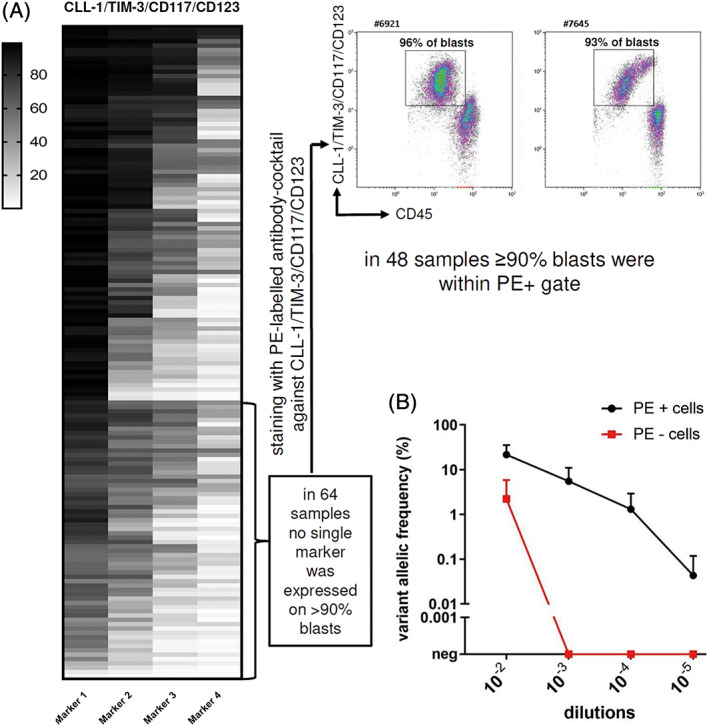
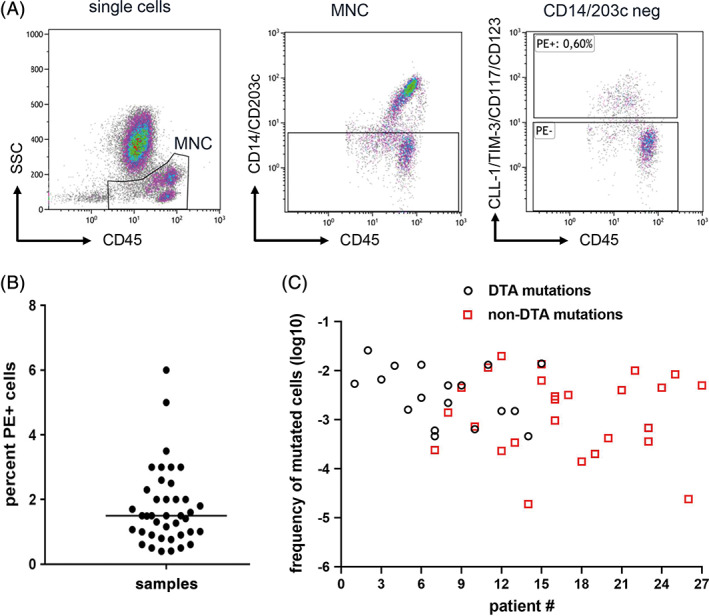
Persistent measurable residual disease (MRD) is an increasingly important prognostic marker in acute myeloid leukemia (AML). Currently, MRD is determined by multi-parameter flow cytometry (MFC) or PCR-based methods detecting leukemia-specific fusion transcripts and mutations. However, while MFC is highly operator-dependent and difficult to standardize, PCR-based methods are only available for a minority of AML patients. Here we describe a novel, highly sensitive and broadly applicable method for MRD detection by combining MFC-based leukemic cell enrichment using an optimized combinatorial antibody panel targeting CLL-1, TIM-3, CD123 and CD117, followed by mutational analysis of recurrently mutated genes in AML. In dilution experiments this method showed a sensitivity of 10 to 10 for residual disease detection. In prospectively collected remission samples this marker combination allowed for a median 67-fold cell enrichment with sufficient DNA quality for mutational analysis using next generation sequencing (NGS) or digital PCR in 39 out of 41 patients. Twenty-one samples (53.8%) tested MRD positive, whereas 18 (46.2%) were negative. With a median follow-up of 559 days, 71.4% of MRD positive (15/21) and 27.8% (5/18) of MRD negative patients relapsed (P = .007). The cumulative incidence of relapse (CIR) was higher for MRD positive patients (5-year CIR: 90.5% vs 28%, P < .001). In multivariate analysis, MRD positivity was a prominent factor for CIR. Thus, MFC-based leukemic cell enrichment using antibodies against CLL-1, TIM-3, CD123 and CD117 followed by mutational analysis allows high sensitive MRD detection and is informative on relapse risk in the majority of AML patients.
持续性可测量残留病(MRD)在急性髓系白血病(AML)中是一个日益重要的预后标志物。目前,MRD通过多参数流式细胞术(MFC)或基于PCR的方法来检测白血病特异性融合转录本和突变。然而,MFC高度依赖操作人员且难以标准化,而基于PCR的方法仅适用于少数AML患者。在此,我们描述了一种新型、高度灵敏且广泛适用的MRD检测方法,该方法通过使用针对CLL-1、TIM-3、CD123和CD117的优化组合抗体组进行基于MFC的白血病细胞富集,随后对AML中反复突变的基因进行突变分析。在稀释实验中,该方法对残留病检测的灵敏度为10至10 。在前瞻性收集的缓解样本中,这种标志物组合使细胞富集倍数中位数达到67倍,DNA质量足以使用下一代测序(NGS)或数字PCR进行突变分析,41例患者中有39例符合要求。21个样本(53.8%)检测MRD呈阳性,而18个(46.2%)为阴性。中位随访559天,MRD阳性患者中有71.4%(15/21)复发,MRD阴性患者中有27.8%(5/18)复发(P = 0.007)。MRD阳性患者的累积复发率(CIR)更高(5年CIR:90.5%对28%,P < 0.001)。在多变量分析中,MRD阳性是CIR的一个突出因素。因此,使用针对CLL-1、TIM-3、CD123和CD117的抗体进行基于MFC的白血病细胞富集,随后进行突变分析,能够实现高灵敏度的MRD检测,并为大多数AML患者的复发风险提供信息。