Department of Psychiatry, Washington University School of Medicine, St Louis, Missouri, USA.
Alvin J. Siteman Cancer Center at Barnes-Jewish Hospital, Washington University School of Medicine, St Louis, Missouri, USA.
Clin Pharmacol Ther. 2020 Dec;108(6):1315-1325. doi: 10.1002/cpt.1971. Epub 2020 Aug 4.
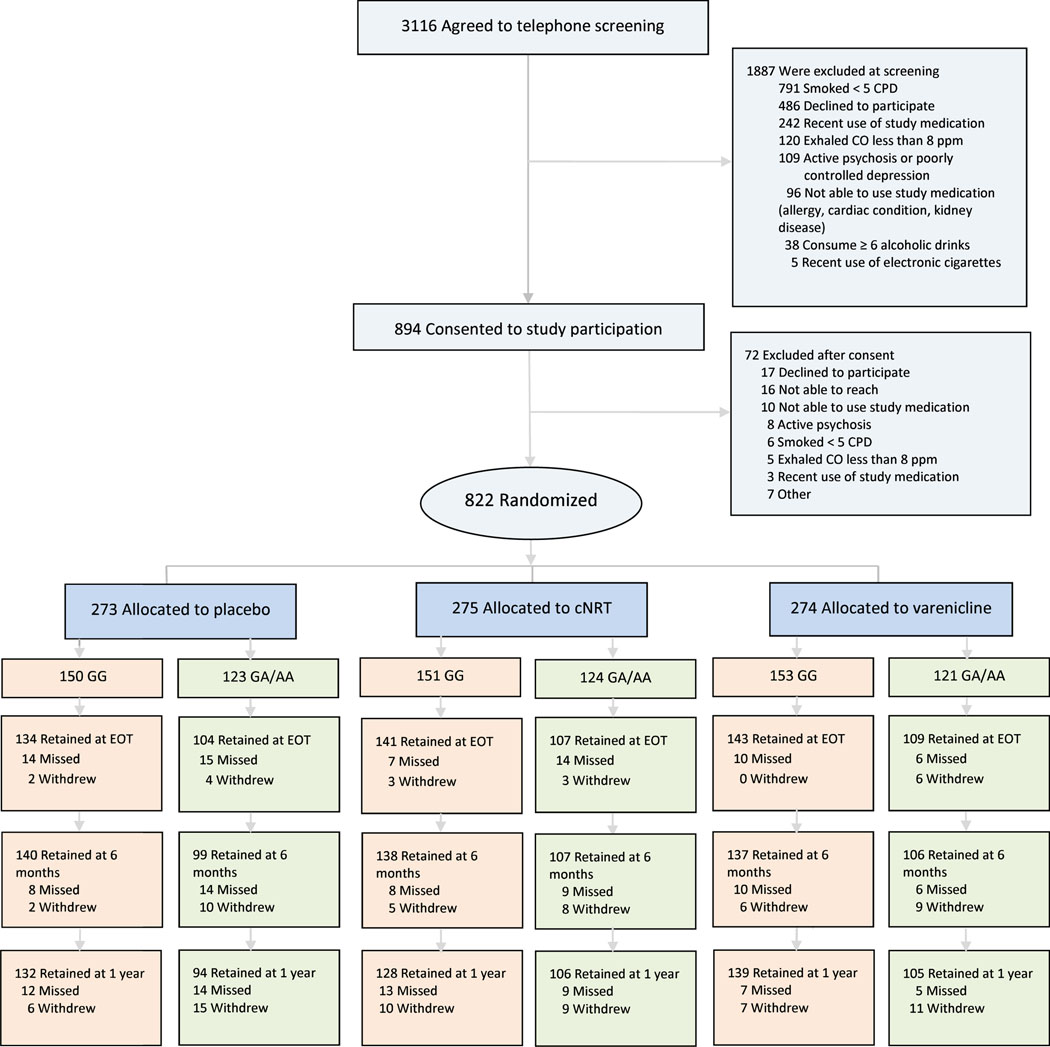
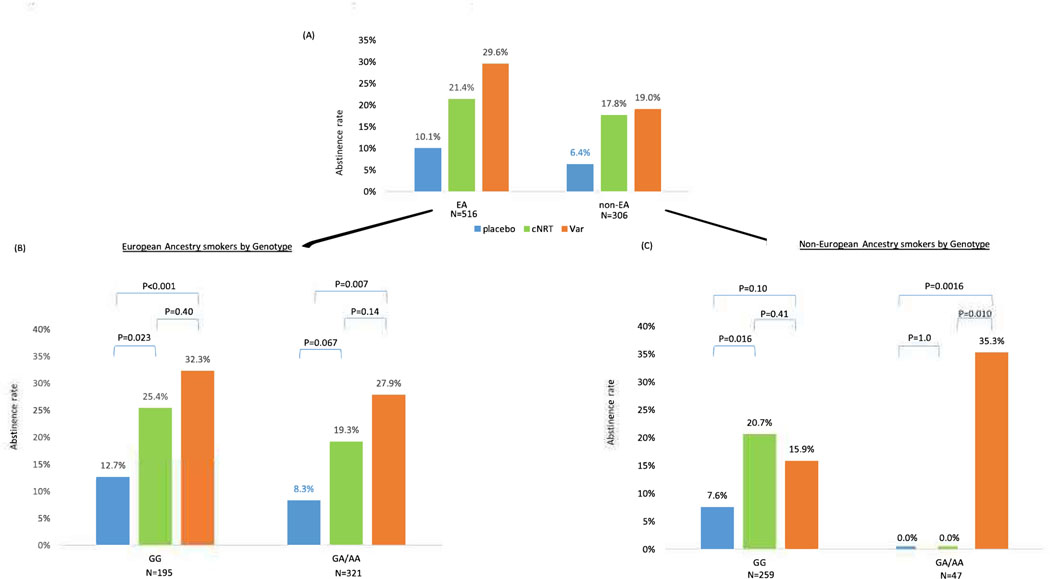
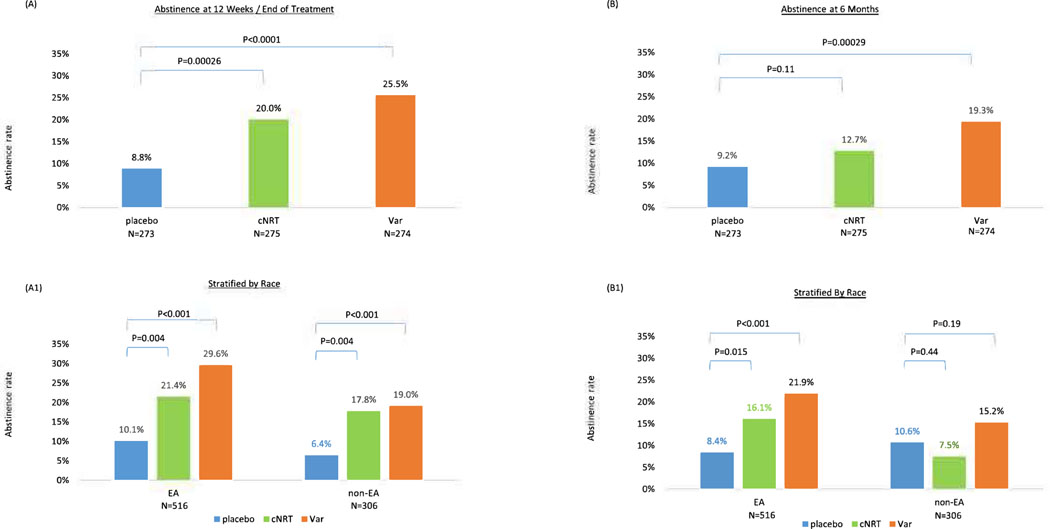
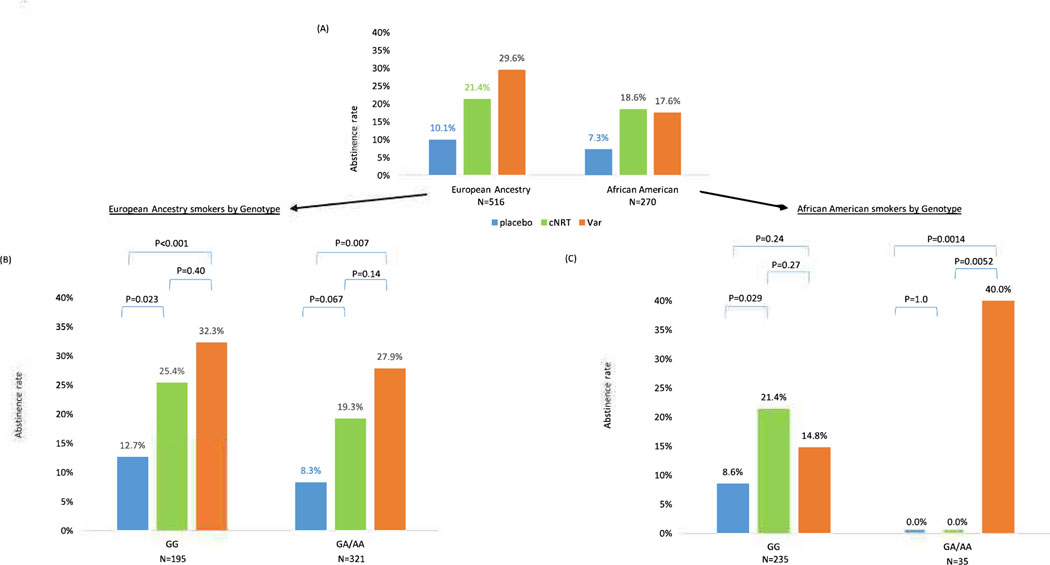
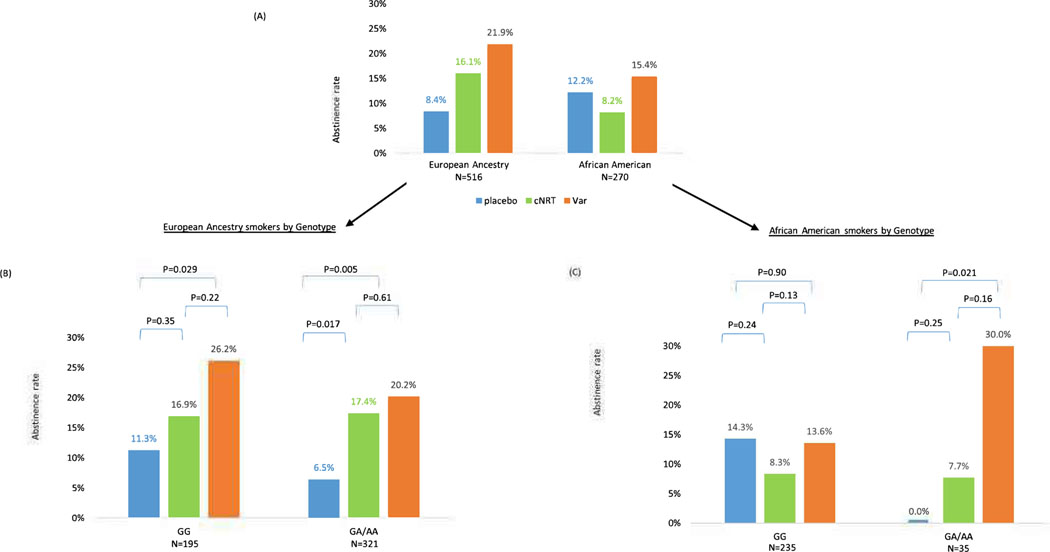
It is unclear if genetic variants affect smoking cessation treatment response. This study tested whether variants in the cholinergic receptor nicotinic alpha 5 subunit (CHRNA5) predict response to smoking cessation medication by directly comparing the two most effective smoking cessation pharmacotherapies. In this genotype-stratified randomized, double-blind, placebo-controlled clinical trial (May 2015-August 2019 in St Louis, Missouri), smokers were randomized by genotype in blocks of six (1:1:1 ratio) to three conditions: 12 weeks of placebo (n = 273), combination nicotine patch and lozenge (combination nicotine replacement therapy, cNRT, n = 275), or varenicline (n = 274). All participants received counseling and were followed for 12 months. The primary end point was biochemically verified 7-day point prevalence abstinence at the end of treatment (EOT, week 12). Trial registration and eligibility criteria are on clinicaltrials.gov (https://clinicaltrials.gov/) (NCT02351167). We conducted the genetic analyses separately for 516 European ancestry (EA) smokers and 306 non-EA smokers (including 270 African American smokers). In African American smokers, there was a genotype-by-treatment interaction for EOT abstinence (χ = 10.7, degrees of freedom = 2. P = 0.0049): specifically, cNRT was more effective in smokers with rs16969968 GG genotype than was placebo, while varenicline was more effective in smokers of GA/AA genotypes. In EA ancestry smokers, there was no significant genotype-by-treatment interaction. In the whole sample, although both were effective at EOT, only varenicline, and not cNRT, was significantly effective relative to placebo at 6-month follow-up. Importantly, this study suggests that genetic information can further enhance smoking cessation treatment effectiveness.
目前尚不清楚遗传变异是否会影响戒烟治疗的反应。本研究通过直接比较两种最有效的戒烟药物治疗方法,测试了胆碱能受体烟碱型 α5 亚单位(CHRNA5)中的变异是否可以预测戒烟药物治疗的反应。这是一项在密苏里州圣路易斯进行的基因分层随机、双盲、安慰剂对照临床试验(2015 年 5 月至 2019 年 8 月),根据基因型将吸烟者以 6 人为一组(1:1:1 比例)分为三组:12 周安慰剂(n=273)、尼古丁贴片和口含锭联合治疗(尼古丁替代疗法联合治疗,cNRT,n=275)或伐尼克兰(n=274)。所有参与者均接受咨询并随访 12 个月。主要终点是治疗结束时(EOT,第 12 周)通过生物化学验证的 7 天点患病率戒烟。试验注册和入选标准在 clinicaltrials.gov(https://clinicaltrials.gov/)上公布(NCT02351167)。我们分别对 516 名欧洲血统(EA)吸烟者和 306 名非 EA 吸烟者(包括 270 名非裔美国人吸烟者)进行了遗传分析。在非裔美国吸烟者中,EOT 戒烟的基因型-治疗相互作用有统计学意义(χ²=10.7,自由度=2,P=0.0049):具体而言,与安慰剂相比,cNRT 在 rs16969968 GG 基因型的吸烟者中更有效,而伐尼克兰在 GA/AA 基因型的吸烟者中更有效。在 EA 血统的吸烟者中,基因型-治疗相互作用没有统计学意义。在整个样本中,虽然两种药物在 EOT 时都有效,但只有伐尼克兰而不是 cNRT 在 6 个月随访时与安慰剂相比具有显著疗效。重要的是,这项研究表明遗传信息可以进一步增强戒烟治疗的效果。