Hewage Sumali, Audimulam Jananie, Sullivan Emily, Chi Claudia, Yew Tong Wei, Yoong Joanne
Saw Swee Hock School of Public Health, National University of Singapore, Singapore, Singapore.
Integrated Health Promotion Unit, Ministry of Health Transformation Office, Singapore, Singapore.
JMIR Form Res. 2020 Jun 30;4(6):e14486. doi: 10.2196/14486.
Gestational diabetes mellitus (GDM) is associated with risks for both the mother and child. The escalated prevalence of GDM because of obesity and changes in screening criteria demands for greater health care needs than before.
This study aimed to understand the perception of patients and health care providers of the barriers to GDM management and preferred interventions to manage GDM in an Asian setting.
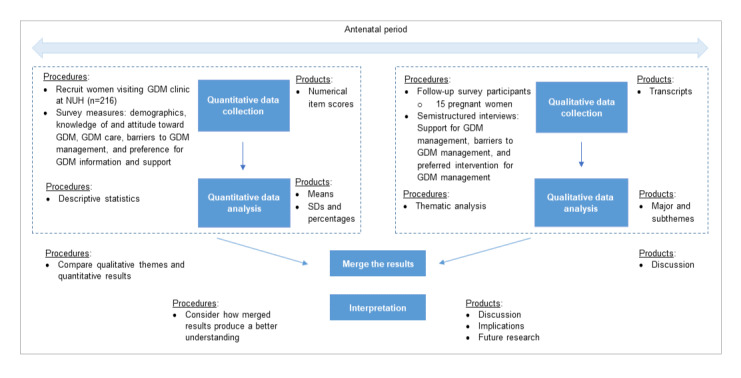
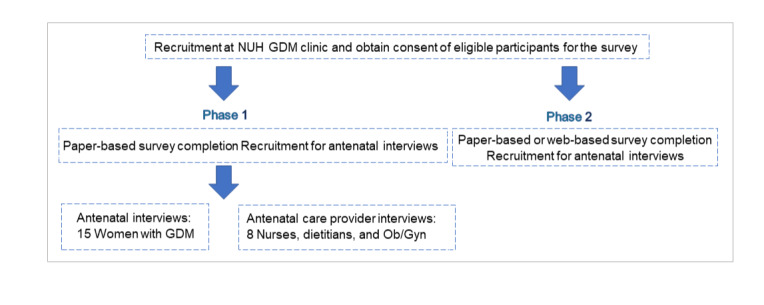
This mixed methods study used a convergent parallel design. Survey data were collected from 216 women with GDM, and semistructured interviews were conducted with 15 women and with 8 health care providers treating patients with GDM. Participants were recruited from 2 specialized GDM clinics at the National University Hospital, Singapore.
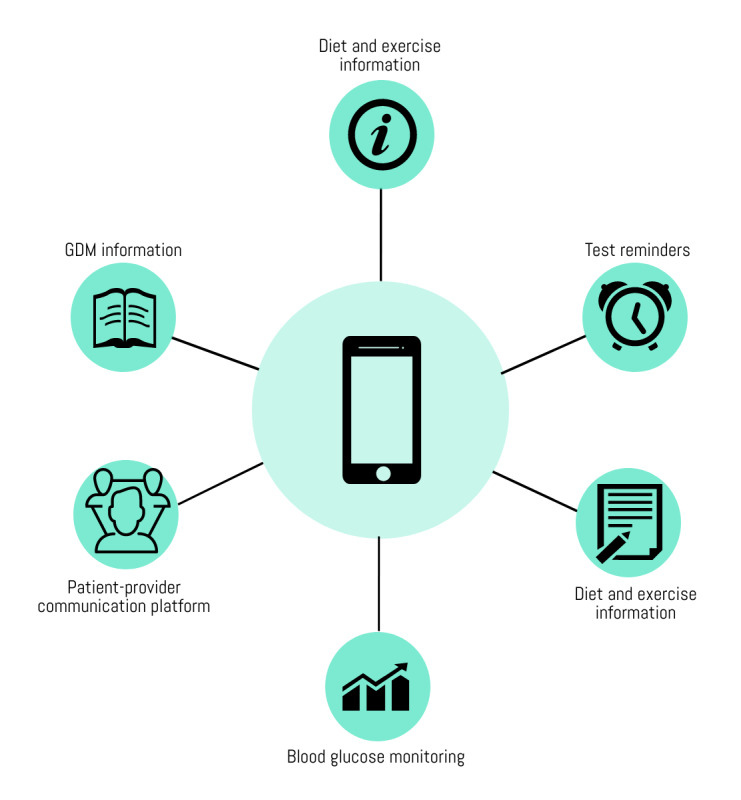
The patients were predominantly Chinese (102/214, 47.6%), employed (201/272, 73.9%), with higher education (150/216, 69.4%) and prenatal attendance at a private clinic (138/214, 64.2%), already on diet control (210/214, 98.1%), and receiving support and information from the GDM clinic (194/215, 90.2%) and web-based sources (131/215, 60.9%). In particular, working women reported barriers to GDM management, including the lack of reminders for blood glucose monitoring, diet control, and insufficient time for exercise. Most women preferred getting such support directly from health care providers, whether at the GDM clinic (174/215, 80.9%) or elsewhere (116/215, 53.9%). Smartphone apps were the preferred means of additional intervention. Desirable intervention features identified by patients included more information on GDM, diet and exercise options, reminders for blood glucose testing, a platform to record blood glucose readings and illustrate or understand trends, and a means to communicate with care providers.
A GDM-focused smartphone app that is able to integrate testing, education, and communication may be a feasible and acceptable intervention to provide support to women with GDM, particularly for working women.
妊娠期糖尿病(GDM)对母亲和孩子均有风险。由于肥胖和筛查标准的变化,GDM患病率不断上升,这对医疗保健的需求比以往更大。
本研究旨在了解亚洲背景下患者和医疗保健提供者对GDM管理障碍的看法以及管理GDM的首选干预措施。
这项混合方法研究采用了收敛平行设计。收集了216名GDM女性的调查数据,并对15名女性和8名治疗GDM患者的医疗保健提供者进行了半结构化访谈。参与者来自新加坡国立大学医院的2家专门的GDM诊所。
患者主要为华裔(102/214,47.6%),有工作(201/272,73.9%),受过高等教育(150/216,69.4%),产前在私立诊所就诊(138/214,64.2%),已进行饮食控制(210/214,98.1%),并从GDM诊所(194/215,90.2%)和网络资源(131/215,60.9%)获得支持和信息。特别是职业女性报告了GDM管理的障碍,包括缺乏血糖监测提醒、饮食控制以及锻炼时间不足。大多数女性更倾向于直接从医疗保健提供者那里获得此类支持,无论是在GDM诊所(174/215,80.9%)还是在其他地方(116/215,53.9%)。智能手机应用程序是首选的额外干预手段。患者确定的理想干预功能包括更多关于GDM、饮食和锻炼选择的信息、血糖检测提醒、记录血糖读数并说明或理解趋势的平台以及与护理人员沟通的方式。
一款专注于GDM的智能手机应用程序,能够整合检测、教育和沟通功能,可能是一种可行且可接受的干预措施,可为GDM女性提供支持,尤其是对职业女性。