Kilimanjaro Christian Medical University College, Moshi, Tanzania.
Department of Pediatrics and Child Health, Kilimanjaro Christian Medical Center (KCMC), Moshi, Tanzania.
PLoS One. 2020 Jun 30;15(6):e0235031. doi: 10.1371/journal.pone.0235031. eCollection 2020.
Respiratory distress syndrome (RDS) is the most common respiratory disease in premature babies and the major cause of morbidity and mortality among preterm babies. Effective treatment of these babies requires exogenous surfactant and/or mechanical ventilation but these are of limited availability in low and middle income countries. A cheaper, simpler and more accessible treatment for preterms with RDS called bubble-continuous positive airway pressure (bCPAP) has been reported to be effective in treating RDS in preterm babies with varying levels of effectiveness ranging from 42% to 85%. We aimed to implement and determine the efficacy of bCPAP and its immediate outcomes as compared to oxygen therapy in preterm babies presenting with respiratory distress at a tertiary hospital in Tanzania.
A randomized control trial, conducted from December 2016 to May 2017, included all preterm babies admitted at the neonatal care unit presenting with signs of respiratory distress and meeting the inclusion criteria. The primary outcome was survival while the secondary outcomes were treatment duration, duration of hospital stay and treatment complications.
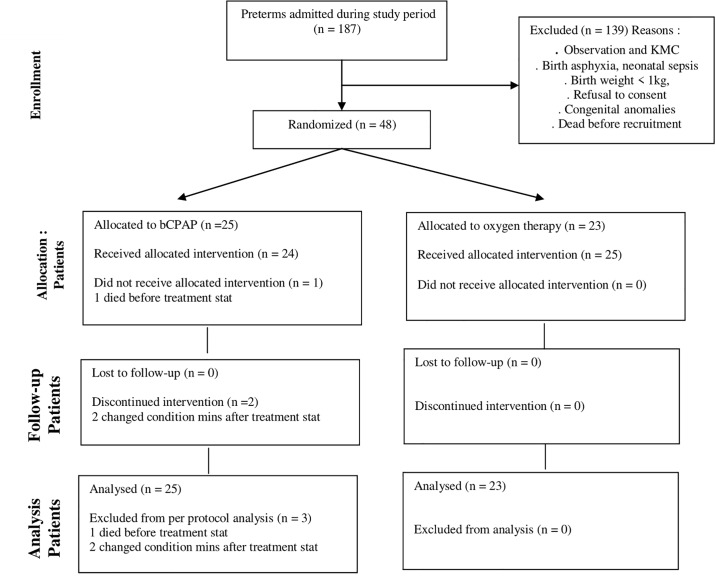
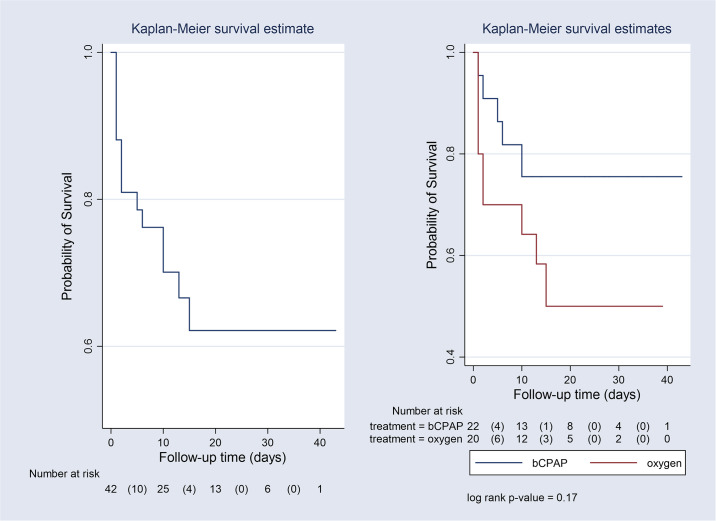
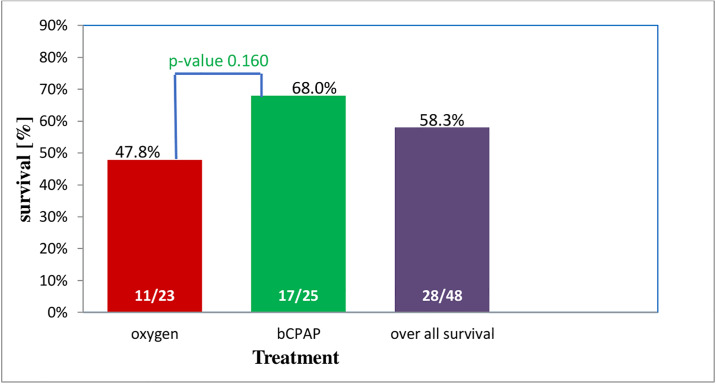
A total of 824 babies were admitted in the neonatal care unit during the study period. Of these, 187 babies were preterm and 48 babies were recruited and randomized (25 bCPAP vs 23 oxygen). The overall survival to discharge for all eligible participants (n = 48) was 58.2% compared to those who adhered to treatment protocol (n = 45, 62.2%). Babies in the bCPAP group had higher survival (17/22; 77.3%) as compared to their counterparts in the oxygen therapy group (11/23; 47.8%). Babies treated with bCPAP had 52% lower risk of death (crude HR 0.48, 95% CI = 0.16-1.43) compared to babies receiving oxygen therapy. The median duration of treatment for babies in the oxygen therapy group was 2 (Range 0-16) days compared to 2 (Range 0-5) days in the bCPAP group. The median duration of hospital stay for babies receiving bCPAP was 14 (range 7-43) days. Nasal bleeding was commonly observed among babies in the bCPAP group as compared to those in the oxygen therapy group.
This study revealed that treatment with bCPAP had a 30% clinical improvement in survival to discharge. Our findings highlight the role of bCPAP in reducing neonatal mortality in resource limited settings but further adequately powered studies in this or similar settings are required.
呼吸窘迫综合征(RDS)是早产儿中最常见的呼吸系统疾病,也是早产儿发病率和死亡率的主要原因。对这些婴儿进行有效的治疗需要外源性表面活性剂和/或机械通气,但在中低收入国家这些资源有限。一种更便宜、更简单、更容易获得的治疗方法,称为气泡持续气道正压通气(bCPAP),已被报道对患有不同严重程度 RDS 的早产儿有效,其疗效从 42%到 85%不等。我们旨在实施并确定 bCPAP 的疗效及其与氧气治疗相比在坦桑尼亚一家三级医院出现呼吸窘迫的早产儿中的即时结果。
一项随机对照试验于 2016 年 12 月至 2017 年 5 月进行,纳入了所有在新生儿护理单元入院的有呼吸窘迫迹象且符合纳入标准的早产儿。主要结局是存活,次要结局是治疗持续时间、住院时间和治疗并发症。
在研究期间,共有 824 名婴儿在新生儿护理单元入院。其中,187 名婴儿为早产儿,48 名婴儿被招募并随机分组(25 名 bCPAP 组与 23 名氧气组)。所有符合条件的参与者(n=48)的总体出院存活率为 58.2%,而遵守治疗方案的参与者(n=45,62.2%)。bCPAP 组的婴儿存活率更高(22/27;77.3%),而氧气治疗组的婴儿存活率较低(23/23;47.8%)。与接受氧气治疗的婴儿相比,接受 bCPAP 治疗的婴儿死亡风险降低 52%(粗 HR 0.48,95%CI=0.16-1.43)。氧气治疗组婴儿的治疗持续时间中位数为 2 天(范围 0-16 天),bCPAP 组为 2 天(范围 0-5 天)。接受 bCPAP 治疗的婴儿的住院时间中位数为 14 天(范围 7-43 天)。与氧气治疗组相比,bCPAP 组的婴儿更常见鼻出血。
本研究表明,bCPAP 治疗可使出院时的存活率提高 30%。我们的研究结果强调了 bCPAP 在减少资源有限环境下新生儿死亡率方面的作用,但需要在类似环境中进行进一步的充分有效、规模的研究。