Department of Pediatric Oncology, Hematology and Clinical Immunology, Medical Faculty, Center of Child and Adolescent Health, Heinrich-Heine-University, Düsseldorf, Germany.
Ludwig Boltzmann Institute for Rare and Undiagnosed Diseases, Vienna, Austria.
Blood. 2020 Dec 3;136(23):2638-2655. doi: 10.1182/blood.2020006738.
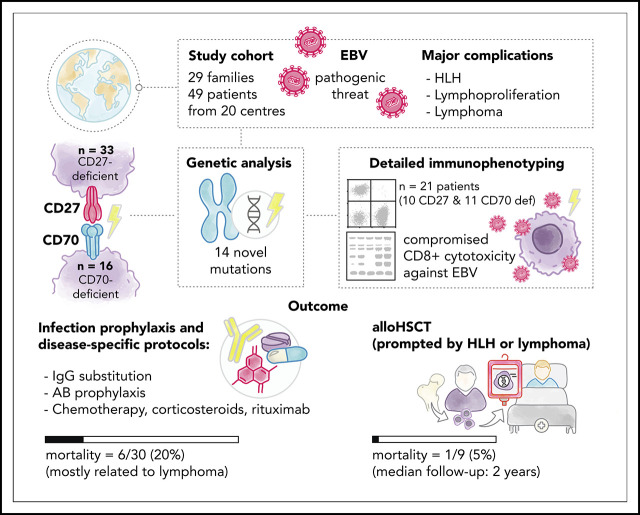
Biallelic mutations in the genes encoding CD27 or its ligand CD70 underlie inborn errors of immunity (IEIs) characterized predominantly by Epstein-Barr virus (EBV)-associated immune dysregulation, such as chronic viremia, severe infectious mononucleosis, hemophagocytic lymphohistiocytosis (HLH), lymphoproliferation, and malignancy. A comprehensive understanding of the natural history, immune characteristics, and transplant outcomes has remained elusive. Here, in a multi-institutional global collaboration, we collected the clinical information of 49 patients from 29 families (CD27, n = 33; CD70, n = 16), including 24 previously unreported individuals and identified a total of 16 distinct mutations in CD27, and 8 in CD70, respectively. The majority of patients (90%) were EBV+ at diagnosis, but only ∼30% presented with infectious mononucleosis. Lymphoproliferation and lymphoma were the main clinical manifestations (70% and 43%, respectively), and 9 of the CD27-deficient patients developed HLH. Twenty-one patients (43%) developed autoinflammatory features including uveitis, arthritis, and periodic fever. Detailed immunological characterization revealed aberrant generation of memory B and T cells, including a paucity of EBV-specific T cells, and impaired effector function of CD8+ T cells, thereby providing mechanistic insight into cellular defects underpinning the clinical features of disrupted CD27/CD70 signaling. Nineteen patients underwent allogeneic hematopoietic stem cell transplantation (HSCT) prior to adulthood predominantly because of lymphoma, with 95% survival without disease recurrence. Our data highlight the marked predisposition to lymphoma of both CD27- and CD70-deficient patients. The excellent outcome after HSCT supports the timely implementation of this treatment modality particularly in patients presenting with malignant transformation to lymphoma.
CD27 或其配体 CD70 基因的双等位基因突变导致先天性免疫缺陷(IEI),其特征主要为 EBV 相关免疫失调,如慢性病毒血症、严重传染性单核细胞增多症、噬血细胞性淋巴组织细胞增生症(HLH)、淋巴组织增生和恶性肿瘤。对其自然病史、免疫特征和移植结果的全面了解仍然难以捉摸。在这里,通过 29 个家族的 49 名患者(CD27,n = 33;CD70,n = 16)的多机构全球合作,我们收集了临床信息,其中包括 24 名以前未报道过的个体,并分别在 CD27 和 CD70 中发现了 16 个和 8 个不同的突变。大多数患者(90%)在诊断时 EBV+,但只有约 30%的患者出现传染性单核细胞增多症。淋巴组织增生和淋巴瘤是主要的临床表现(分别为 70%和 43%),9 名 CD27 缺陷患者发展为 HLH。21 名患者(43%)出现自身炎症特征,包括葡萄膜炎、关节炎和周期性发热。详细的免疫学特征显示记忆 B 和 T 细胞异常生成,包括 EBV 特异性 T 细胞缺乏,以及 CD8+T 细胞效应功能受损,从而为 CD27/CD70 信号通路中断的临床特征提供了细胞缺陷的机制见解。19 名患者在成年前接受了同种异体造血干细胞移植(HSCT),主要是因为淋巴瘤,95%的患者无病生存且无疾病复发。我们的数据突出了 CD27 和 CD70 缺陷患者淋巴瘤的明显易感性。HSCT 后的良好结果支持及时实施这种治疗方式,特别是在恶性转化为淋巴瘤的患者中。