Salemi Negin, Shojaie Behrokh, Bolourinejad Paria, Sherkat Roya, Zamanifar Aryana, Ghaedrahmati Farhoodeh, Azizi Mahdieh, Aria Hamid
Immunodeficiency Diseases Research Center, Isfahan University of Medical Sciences, Isfahan, Iran.
Student Research Committee, Isfahan University of Medical Sciences, Isfahan, Iran.
Adv Biomed Res. 2024 Nov 30;13:112. doi: 10.4103/abr.abr_134_23. eCollection 2024.
The relationship between inborn errors of immunity (IEIs) and COVID-19 severity and incidence rates remains unclear due to limited and diverse data. This study aimed to address this gap by identifying specific IEIs associated with an increased risk of severe COVID-19 or a predisposition to severe disease before vaccination.
Data were collected from the medical records of 15 patients with various IEIs, supplemented by interviews with individuals from an IEIs registry who had experienced COVID-19 before vaccination.
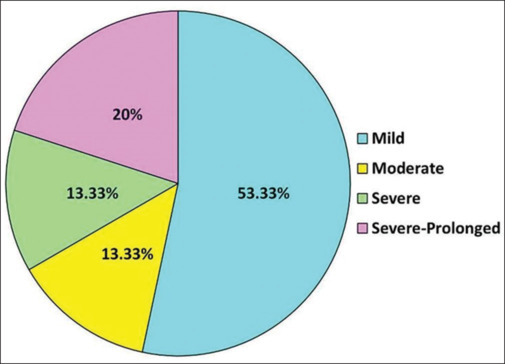
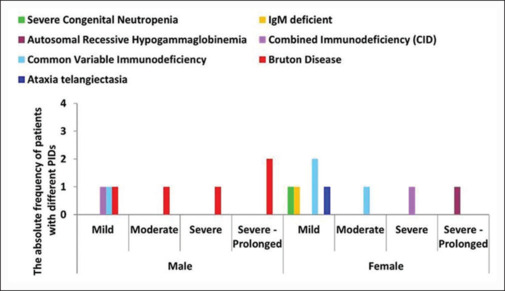
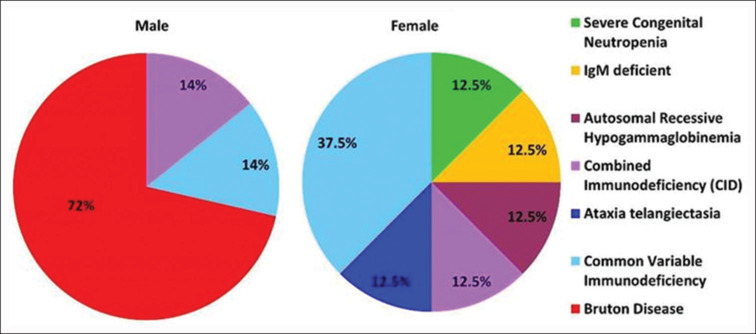
Among the participants, only three patients (20%) experienced severe-prolonged COVID-19. Notably, this severity was predominantly observed in two male patients with Bruton's disease (BD) and one female patient with autosomal recessive hypogammaglobinemia. Moderate and severe COVID-19 cases were equally distributed (13.33%). In the female subgroup, one patient with common variable immunodeficiency and another with combined immunodeficiency experienced moderate and severe COVID-19, respectively. Conversely, both male patients with moderate and severe COVID-19 had BD.
Despite the limited number of severe cases, the absence of cytokine storm manifestation suggests potential protective mechanisms, possibly due to intravenous immunoglobulin therapy and inherent deficiencies within cytokine-producing cells (B and T cells). While IEIs may not be significant risk factors for COVID-19, they offer promising avenues for further research into therapeutic strategies targeting specific immune system components to mitigate severe COVID-19.
由于数据有限且多样,免疫缺陷病(IEIs)与新冠病毒疾病(COVID-19)严重程度及发病率之间的关系仍不明确。本研究旨在通过识别与严重COVID-19风险增加或接种疫苗前易患严重疾病相关的特定IEIs来填补这一空白。
从15例患有各种IEIs的患者的病历中收集数据,并辅以对来自IEIs登记处且在接种疫苗前感染过COVID-19的个体的访谈。
在参与者中,只有3例患者(20%)经历了严重且持续时间长的COVID-19。值得注意的是,这种严重程度主要在两名患有布鲁顿病(BD)的男性患者和一名患有常染色体隐性低丙种球蛋白血症的女性患者中观察到。中度和重度COVID-19病例分布均匀(13.33%)。在女性亚组中,一名患有常见可变免疫缺陷的患者和另一名患有联合免疫缺陷的患者分别经历了中度和重度COVID-19。相反,患有中度和重度COVID-19的男性患者均患有BD。
尽管严重病例数量有限,但未出现细胞因子风暴表现提示了潜在的保护机制,可能是由于静脉注射免疫球蛋白治疗以及细胞因子产生细胞(B细胞和T细胞)内的固有缺陷。虽然IEIs可能不是COVID-19的重要风险因素,但它们为进一步研究针对特定免疫系统成分的治疗策略以减轻严重COVID-19提供了有前景的途径。