
转录组分析揭示了脱落酸和多酚在适应青藏高原极端环境条件中的潜在作用。
Transcriptome Analysis Reveals Potential Roles of Abscisic Acid and Polyphenols in Adaptation of to Extreme Environmental Conditions in the Qinghai-Tibetan Plateau.
机构信息
State Key Laboratory of Plateau Ecology and Agriculture, Qinghai University, Xining 810016, China.
The Key Laboratory of Restoration Ecology in Cold Region of Qinghai Province, Northwest Institute of Plateau Biology, Chinese Academy of Science, Xining 810008, China.
出版信息
Biomolecules. 2020 Jun 26;10(6):967. doi: 10.3390/biom10060967.
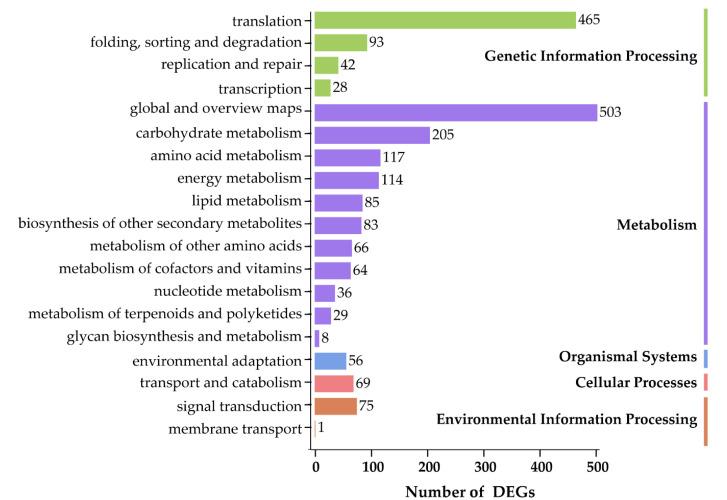
A detailed understanding of the molecular mechanisms of plant stress resistance in the face of ever-changing environmental stimuli will be helpful for promoting the growth and production of crop and forage plants. Investigations of plant responses to various single abiotic or biotic factors, or combined stresses, have been extensively reported. However, the molecular mechanisms of plants in responses to environmental stresses under natural conditions are not clearly understood. In this study, we carried out a transcriptome analysis using RNA-sequencing to decipher the underlying molecular mechanisms of responding and adapting to the extreme natural environment in the Qinghai-Tibetan Plateau (QTP). The transcriptome data of plant samples collected from two different altitudes revealed a total of 8212 differentially expressed genes (DEGs), including 5387 up-regulated and 2825 down-regulated genes. Detailed analysis of the identified DEGs uncovered that up-regulation of genes potentially leading to changes in hormone homeostasis and signaling, particularly abscisic acid-related ones, and enhanced biosynthesis of polyphenols play vital roles in the adaptive processes of . Interestingly, several DEGs encoding uridine diphosphate glycosyltransferases, which putatively regulate phytohormone homeostasis to resist environmental stresses, were also discovered. Furthermore, numerous DEGs encoding transcriptional factors, such as members of the (), (), , and () families, might be involved in the adaptive responses of to the extreme natural environmental conditions. The DEGs identified in this study represent candidate targets for improving environmental stress resistance of grown in higher altitudes of the QTP, and can provide deep insights into the molecular mechanisms underlying the responses of this plant species to the extreme natural environmental conditions of the QTP.
深入了解植物在应对不断变化的环境刺激时的抗逆分子机制,将有助于促进作物和饲料植物的生长和生产。已经广泛报道了对各种单一非生物或生物因素或综合胁迫的植物响应的研究。然而,植物在自然条件下应对环境胁迫的分子机制尚不清楚。在这项研究中,我们使用 RNA-seq 进行了转录组分析,以揭示 响应和适应青藏高原(QTP)极端自然环境的潜在分子机制。从两个不同海拔高度采集的植物样本的转录组数据共揭示了 8212 个差异表达基因(DEGs),包括 5387 个上调基因和 2825 个下调基因。对鉴定出的 DEGs 的详细分析表明,基因的上调可能导致激素稳态和信号转导的变化,特别是与脱落酸相关的基因,以及多酚生物合成的增强,在 的适应过程中起着至关重要的作用。有趣的是,还发现了几个编码尿苷二磷酸糖基转移酶的 DEGs,这些酶可能调节植物激素稳态以抵抗环境胁迫。此外,许多转录因子编码 DEGs,如()、()、()和()家族的成员,可能参与 对 QTP 极端自然环境条件的适应反应。本研究中鉴定的 DEGs 代表了提高在 QTP 高海拔地区生长的 环境胁迫抗性的候选靶标,并为深入了解该植物物种对 QTP 极端自然环境条件的响应的分子机制提供了深入的见解。




 Zotero 插件