Department of Environmental Engineering, National Cheng Kung University, Tainan City 701, Taiwan.
Int J Mol Sci. 2020 Jun 26;21(12):4554. doi: 10.3390/ijms21124554.
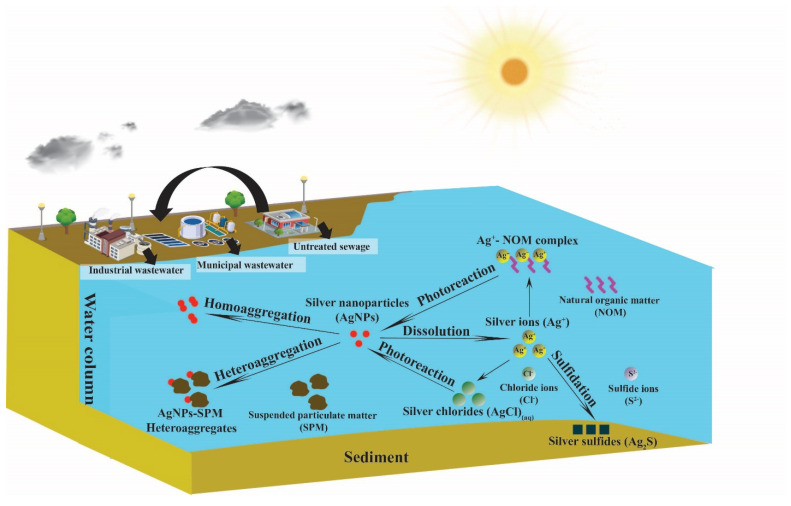
Exposure assessment is a key component in the risk assessment of engineered nanomaterials (ENMs). While direct and quantitative measurements of ENMs in complex environmental matrices remain challenging, environmental fate models (EFMs) can be used alternatively for estimating ENMs' distributions in the environment. This review describes and assesses the development and capability of EFMs, focusing on surface waters. Our review finds that current engineered nanomaterial (ENM) exposure models can be largely classified into three types: material flow analysis models (MFAMs), multimedia compartmental models (MCMs), and spatial river/watershed models (SRWMs). MFAMs, which is already used to derive predicted environmental concentrations (PECs), can be used to estimate the releases of ENMs as inputs to EFMs. Both MCMs and SRWMs belong to EFMs. MCMs are spatially and/or temporally averaged models, which describe ENM fate processes as intermedia transfer of well-mixed environmental compartments. SRWMs are spatiotemporally resolved models, which consider the variability in watershed and/or stream hydrology, morphology, and sediment transport of river networks. As the foundation of EFMs, we also review the existing and emerging ENM fate processes and their inclusion in recent EFMs. We find that while ENM fate processes, such as heteroaggregation and dissolution, are commonly included in current EFMs, few models consider photoreaction and sulfidation, evaluation of the relative importance of fate processes, and the fate of weathered/transformed ENMs. We conclude the review by identifying the opportunities and challenges in using EFMs for ENMs.
暴露评估是工程纳米材料 (ENMs) 风险评估的关键组成部分。虽然在复杂的环境基质中直接和定量测量 ENMs 仍然具有挑战性,但环境归宿模型 (EFMs) 可用于替代估计 ENMs 在环境中的分布。本综述描述和评估了 EFMs 的发展和能力,重点是地表水。我们的综述发现,目前的工程纳米材料 (ENM) 暴露模型大致可以分为三类:物质流动分析模型 (MFAMs)、多媒体分隔模型 (MCMs) 和空间河流/流域模型 (SRWMs)。MFAMs 已经用于推导预测环境浓度 (PECs),可用于估计 ENMs 的释放,作为 EFMs 的输入。MCMs 和 SRWMs 都属于 EFMs。MCMs 是时空平均模型,描述了作为混合良好的环境分隔体之间的中间转移的 ENM 归宿过程。SRWMs 是时空分辨模型,考虑了流域和/或溪流水文学、形态和河流网络泥沙输运的变异性。作为 EFMs 的基础,我们还回顾了现有的和新兴的 ENM 归宿过程及其在最近的 EFMs 中的纳入。我们发现,虽然 ENM 归宿过程,如异质聚集和溶解,通常包含在当前的 EFMs 中,但很少有模型考虑光反应和硫化、归宿过程的相对重要性的评估,以及风化/转化的 ENMs 的归宿。我们通过确定在使用 EFMs 评估 ENMs 时的机会和挑战来结束综述。