Philipp Julia, Truttmann Stefanie, Zeiler Michael, Franta Claudia, Wittek Tanja, Schöfbeck Gabriele, Mitterer Michaela, Mairhofer Dunja, Zanko Annika, Imgart Hartmut, Auer-Welsbach Ellen, Treasure Janet, Wagner Gudrun, Karwautz Andreas F K
Eating Disorders Unit, Department of Child and Adolescent Psychiatry, Medical University of Vienna, 1090 Vienna, Austria.
Parkland Clinic, Clinic for Psychosomatic Medicine and Psychotherapy, 34537 Bad Wildungen, Germany.
J Clin Med. 2020 Jun 27;9(7):2021. doi: 10.3390/jcm9072021.
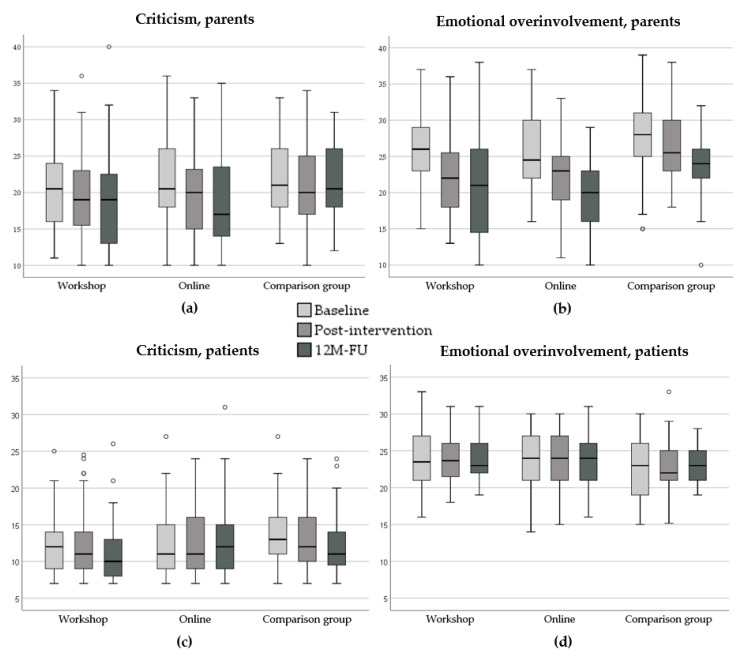
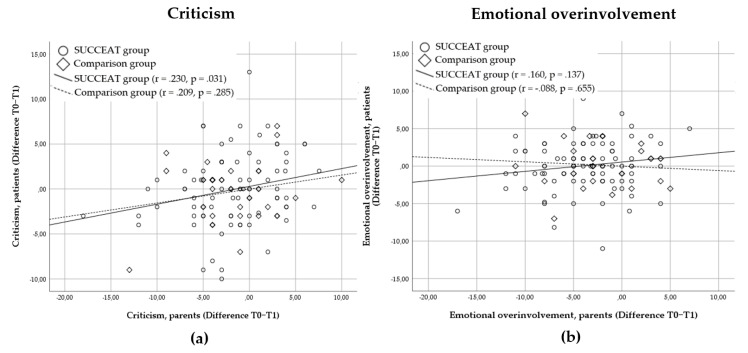
High expressed emotion (EE) is common in caregivers of patients with anorexia nervosa (AN) and associated with poorer outcome for patients. In this study, we examined the prevalence of high EE in caregivers of adolescents with AN and analyzed predictors for EE using multivariate linear regression models. We further analyzed whether EE is reduced by the "Supporting Carers of Children and Adolescents with Eating Disorders in Austria" (SUCCEAT) intervention using general linear mixed models and whether a reduction of EE predicts patients' outcomes. Caregivers were randomly allocated to the SUCCEAT workshop ( = 50) or online intervention ( = 50) and compared to a comparison group ( = 49). EE and patients' outcomes were assessed at the baseline, post-intervention, and at the 12-month follow-up. Up to 47% of caregivers showed high EE. Lower caregiver skills, higher AN symptom impact, higher levels of depression and motivation to change in caregivers were significant predictors for high EE. EE significantly decreased in the SUCCEAT groups and the comparison group according to the caregivers', but not the patients' perspective. The level of reduction could partially predict subjective improvement and improvement in clinically assessed AN symptoms and body mass index of patients. Implementing interventions for caregivers addressing EE in the treatment of adolescents with AN is strongly recommended.
高表达情绪(EE)在神经性厌食症(AN)患者的照料者中很常见,且与患者较差的预后相关。在本研究中,我们调查了青少年AN患者照料者中高EE的患病率,并使用多元线性回归模型分析了EE的预测因素。我们还使用一般线性混合模型分析了“奥地利支持饮食失调儿童和青少年照料者”(SUCCEAT)干预措施是否能降低EE,以及EE的降低是否能预测患者的预后。照料者被随机分配到SUCCEAT工作坊组(n = 50)或在线干预组(n = 50),并与一个对照组(n = 49)进行比较。在基线、干预后和12个月随访时评估EE和患者的预后。高达47%的照料者表现出高EE。照料者技能较低、AN症状影响较大、照料者的抑郁水平较高以及改变的动机较强是高EE的显著预测因素。从照料者而非患者的角度来看,SUCCEAT组和对照组的EE均显著降低。降低的程度可以部分预测患者主观状况的改善以及临床评估的AN症状和体重指数的改善。强烈建议在青少年AN的治疗中针对照料者实施解决EE问题的干预措施。