Zhong Zhenhui, Chen Meilian, Lin Lianyu, Chen Ruiqi, Liu Dan, Norvienyeku Justice, Zheng Huakun, Wang Zonghua
State Key Laboratory of Ecological Pest Control for Fujian and Taiwan Crops, College of Plant Protection, Fujian Agriculture and Forestry University, Fuzhou, China.
Institute of Oceanography, Minjiang University, Fuzhou, China.
mSystems. 2020 Jun 30;5(3):e00346-20. doi: 10.1128/mSystems.00346-20.
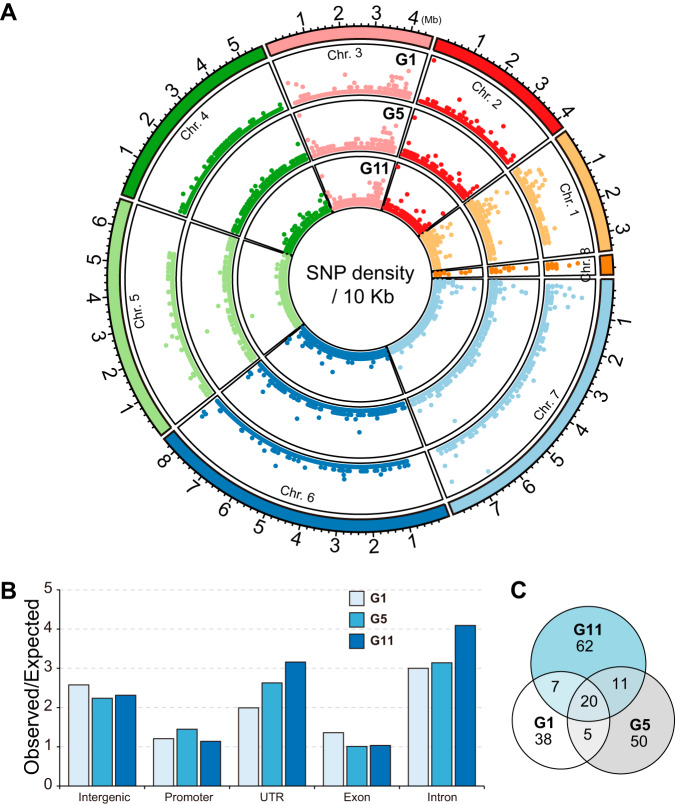
The genomes of plant pathogens are highly variable and plastic. Pathogen gene repertoires change quickly with the plant environment, which results in a rapid loss of plant resistance shortly after the pathogen emerges in the field. Extensive studies have evaluated natural pathogen populations to understand their evolutionary effects; however, the number of studies that have examined the dynamic processes of the mutation and adaptation of plant pathogens to host plants remains limited. Here, we applied experimental evolution and high-throughput pool sequencing to , a fungal pathogen that causes massive losses in rice production, to observe the evolution of genome variation. We found that mutations, including single-nucleotide variants (SNVs), insertions and deletions (indels), and transposable element (TE) insertions, accumulated very rapidly throughout the genome of during sequential plant inoculation and preferentially in noncoding regions, while such mutations were not frequently found in coding regions. However, we also observed that new TE insertions accumulated with time and preferentially accumulated at the proximal region of secreted protein (SP) coding genes in populations. Taken together, these results revealed a bias in genetic variation toward noncoding regions and SP genes in and may contribute to the rapid adaptive evolution of the blast fungal effectors under host selection. Plants "lose" resistance toward pathogens shortly after their widespread emergence in the field because plant pathogens mutate and adapt rapidly under resistance selection. Thus, the rapid evolution of pathogens is a serious threat to plant health. Extensive studies have evaluated natural pathogen populations to understand their evolutionary effects; however, the study of the dynamic processes of the mutation and adaptation of plant pathogens to host plants remains limited. Here, by performing an experimental evolution study, we found a bias in genetic variation toward noncoding regions and SPs in the rice blast fungus , which explains the ability of the rice blast fungus to maintain high virulence variation to overcome rice resistance in the field.
植物病原体的基因组具有高度的变异性和可塑性。病原体的基因库会随着植物环境迅速变化,这导致病原体在田间出现后不久,植物的抗性就会迅速丧失。大量研究评估了天然病原体群体,以了解它们的进化影响;然而,研究植物病原体对宿主植物的突变和适应动态过程的研究数量仍然有限。在这里,我们将实验进化和高通量混合测序应用于一种在水稻生产中造成巨大损失的真菌病原体,以观察基因组变异的进化。我们发现,在连续接种植物的过程中,突变,包括单核苷酸变异(SNV)、插入和缺失(indel)以及转座元件(TE)插入,在整个基因组中迅速积累,并且优先在非编码区域积累,而在编码区域中这种突变并不常见。然而,我们还观察到新的TE插入随着时间的推移而积累,并且在群体的分泌蛋白(SP)编码基因的近端区域优先积累。综上所述,这些结果揭示了在中的遗传变异偏向于非编码区域和SP基因,这可能有助于稻瘟病菌效应子在宿主选择下的快速适应性进化。在病原体在田间广泛出现后不久,植物就“失去”了对病原体的抗性,因为植物病原体在抗性选择下会迅速突变和适应。因此,病原体的快速进化对植物健康构成了严重威胁。大量研究评估了天然病原体群体,以了解它们的进化影响;然而,对植物病原体对宿主植物的突变和适应动态过程的研究仍然有限。在这里,通过进行实验进化研究,我们发现稻瘟病菌的遗传变异偏向于非编码区域和SP,这解释了稻瘟病菌在田间维持高毒力变异以克服水稻抗性的能力。