Department of Anatomy, Physiology and Pharmacology & Cameco MS Neuroscience Research Center, College of Medicine, University of Saskatchewan, Saskatoon, SK, Canada.
Office of the Saskatchewan Multiple Sclerosis Clinical Research Chair, University of Saskatchewan, Saskatoon, SK, Canada.
Ann Clin Transl Neurol. 2020 Jul;7(7):1214-1224. doi: 10.1002/acn3.51103. Epub 2020 Jul 1.
Neurodegeneration is thought to be the primary cause of neurological disability in multiple sclerosis (MS). Dysfunctional RNA-binding proteins (RBPs) including their mislocalization from nucleus to cytoplasm, stress granule formation, and altered RNA metabolism have been found to underlie neurodegeneration in amyotrophic lateral sclerosis and frontotemporal dementia. Yet, little is known about the role of dysfunctional RBPs in the pathogenesis of neurodegeneration in MS. As a follow-up to our seminal finding of altered RBP function in a single case of MS, we posited that there would be evidence of RBP dysfunction in cortical neurons in MS.
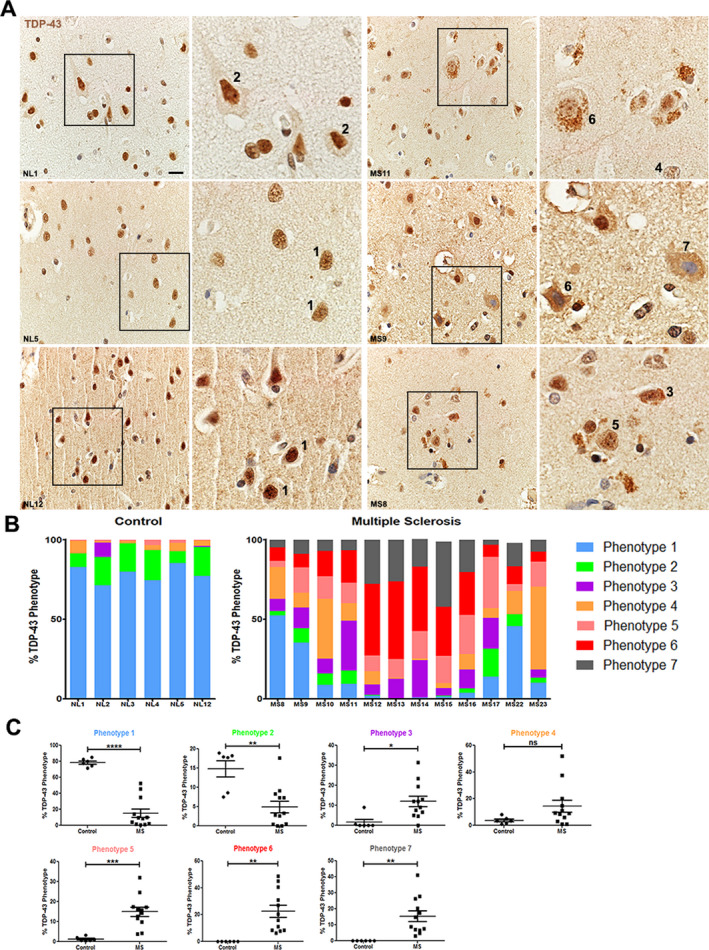
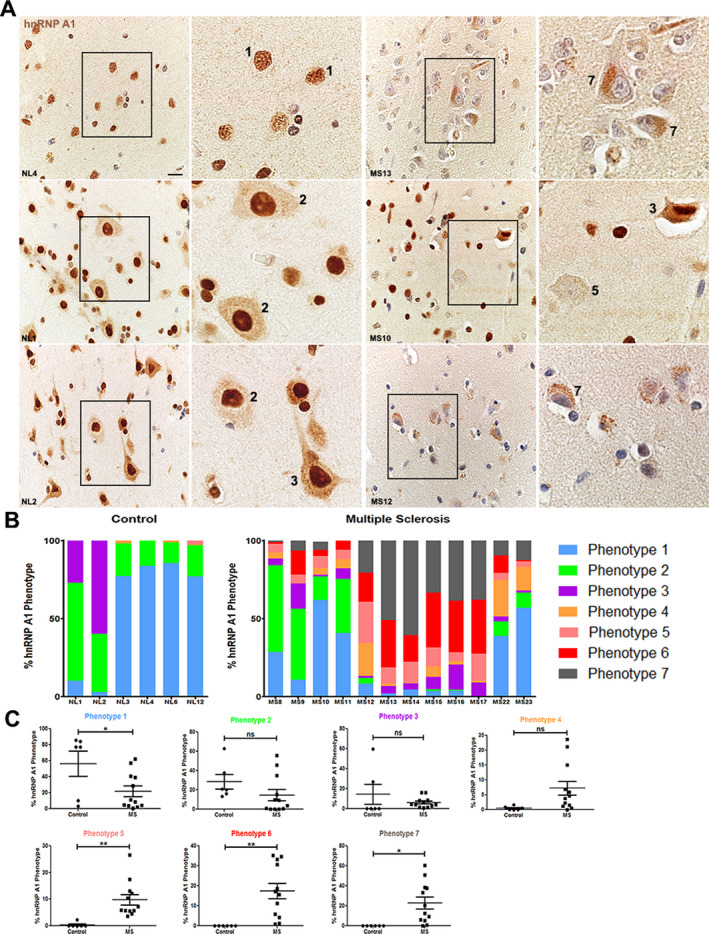
Cortical neurons from 12 MS and six control cases were analyzed by immunohistochemistry for heterogeneous nuclear ribonucleoprotein A1 (hnRNP A1) and TAR-DNA-binding protein-43 (TDP-43). Seven distinct neuronal phenotypes were identified based on the nucleocytoplasmic staining of these RBPs. Statistical analyses were performed by analyzing each phenotype in relation to MS versus controls.
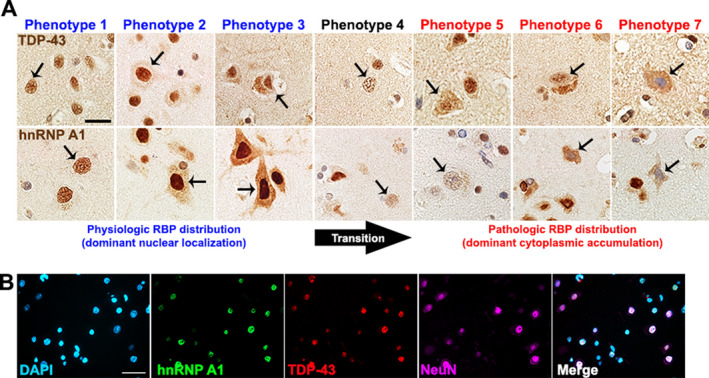
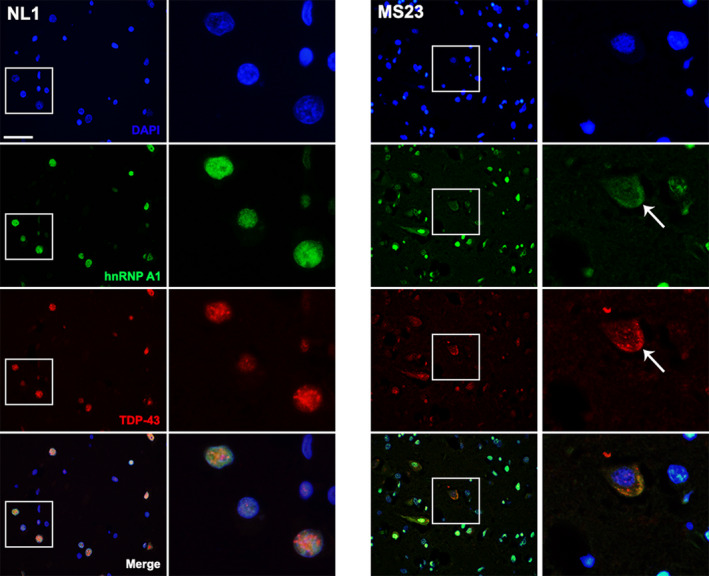
Analyses revealed a continuum of hnRNP A1 and TDP-43 nucleocytoplasmic staining was found in cortical neurons, from neurons with entirely nuclear staining with little cytoplasmic staining in contrast to those with complete nuclear depletion of RBPs concurrent with robust cytoplasmic staining. The neuronal phenotypes that showed the most nucleocytoplasmic mislocalization of hnRNP A1 and TDP-43 statistically distinguished MS from control cases (P < 0.01, P < 0.001, respectively).
The discovery of hnRNP A1 and TDP-43 nucleocytoplasmic mislocalization in neurons in MS brain demonstrate that dysfunctional RBPs may play a role in neurodegeneration in MS, as they do in other neurological diseases.
神经退行性变被认为是多发性硬化症(MS)中神经功能障碍的主要原因。现已发现,包括 RNA 结合蛋白(RBPs)在内的功能失调的 RNA 结合蛋白从核内易位到细胞质、应激颗粒形成以及改变的 RNA 代谢,是肌萎缩侧索硬化症和额颞叶痴呆神经退行性变的基础。然而,关于功能失调的 RBPs 在 MS 神经退行性变发病机制中的作用知之甚少。继我们在单个 MS 病例中发现 RBP 功能改变的开创性发现之后,我们假设在 MS 中皮质神经元中会存在 RBP 功能障碍的证据。
通过免疫组织化学方法分析了来自 12 例 MS 和 6 例对照病例的皮质神经元,以检测异质核核糖核蛋白 A1(hnRNP A1)和 TAR DNA 结合蛋白 43(TDP-43)。根据这些 RBP 的核质染色,确定了七种不同的神经元表型。通过分析每种表型与 MS 与对照组的关系,进行统计分析。
分析结果显示,在皮质神经元中,hnRNP A1 和 TDP-43 的核质染色存在连续体,从细胞核染色完全,细胞质染色很少的神经元,与 RBPs 完全核内耗竭且同时伴有强烈的细胞质染色的神经元形成鲜明对比。表现出 hnRNP A1 和 TDP-43 核质最明显易位的神经元表型在统计学上能够将 MS 与对照病例区分开来(分别为 P<0.01,P<0.001)。
在 MS 脑神经元中发现 hnRNP A1 和 TDP-43 的核质易位表明,功能失调的 RBPs 可能在 MS 中的神经退行性变中发挥作用,就像它们在其他神经退行性疾病中一样。