.
,.
Invest Ophthalmol Vis Sci. 2020 Jul 1;61(8):2. doi: 10.1167/iovs.61.8.2.
To examine whether perceptual learning can improve face discrimination and recognition in older adults with central vision loss.
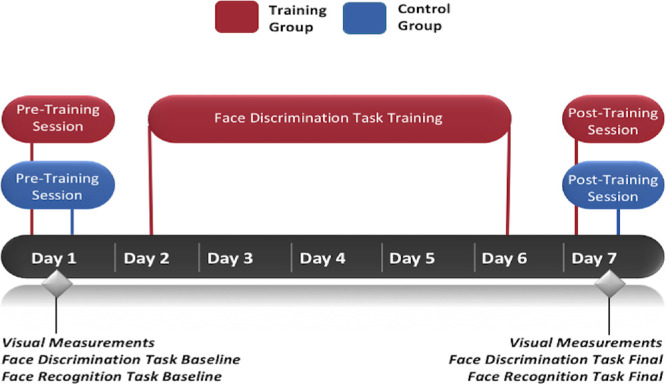
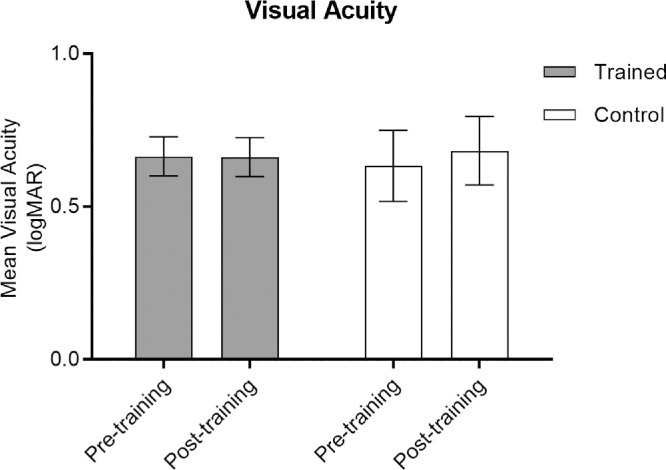
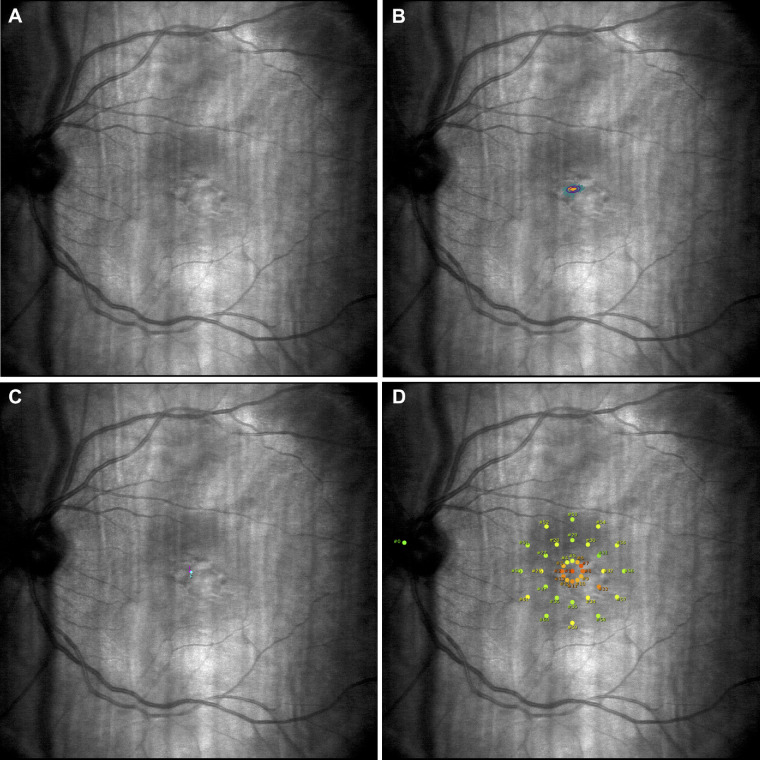
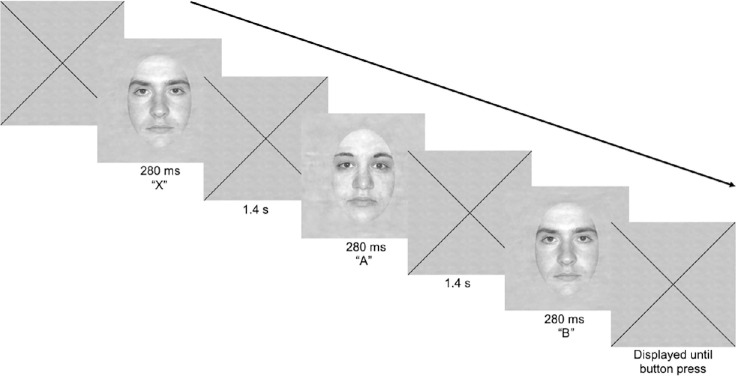
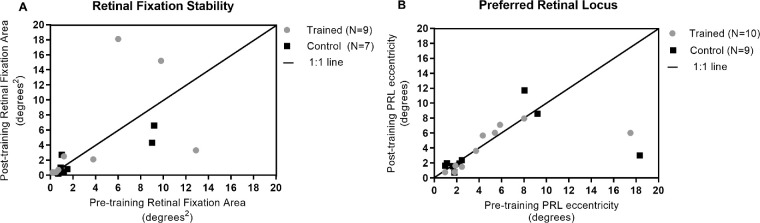
Ten participants with age-related macular degeneration (ARMD) received 5 days of training on a face discrimination task (mean age, 78 ± 10 years). We measured the magnitude of improvements (i.e., a reduction in threshold size at which faces were able to be discriminated) and whether they generalized to an untrained face recognition task. Measurements of visual acuity, fixation stability, and preferred retinal locus were taken before and after training to contextualize learning-related effects. The performance of the ARMD training group was compared to nine untrained age-matched controls (8 = ARMD, 1 = juvenile macular degeneration; mean age, 77 ± 10 years).
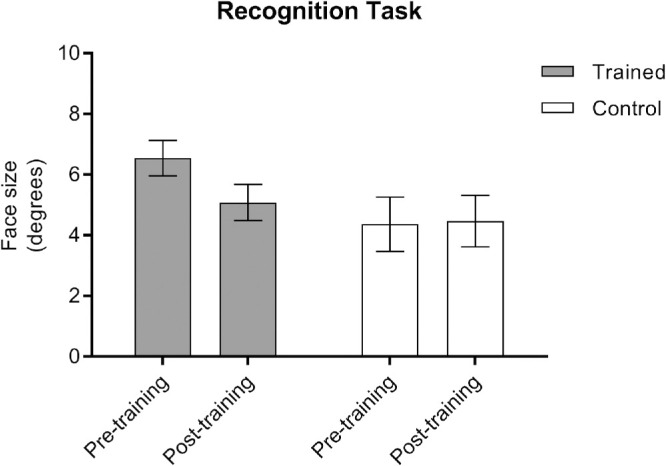
Perceptual learning on the face discrimination task reduced the threshold size for face discrimination performance in the trained group, with a mean change (SD) of -32.7% (+15.9%). The threshold for performance on the face recognition task was also reduced, with a mean change (SD) of -22.4% (+2.31%). These changes were independent of changes in visual acuity, fixation stability, or preferred retinal locus. Untrained participants showed no statistically significant reduction in threshold size for face discrimination, with a mean change (SD) of -8.3% (+10.1%), or face recognition, with a mean change (SD) of +2.36% (-5.12%).
This study shows that face discrimination and recognition can be reliably improved in ARMD using perceptual learning. The benefits point to considerable perceptual plasticity in higher-level cortical areas involved in face-processing. This novel finding highlights that a key visual difficulty in those suffering from ARMD is readily amenable to rehabilitation.
探究知觉学习能否改善中老年中心性视力丧失患者的面孔辨别和识别能力。
10 名年龄相关性黄斑变性(AMD)患者接受了 5 天的面孔辨别任务训练(平均年龄 78 ± 10 岁)。我们测量了改善的幅度(即,能够辨别面孔的阈值大小的减少),以及它们是否可以推广到未训练的面孔识别任务。在训练前后测量了视力、注视稳定性和优势视网膜位置,以将学习相关的效果置于上下文中。将 AMD 训练组的表现与 9 名未经训练的年龄匹配对照组(8 名 AMD,1 名青少年黄斑变性;平均年龄 77 ± 10 岁)进行比较。
面孔辨别任务的知觉学习降低了训练组面孔辨别表现的阈值大小,平均变化(SD)为-32.7%(+15.9%)。面孔识别任务的阈值也降低了,平均变化(SD)为-22.4%(+2.31%)。这些变化与视力、注视稳定性或优势视网膜位置的变化无关。未经训练的参与者在面孔辨别任务的阈值大小上没有统计学上显著的变化,平均变化(SD)为-8.3%(+10.1%),或者在面孔识别任务上的阈值大小没有统计学上显著的变化,平均变化(SD)为+2.36%(-5.12%)。
这项研究表明,使用知觉学习可以可靠地改善 AMD 患者的面孔辨别和识别能力。这些益处表明,参与面孔处理的高级皮质区域具有相当大的知觉可塑性。这一新颖的发现强调了那些患有 AMD 的人面临的一个关键视觉困难是易于康复的。