Taub Institute for Research on Alzheimer's Disease and the Aging Brain, Department of Neurology, Columbia University Irving Medical Center, New York, New York.
Julius Center for Health Sciences and Primary Care, University Medical Center Utrecht, The Netherlands.
J Gerontol B Psychol Sci Soc Sci. 2020 Oct 16;75(9):1850-1862. doi: 10.1093/geronb/gbaa080.
To better understand and compare effects of aging and education across domains of language and cognition, we investigated whether (a) these domains show different associations with age and education, (b) these domains show similar patterns of age-related change over time, and (c) education moderates the rate of decline in these domains.
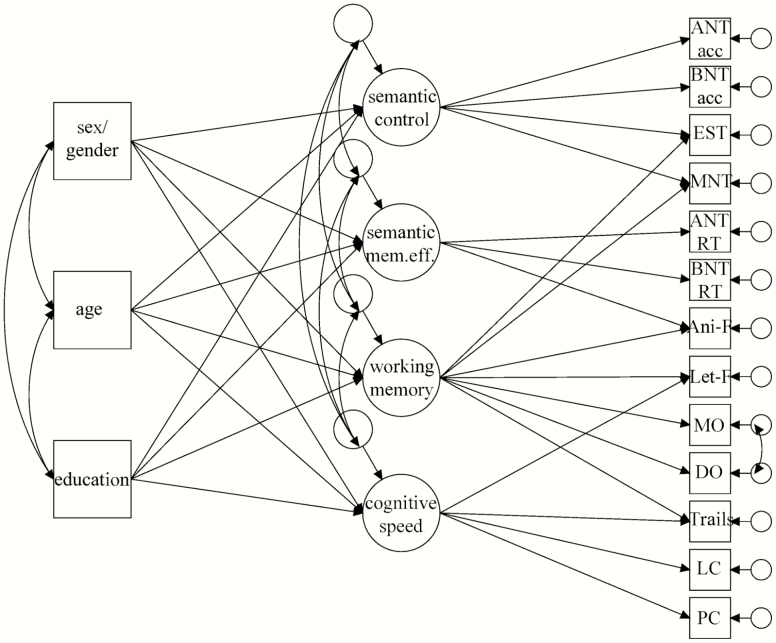
We analyzed data from 306 older adults aged 55-85 at baseline of whom 116 returned for follow-up 4-8 years later. An exploratory factor analysis identified domains of language and cognition across a range of tasks. A confirmatory factor analysis analyzed cross-sectional associations of age and education with these domains. Subsequently, mixed linear models analyzed longitudinal change as a function of age and moderation by education.
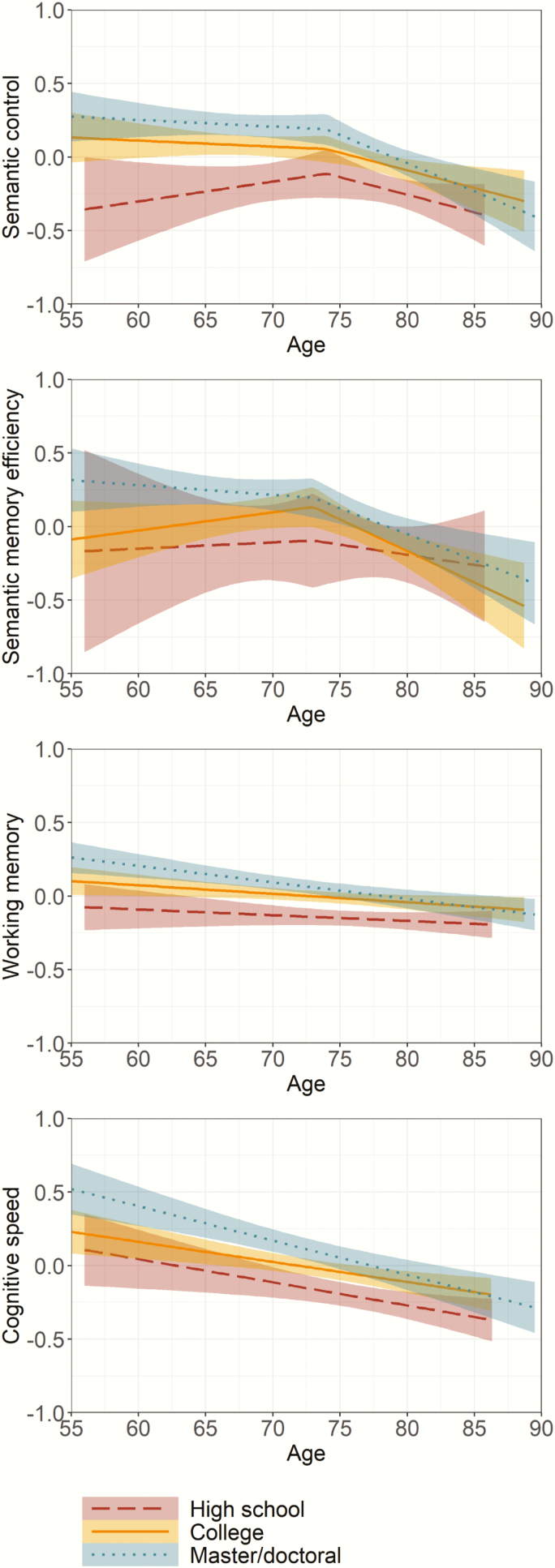
We identified 2 language domains, that is, semantic control and semantic memory efficiency, and 2 cognitive domains, that is, working memory and cognitive speed. Older age negatively affected all domains except semantic memory efficiency, and higher education positively affected all domains except cognitive speed at baseline. In language domains, a steeper age-related decline was observed after age 73-74 compared to younger ages, while cognition declined linearly with age. Greater educational attainment did not protect the rate of decline over time in any domain.
Separate domains show varying effects of age and education at baseline, language versus cognitive domains show dissimilar patterns of age-related change over time, and education does not moderate the rate of decline in these domains. These findings broaden our understanding of age effects on cognitive and language abilities by placing observed age differences in context.
为了更好地理解和比较语言和认知领域中衰老和教育的影响,我们研究了以下三个问题:(a)这些领域与年龄和教育的关联是否不同;(b)这些领域是否表现出随时间推移而相似的与年龄相关的变化模式;(c)教育是否调节这些领域的衰退速度。
我们分析了 306 名年龄在 55-85 岁之间的老年人在基线时的数据,其中 116 人在 4-8 年后的随访中返回。一项探索性因素分析确定了语言和认知领域在一系列任务中的分布。一项验证性因素分析分析了年龄和教育与这些领域的横断面关联。随后,混合线性模型分析了作为年龄和教育调节作用的函数的纵向变化。
我们确定了 2 个语言领域,即语义控制和语义记忆效率,以及 2 个认知领域,即工作记忆和认知速度。与语义记忆效率相比,年龄较大对所有领域都有负面影响,而教育程度较高对所有领域都有积极影响,除了认知速度。在语言领域,与年轻年龄相比,73-74 岁以后观察到的与年龄相关的下降速度更快,而认知则随年龄线性下降。更高的教育程度并不能保护任何领域的下降速度随时间的变化。
不同的领域在基线时表现出不同的年龄和教育效应,语言领域和认知领域表现出随时间推移的不同与年龄相关的变化模式,而教育并不能调节这些领域的下降速度。这些发现通过将观察到的年龄差异置于背景中,拓宽了我们对认知和语言能力受年龄影响的理解。