Davis Sarah M, Sousa Jacquelyn, Vangjeli Lorenc, Hassler Matthew R, Echeverria Dimas, Knox Emily, Turanov Anton A, Alterman Julia F, Khvorova Anastasia
RNA Therapeutics Institute, University of Massachusetts Medical School, Worcester, MA, USA.
RNA Therapeutics Institute, University of Massachusetts Medical School, Worcester, MA, USA; Department of Molecular Medicine, University of Massachusetts Medical School, Worcester, MA 01605, USA.
Mol Ther Nucleic Acids. 2020 Sep 4;21:266-277. doi: 10.1016/j.omtn.2020.05.010. Epub 2020 May 15.
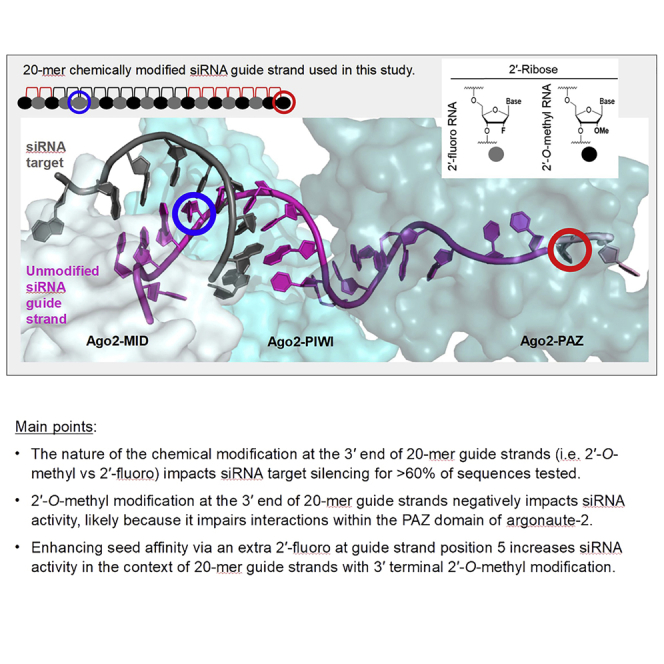
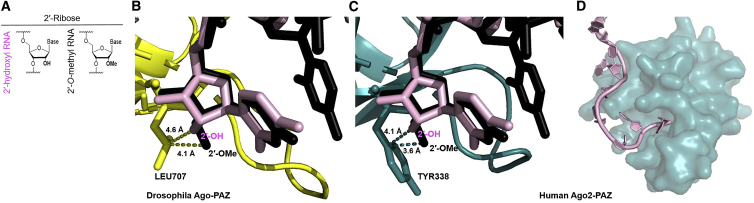
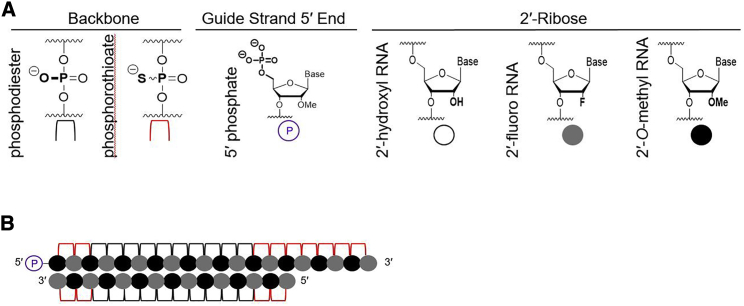
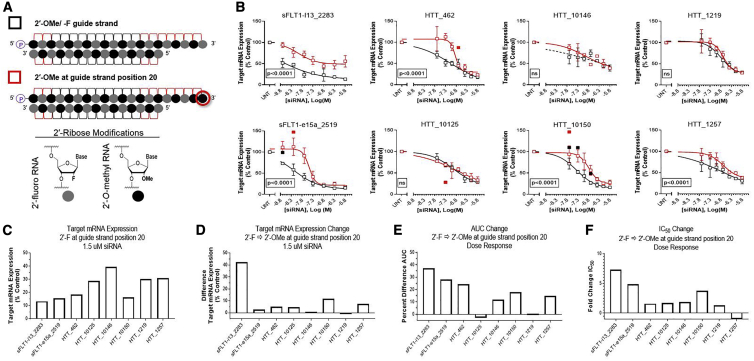
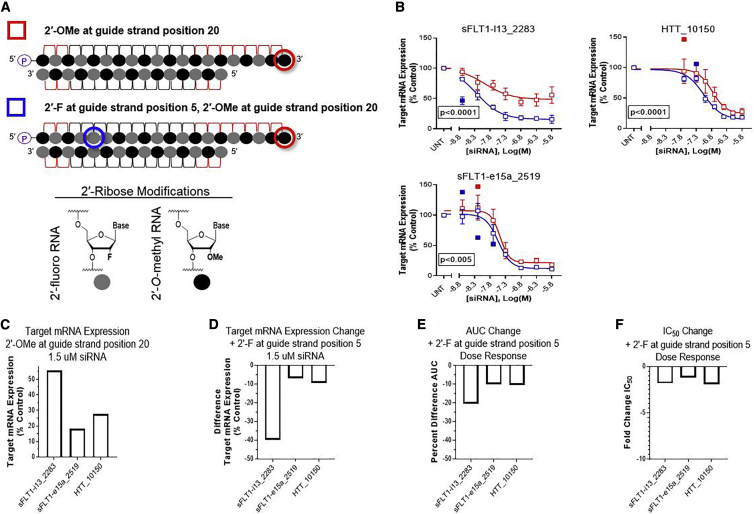
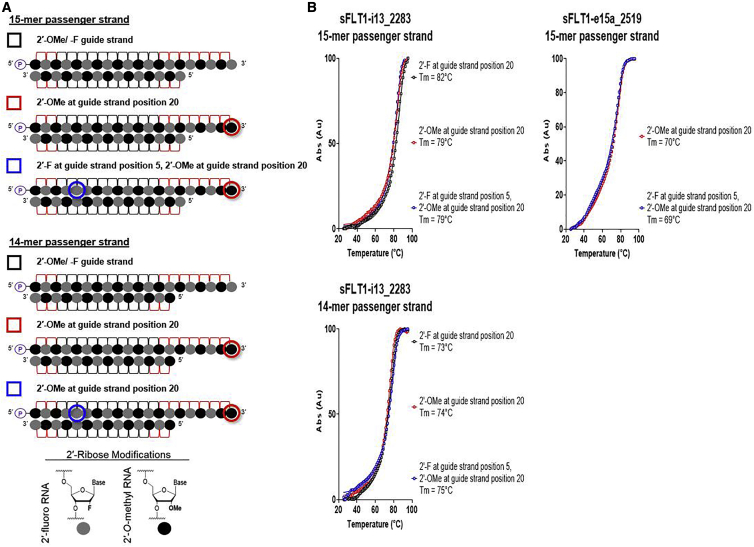
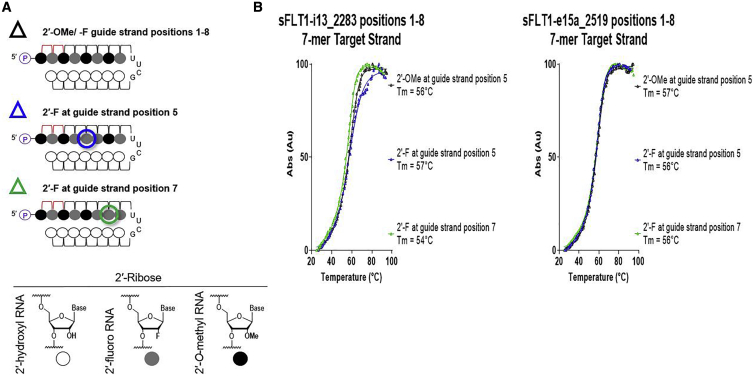
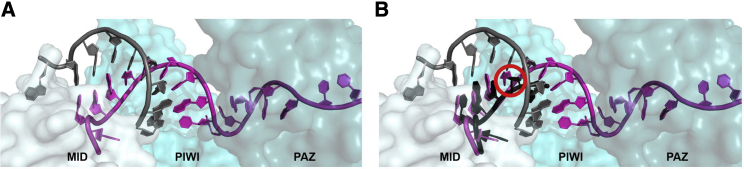
Small interfering RNAs (siRNAs) have the potential to treat a broad range of diseases. siRNAs need to be extensively chemically modified to improve their bioavailability, safety, and stability in vivo. However, chemical modifications variably impact target silencing for different siRNA sequences, making the activity of chemically modified siRNA difficult to predict. Here, we systematically evaluated the impact of 3' terminal modifications (2'-O-methyl versus 2'-fluoro) on guide strands of different length and showed that 3' terminal 2'-O-methyl modification negatively impacts activity for >60% of siRNA sequences tested but only in the context of 20- and not 19- or 21-nt-long guide strands. These results indicate that sequence, modification pattern, and structure may cooperatively affect target silencing. Interestingly, the introduction of an extra 2'-fluoro modification in the seed region at guide strand position 5, but not 7, may partially compensate for the negative impact of 3' terminal 2'-O-methyl modification. Molecular modeling analysis suggests that 2'-O-methyl modification may impair guide strand interactions within the PAZ domain of argonaute-2, which may affect target recognition and cleavage, specifically when guide strands are 20-nt long. Our findings emphasize the complex nature of modified RNA-protein interactions and contribute to design principles for chemically modified siRNAs.
小分子干扰RNA(siRNA)有潜力治疗多种疾病。siRNA需要进行广泛的化学修饰,以提高其在体内的生物利用度、安全性和稳定性。然而,化学修饰对不同siRNA序列的靶标沉默有不同程度的影响,使得化学修饰的siRNA的活性难以预测。在此,我们系统地评估了3'末端修饰(2'-O-甲基与2'-氟)对不同长度引导链的影响,结果表明,对于超过60%的测试siRNA序列,3'末端2'-O-甲基修饰会对活性产生负面影响,但仅在20 nt长的引导链情况下如此,19 nt或21 nt长的引导链则不然。这些结果表明,序列、修饰模式和结构可能协同影响靶标沉默。有趣的是,在引导链第5位而非第7位的种子区域引入额外的2'-氟修饰,可能会部分补偿3'末端2'-O-甲基修饰的负面影响。分子模拟分析表明,2'-O-甲基修饰可能会损害AGO2的PAZ结构域内引导链的相互作用,这可能会影响靶标识别和切割,特别是当引导链为20 nt长时。我们的研究结果强调了修饰的RNA-蛋白质相互作用的复杂性,并为化学修饰的siRNA的设计原则做出了贡献。