Vogt Lea, Sellmann Timur, Wetzchewald Dietmar, Schwager Heidrun, Russo Sebastian, Marsch Stephan
Department of Anaesthesiology, Bethesda Hospital, 47053 Duisburg, Germany.
Department of Anaesthesiology 1, Witten/Herdecke University, 58455 Witten, Germany.
J Clin Med. 2020 Jun 29;9(7):2045. doi: 10.3390/jcm9072045.
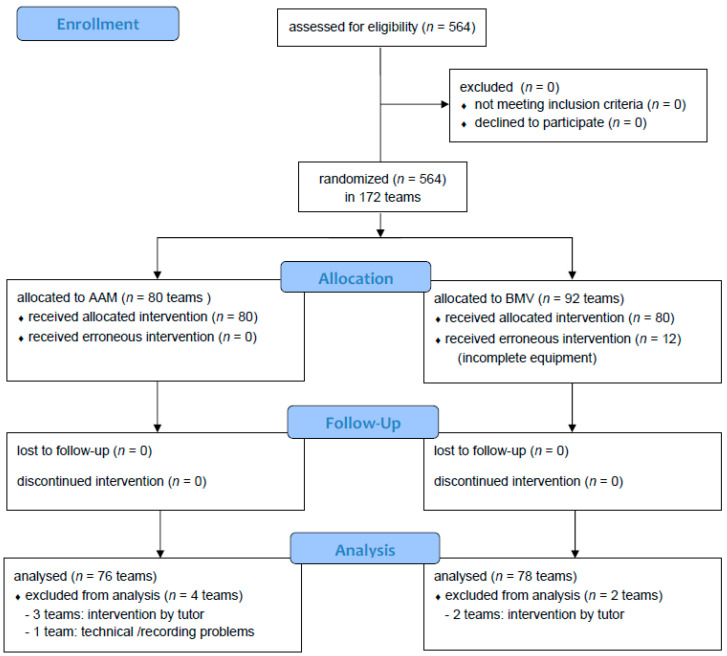
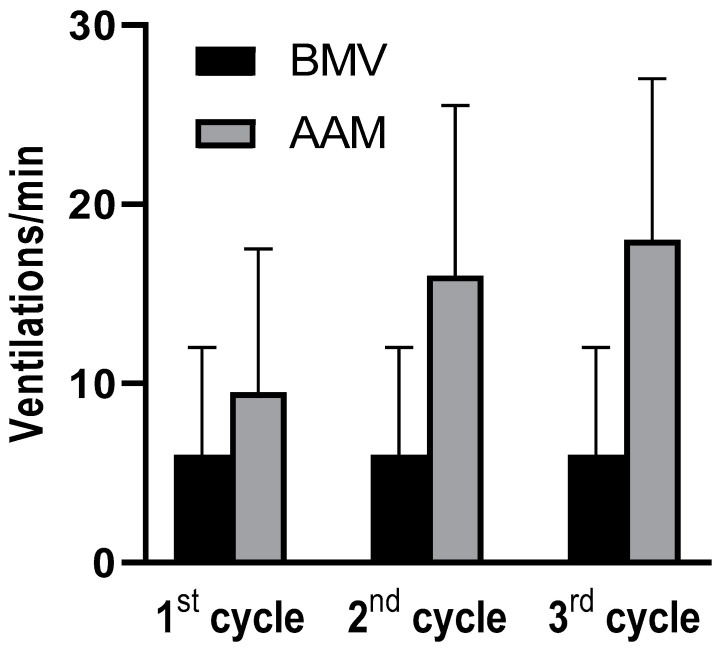
The role of advanced airway management (AAM) in cardiopulmonary resuscitation (CPR) is currently debated as observational studies reported better outcomes after bag-mask ventilation (BMV), and the only prospective randomized trial was inconclusive. Adherence to CPR guidelines ventilation recommendations is unknown and difficult to assess in clinical trials. This study compared AAM and BMV with regard to adherence to ventilation recommendations and chest compression fractions in simulated cardiac arrests. A total of 154 teams of 3-4 physicians were randomized to perform CPR with resuscitation equipment restricting airway management to BMV only or equipment allowing for all forms of AAM. BMV teams ventilated 6 ± 6/min and AAM teams 19 ± 8/min (range 3-42/min; < 0.0001 vs. BMV). 68/78 BMV teams and 23/71 AAM teams adhered to the ventilation recommendations ( < 0.0001). BMV teams had lower compression fractions than AAM teams (78 ± 7% vs. 86 ± 6%, < 0.0001) resulting entirely from higher no-flow times for ventilation (9 ± 4% vs. 3 ± 3 %; < 0.0001). Compared to BMV, AAM leads to significant hyperventilation and lower adherence to ventilation recommendations but favourable compression fractions. The cumulative effect of deviations from ventilation recommendations has the potential to blur findings in clinical trials.
高级气道管理(AAM)在心肺复苏(CPR)中的作用目前存在争议,因为观察性研究报告称面罩通气(BMV)后预后更好,而唯一的前瞻性随机试验尚无定论。在临床试验中,对CPR指南通气建议的遵循情况未知且难以评估。本研究比较了AAM和BMV在模拟心脏骤停中对通气建议的遵循情况和胸外按压比例。总共154个由3至4名医生组成的团队被随机分组,使用仅将气道管理限制为BMV的复苏设备或允许所有形式AAM的设备进行CPR。BMV组每分钟通气6±6次,AAM组每分钟通气19±8次(范围3 - 42次/分钟;与BMV相比,P<0.0001)。68/78个BMV组和23/71个AAM组遵循通气建议(P<0.0001)。BMV组的按压比例低于AAM组(78±7%对86±6%,P<0.0001),这完全是由于通气的无血流时间更长(9±4%对3±3%;P<0.0001)。与BMV相比,AAM会导致明显的通气过度和对通气建议的较低遵循率,但胸外按压比例良好。偏离通气建议的累积效应有可能模糊临床试验的结果。