Chen Feiyu, Zhong Zhangfeng, Tan Hor-Yue, Wang Ning, Feng Yibin
School of Chinese Medicine, Li Ka Shing Faculty of Medicine, The University of Hong Kong, Hong Kong, China.
Cancers (Basel). 2020 Jun 29;12(7):1734. doi: 10.3390/cancers12071734.
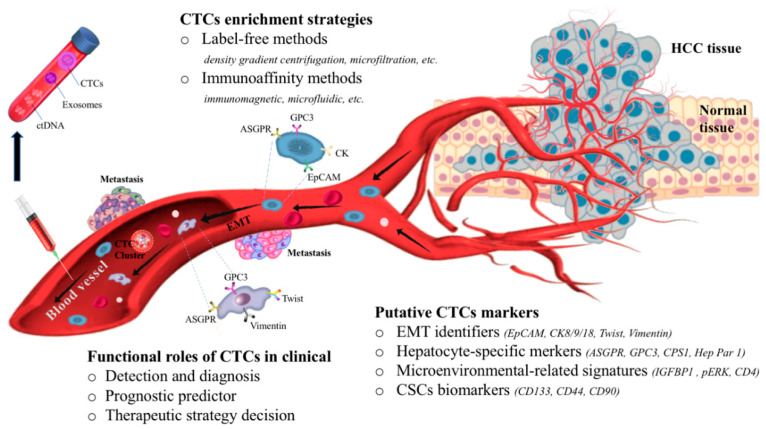
Hepatocellular carcinoma (HCC) is ranked as the sixth most common cancer around the world. With the emergence of the state-of-the-art modalities lately, such as liver transplantation, image-guided ablation, and chemoembolization, the death rate is still high due to high metastasis rate after therapy. Observation by biannual ultrasonography allows effective diagnosis at an early stage for candidates with no extrahepatic metastasis, but its effectiveness still remains unsatisfactory. Developing a new test with improved effectiveness and specificity is urgently needed for HCC diagnosis, especially for patients after first line therapy. Circulating tumor cells (CTCs) are a small sub-population of tumor cells in human peripheral blood, they release from the primary tumor and invade into the blood circulatory system, thereby residing into the distal tissues and survive. As CTCs have specific and aggressive properties, they can evade from immune defenses, induce gene alterations, and modulate signal transductions. Ultimately, CTCs can manipulate tumor behaviors and patient reactions to anti-tumor treatment. Given the fact that in HCC blood is present around the immediate vicinity of the tumor, which allows thousands of CTCs to release into the blood circulation daily, so CTCs are considered to be the main cause for HCC occurrence, and are also a pivotal factor for HCC prognosis. In this review, we highlight the characteristics and enrichment strategies of CTCs, and focus on the use of CTCs for tumor evaluation and management in patients with HCC.
肝细胞癌(HCC)是全球第六大常见癌症。尽管近来出现了诸如肝移植、图像引导消融和化疗栓塞等先进治疗方式,但由于治疗后转移率高,死亡率仍然很高。对于无肝外转移的患者,每半年进行一次超声检查有助于早期有效诊断,但其有效性仍不尽人意。迫切需要开发一种有效性和特异性更高的新检测方法用于HCC诊断,尤其是用于一线治疗后的患者。循环肿瘤细胞(CTC)是人类外周血中一小部分肿瘤细胞,它们从原发肿瘤脱落并侵入血液循环系统,进而在远端组织中存活。由于CTC具有特异性和侵袭性,它们能够逃避免疫防御、诱导基因改变并调节信号转导。最终,CTC可操控肿瘤行为以及患者对抗肿瘤治疗的反应。鉴于在HCC中肿瘤周围存在血液,这使得每天有成千上万的CTC释放到血液循环中,因此CTC被认为是HCC发生的主要原因,也是HCC预后的关键因素。在本综述中,我们重点介绍了CTC的特征和富集策略,并着重阐述了CTC在HCC患者肿瘤评估和管理中的应用。