Scottish Centre for Respiratory Research, University of Dundee, Ninewells Hospital and Medical School, Dundee, DD1 9SY, UK.
Epidemiology, Value Evidence and Outcomes, GSK R&D, Collegeville, PA, USA.
Respir Res. 2020 Jul 1;21(1):166. doi: 10.1186/s12931-020-01436-7.
Identifying patients with COPD at increased risk of poor outcomes is challenging due to disease heterogeneity. Potential biomarkers need to be readily available in real-life clinical practice. Blood eosinophil counts are widely studied but few studies have examined the prognostic value of blood neutrophil counts (BNC).
In a large population-based COPD registry in the East of Scotland (TARDIS: Tayside Allergic and Respiratory Disease Information System), BNC were compared to measures of disease severity and mortality for up to 15 years follow-up. Potential mechanisms of disease modification by BNC were explored in a nested microbiome substudy.
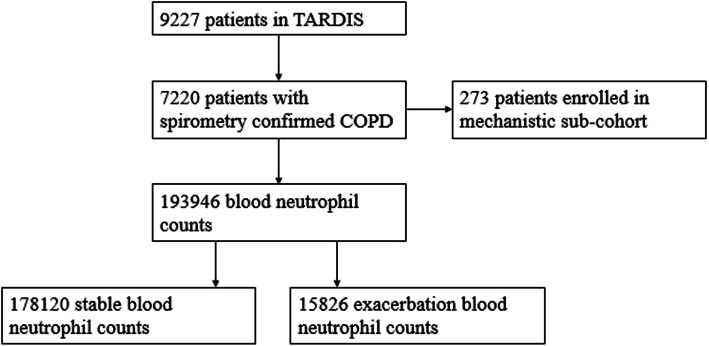
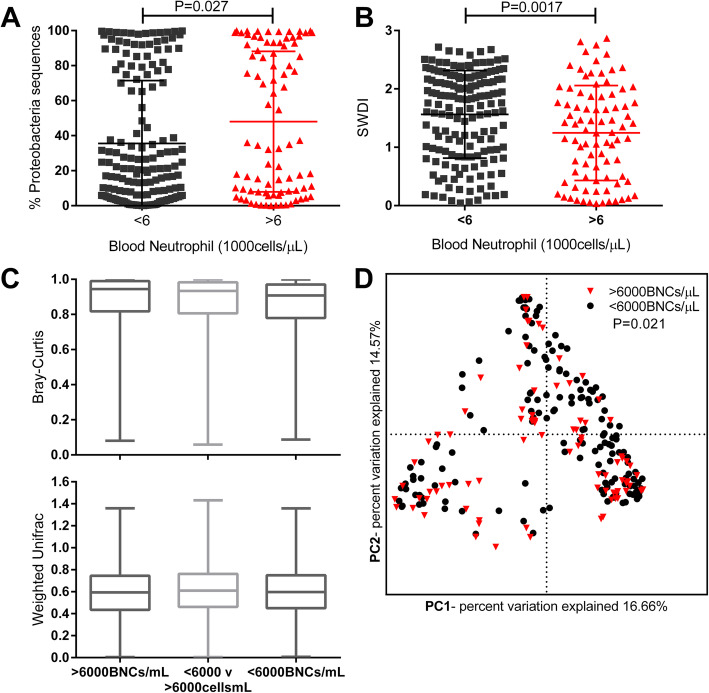
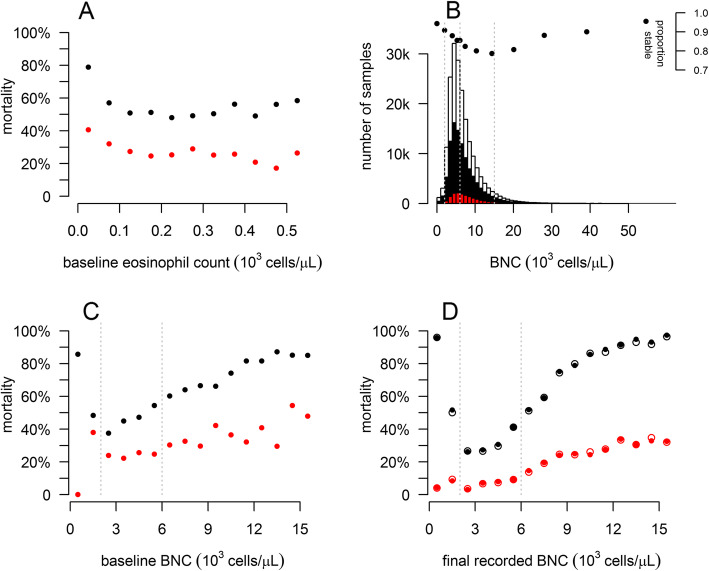
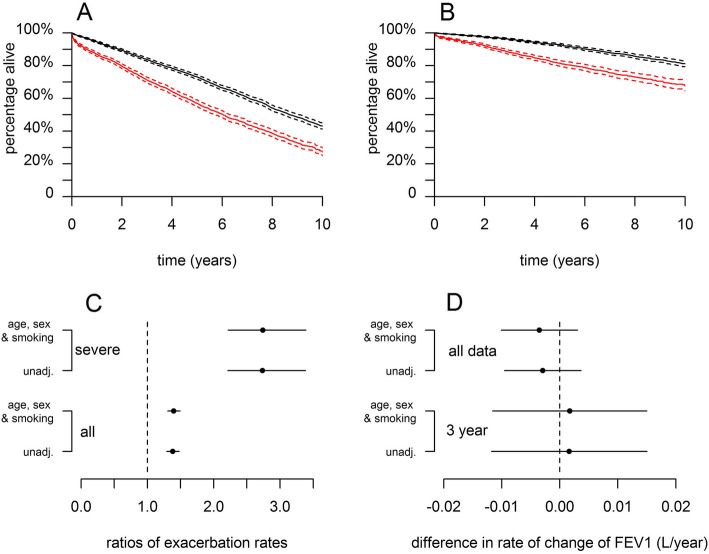
178,120 neutrophil counts were obtained from 7220 people (mean follow up 9 years) during stable disease periods. Median BNC was 5200cells/μL (IQR 4000-7000cells/μL). Mortality rates among the 34% of patients with elevated BNCs (defined as 6000-15000cells/μL) at the study start were 80% higher (14.0/100 person years v 7.8/100py, P < 0.001) than those with BNC in the normal range (2000-6000cells/μL). People with elevated BNC were more likely to be classified as GOLD D (46% v 33% P < 0.001), have more exacerbations (mean 2.3 v 1.3/year, P < 0.001), and were more likely to have severe exacerbations (13% vs. 5%, P < 0.001) in the following year. Eosinophil counts were much less predictive of these outcomes. In a sub-cohort (N = 276), patients with elevated BNC had increased relative abundance of Proteobacteria and reduced microbiome diversity.
High BNC may provide a useful indicator of risk of exacerbations and mortality in COPD patients.
由于 COPD 疾病异质性,识别预后不良风险较高的患者具有挑战性。潜在的生物标志物需要在实际临床实践中易于获得。血液嗜酸性粒细胞计数已广泛研究,但很少有研究检查血液中性粒细胞计数(BNC)的预后价值。
在苏格兰东部的一个大型基于人群的 COPD 注册中心(TARDIS:泰赛德过敏和呼吸道疾病信息系统)中,在长达 15 年的随访期间,将 BNC 与疾病严重程度和死亡率的测量值进行了比较。在一项嵌套的微生物组子研究中,探索了 BNC 对疾病修饰的潜在机制。
在稳定期,从 7220 人(平均随访 9 年)中获得了 178120 个中性粒细胞计数。中位 BNC 为 5200 个/μL(IQR 4000-7000 个/μL)。在研究开始时 BNC 升高(定义为 6000-15000 个/μL)的 34%患者中,死亡率(14.0/100 人年)比 BNC 正常范围(2000-6000 个/μL)的患者高 80%(7.8/100py,P<0.001)。BNC 升高的患者更有可能被归类为 GOLD D(46%比 33%,P<0.001),更频繁发生加重(平均每年 2.3 次比 1.3 次/年,P<0.001),并且在接下来的一年中更有可能发生严重加重(13%比 5%,P<0.001)。嗜酸性粒细胞计数对这些结果的预测性要差得多。在一个子队列(N=276)中,BNC 升高的患者中变形菌门的相对丰度增加,微生物组多样性降低。
高 BNC 可能为 COPD 患者的加重和死亡率风险提供有用的指标。