Chen Jiarui, Liu Xingyu, Zeng Zihang, Li Jiali, Luo Yuan, Sun Wenjie, Gong Yan, Zhang Junhong, Wu Qiuji, Xie Conghua
Department of Radiation and Medical Oncology, Zhongnan Hospital of Wuhan University, Wuhan, China.
Department of Biological Repositories, Zhongnan Hospital of Wuhan University, Wuhan, China.
Front Oncol. 2020 Jun 16;10:874. doi: 10.3389/fonc.2020.00874. eCollection 2020.
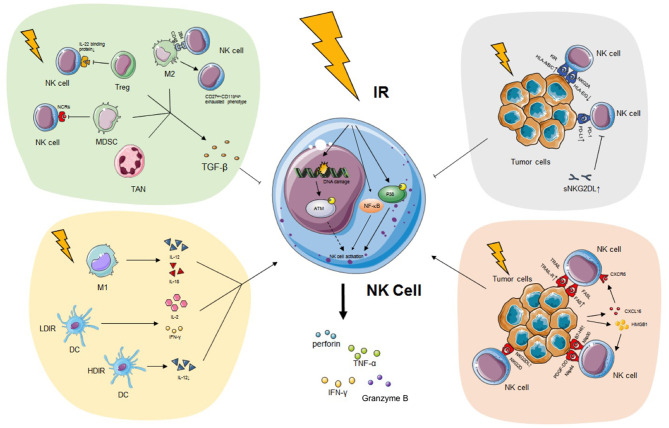
Natural killer (NK) cells play a critical role in the antitumor immunity. Ionizing radiation (IR) has a pronounced effect on modifying NK cell biology, while the molecular mechanisms remain elusive. In this review, we briefly introduce the anti-tumor activity of NK cells and summarize the impact of IR on NK cells both directly and indirectly. On one hand, low-dose ionizing radiation (LDIR) activates NK functions while high-dose ionizing radiation (HDIR) is likely to partially impair NK functions, which can be reversed by interleukin (IL)-2 pretreatment. On the other hand, NK functions may be adjusted by other immune cells and the alternated malignant cell immunogenicity under the settings of IR. Various immune cells, such as the tumor-associated macrophage (TAM), dendritic cell (DC), regulatory T cell (Treg), myeloid-derived suppressor cell (MDSC), and tumor exhibited ligands, such as the natural killer group 2 member D ligand (NKG2DL), natural cytotoxicity receptors (NCR) ligand, TNF-related apoptosis-inducing ligand-receptor (TRAIL-R), and FAS, have been involved in this process. Better understanding the molecular basis is a promising way in which to augment NK-cell-based antitumor immunity in combination with IR.
自然杀伤(NK)细胞在抗肿瘤免疫中发挥着关键作用。电离辐射(IR)对NK细胞生物学特性的改变具有显著影响,但其分子机制仍不清楚。在本综述中,我们简要介绍了NK细胞的抗肿瘤活性,并总结了IR对NK细胞的直接和间接影响。一方面,低剂量电离辐射(LDIR)可激活NK细胞功能,而高剂量电离辐射(HDIR)可能会部分损害NK细胞功能,白细胞介素(IL)-2预处理可使其逆转。另一方面,在IR环境下,NK细胞功能可能会受到其他免疫细胞以及恶性细胞免疫原性改变的调节。多种免疫细胞,如肿瘤相关巨噬细胞(TAM)、树突状细胞(DC)、调节性T细胞(Treg)、髓源性抑制细胞(MDSC),以及肿瘤表达的配体,如自然杀伤细胞2族成员D配体(NKG2DL)、自然细胞毒性受体(NCR)配体、肿瘤坏死因子相关凋亡诱导配体受体(TRAIL-R)和FAS,均参与了这一过程。更好地理解分子基础是结合IR增强基于NK细胞的抗肿瘤免疫的一种有前景的方法。