Academic Department of Pediatrics, Research Unit of Congenital and Perinatal Infection, Bambino Gesù Children's Hospital, 00165 Rome, Italy.
Department of Systems Medicine, University of Rome Tor Vergata, 00133 Rome, Italy.
Int J Mol Sci. 2019 Jul 30;20(15):3715. doi: 10.3390/ijms20153715.
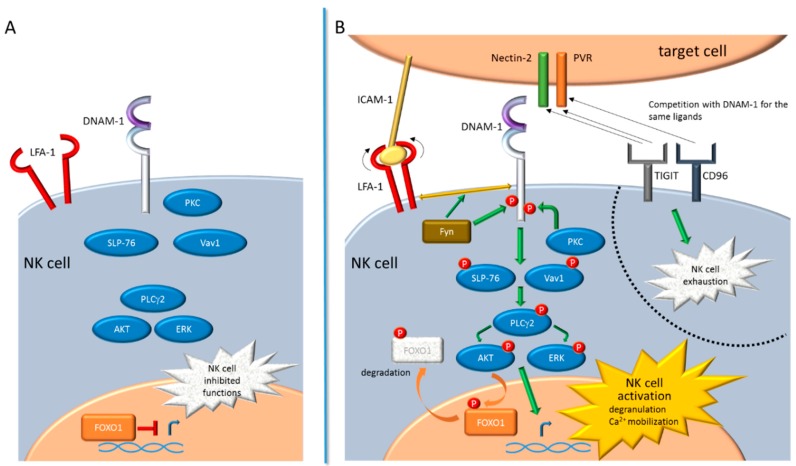
Natural Killer (NK) cells play a critical role in host defense against viral infections. The mechanisms of recognition and killing of virus-infected cells mediated by NK cells are still only partially defined. Several viruses induce, on the surface of target cells, the expression of molecules that are specifically recognized by NK cell-activating receptors. The main NK cell-activating receptors involved in the recognition and killing of virus-infected cells are NKG2D and DNAM-1. In particular, ligands for DNAM-1 are nectin/nectin-like molecules involved also in mechanisms allowing viral infection. Viruses adopt several immune evasion strategies, including those affecting NK cell-mediated immune surveillance, causing persistent viral infection and the development of virus-associated diseases. The virus's immune evasion efficacy depends on molecules differently expressed during the various phases of infection. In this review, we overview the molecular strategies adopted by viruses, specifically cytomegalovirus (CMV), human immunodeficiency virus (HIV-1), herpes virus (HSV), Epstein-Barr virus (EBV) and hepatitis C virus (HCV), aiming to evade NK cell-mediated surveillance, with a special focus on the modulation of DNAM-1 activating receptor and its ligands in various phases of the viral life cycle. The increasing understanding of mechanisms involved in the modulation of activating ligands, together with those mediating the viral immune evasion strategies, would provide critical tools leading to design novel NK cell-based immunotherapies aiming at viral infection control, thus improving cure strategies of virus-associated diseases.
自然杀伤 (NK) 细胞在宿主防御病毒感染中发挥着关键作用。NK 细胞识别和杀伤病毒感染细胞的机制仍部分定义。几种病毒在靶细胞表面诱导特定识别 NK 细胞激活受体的分子表达。参与识别和杀伤病毒感染细胞的主要 NK 细胞激活受体是 NKG2D 和 DNAM-1。特别是,DNAM-1 的配体是参与允许病毒感染的机制的连接蛋白/连接蛋白样分子。病毒采用多种免疫逃避策略,包括影响 NK 细胞介导的免疫监视的策略,导致持续的病毒感染和病毒相关疾病的发展。病毒的免疫逃避效率取决于在感染的各个阶段不同表达的分子。在这篇综述中,我们概述了病毒(特别是巨细胞病毒 (CMV)、人类免疫缺陷病毒 (HIV-1)、疱疹病毒 (HSV)、爱泼斯坦-巴尔病毒 (EBV) 和丙型肝炎病毒 (HCV))采用的分子策略,旨在逃避 NK 细胞介导的监视,特别关注 DNAM-1 激活受体及其在病毒生命周期的各个阶段的配体的调节。对调节激活配体以及介导病毒免疫逃避策略的机制的深入了解,将为设计新型基于 NK 细胞的免疫疗法提供关键工具,旨在控制病毒感染,从而改善病毒相关疾病的治疗策略。