Department of Clinical Chemistry, Erasmus MC, University Medical Center Rotterdam , Rotterdam, The Netherlands.
Department of Clinical Chemistry, Amsterdam Gastroenterology and Metabolism, Amsterdam UMC, Vrije Universiteit Amsterdam , Amsterdam, The Netherlands.
Epigenetics. 2021 Jan;16(1):45-53. doi: 10.1080/15592294.2020.1786318. Epub 2020 Jul 2.
Epigenetic markers are often quantified and related to disease in stored samples. While, effects of storage on stability of these markers have not been thoroughly examined. In this longitudinal study, we investigated the influence of storage time, material, temperature, and freeze-thaw cycles on stability of global DNA (hydroxy)methylation.
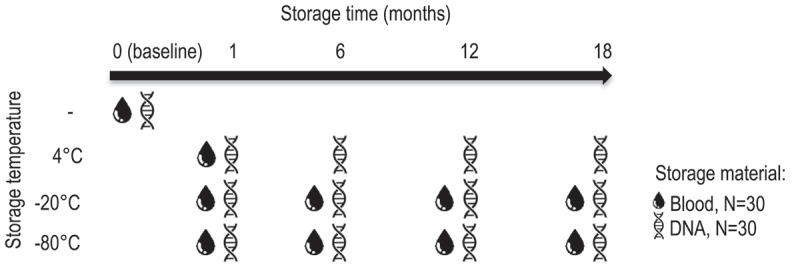
EDTA blood was collected from 90 individuals. Blood (n = 30, group 1) and extracted DNA (n = 30, group 2) were stored at 4°C, -20°C and -80°C for 0, 1 (endpoint blood 4°C), 6, 12 or 18 months. Additionally, freeze-thaw cycles of blood and DNA samples (n = 30, group 3) were performed over three days. Global DNA methylation and hydroxymethylation (mean ± SD) were quantified using liquid chromatography-electrospray ionization-tandem mass spectrometry (LC-ESI-MS/MS) with between-run precision of 2.8% (methylation) and 6.3% (hydroxymethylation). Effects on stability were assessed using linear mixed models.
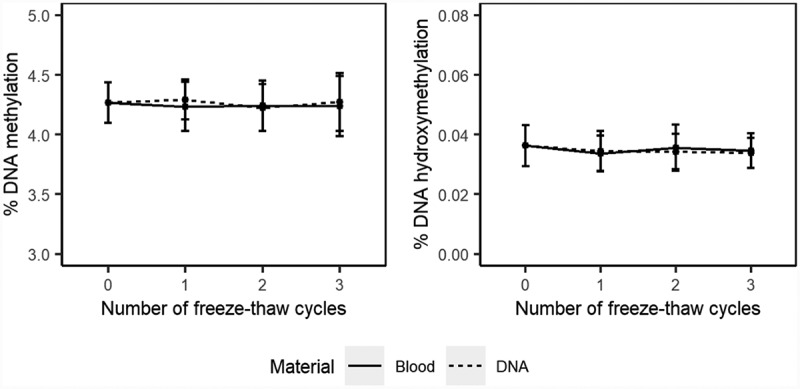
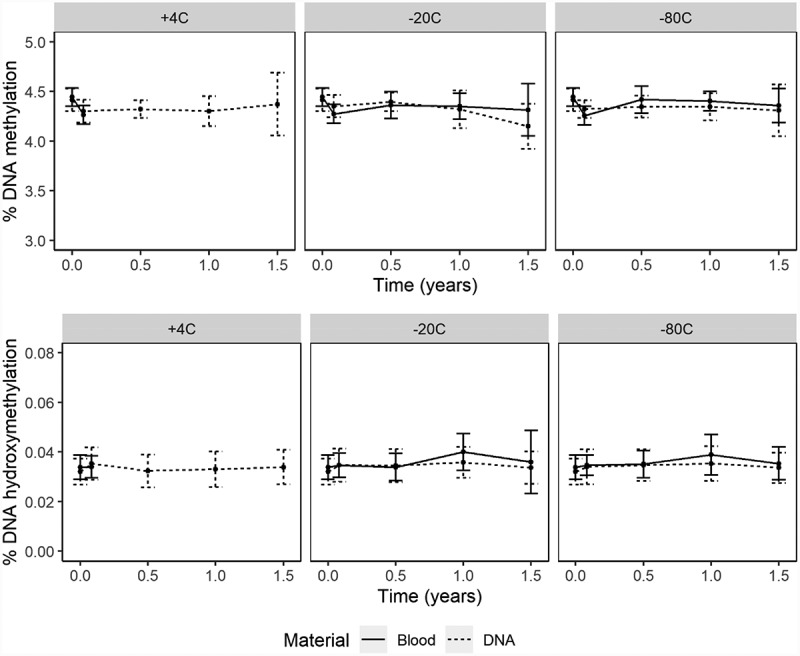
global DNA methylation was stable over 18 months in blood at -20°C and -80°C and DNA at 4°C and -80°C. However, at 18 months DNA methylation from DNA stored at -20°C relatively decreased -6.1% compared to baseline. Global DNA hydroxymethylation was more stable in DNA samples compared to blood, independent of temperature (p = 0.0131). Stability of global DNA methylation and hydroxymethylation was not affected up to three freeze - thaw cycles.
Global DNA methylation and hydroxymethylation stored as blood and DNA can be used for epigenetic studies. The relevance of small differences occuring during storage depend on the expected effect size and research question.
表观遗传标记通常在储存样本中进行定量,并与疾病相关。然而,储存对这些标记稳定性的影响尚未得到彻底研究。在这项纵向研究中,我们研究了储存时间、材料、温度和冻融循环对全基因组 DNA(羟)甲基化稳定性的影响。
从 90 名个体中采集 EDTA 血液。血液(n=30,第 1 组)和提取的 DNA(n=30,第 2 组)分别在 4°C、-20°C 和-80°C 下储存 0、1(终点血液 4°C)、6、12 或 18 个月。此外,血液和 DNA 样本(n=30,第 3 组)在三天内进行了冻融循环。使用液相色谱-电喷雾串联质谱(LC-ESI-MS/MS)定量测量全基因组甲基化和羟甲基化(平均值±标准差),批内精密度为 2.8%(甲基化)和 6.3%(羟甲基化)。使用线性混合模型评估稳定性的影响。
在-20°C 和-80°C 下储存的血液以及在 4°C 和-80°C 下储存的 DNA 中,全基因组甲基化在 18 个月内保持稳定。然而,与基线相比,在 18 个月时,-20°C 下储存的 DNA 甲基化相对减少了 6.1%。与血液相比,全基因组羟甲基化在 DNA 样本中更为稳定,与温度无关(p=0.0131)。全基因组甲基化和羟甲基化的稳定性在三个冻融循环内不受影响。
以血液和 DNA 形式储存的全基因组甲基化和羟甲基化可用于表观遗传学研究。在储存过程中发生的小差异的相关性取决于预期的效应大小和研究问题。