Department of Internal Medicine, School of Medicine, Kyungpook National University, Kyungpook National University Hospital, Daegu, South Korea.
Department of Internal Medicine, Pohang St. Mary's Hospital, Pohang, South Korea.
PLoS One. 2020 Jul 2;15(7):e0235418. doi: 10.1371/journal.pone.0235418. eCollection 2020.
Little is known regarding optimal tacrolimus (TAC) trough levels after 1 year post-transplant in stable kidney transplant recipients (KTRs) who have not experienced renal or cardiovascular outcomes. This study aimed to investigate the effect of 1-year post-transplant TAC trough levels on long-term renal and cardiovascular outcomes and opportunistic infections in stable KTRs.
KTRs receiving TAC with mycophenolate-based immunosuppression who did not experience renal or cardiovascular outcomes within 1 year post-transplant were enrolled from a multicenter observational cohort study. Renal outcome was defined as a composite of biopsy-proven acute rejection, interstitial fibrosis and tubular atrophy, and death-censored graft loss. Cardiovascular outcome was defined as a composite of de novo cardiomegaly, left ventricular hypertrophy, and cardiovascular events. Opportunistic infections were defined as the occurrence of BK virus or cytomegalovirus infections.
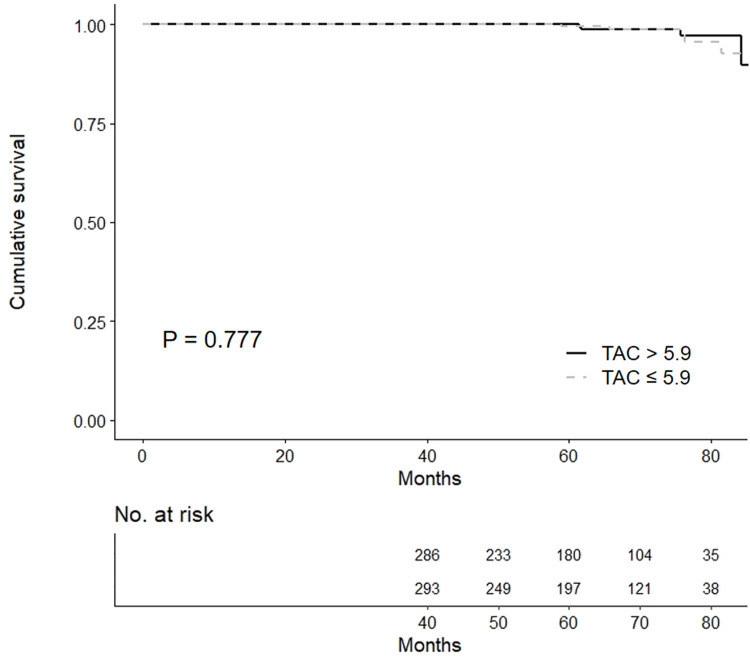
A total of 603 eligible KTRs were divided into the low-level TAC (LL-TAC) and high-level TAC (HL-TAC) groups based on a median TAC level of 5.9 ng/mL (range 1.3-14.3) at 1 year post-transplant. The HL-TAC group had significantly higher TAC trough levels at 2, 3, 4, and 5 years compared with the levels of the LL-TAC group. During the mean follow-up of 63.7 ± 13.0 months, there were 121 renal outcomes and 224 cardiovascular outcomes. In multivariate Cox regression analysis, LL-TAC and HL-TAC were not independent risk factors for renal and cardiovascular outcomes, respectively. No significant differences in the development of opportunistic infections and de novo donor-specific anti-human leukocyte antigen antibodies and renal allograft function were observed between the two groups.
TAC trough levels after 1 year post-transplant remained at a similar level until the fifth year after kidney transplantation and were not directly associated with long-term outcomes in stable Korean KTRs who did not experience renal or cardiovascular outcomes. Therefore, in Asian KTRs with a stable clinical course, TAC trough levels higher than approximately 6 ng/mL might not be required after a year of kidney transplantation.
对于在移植后 1 年内未发生肾脏或心血管结局的稳定肾移植受者(KTR),我们对于他 们在移植后 1 年时的最佳他克莫司(TAC)谷浓度知之甚少。本研究旨在探讨稳定 KTR 在移植后 1 年时的 TAC 谷浓度对长期肾脏和心血管结局及机会性感染的影响。
我们从一项多中心观察性队列研究中纳入了在移植后 1 年内未发生肾脏或心血管结局且接受霉酚酸为基础的免疫抑制方案治疗的 KTR,这些患者接受 TAC 治疗。肾脏结局定义为经活检证实的急性排斥反应、间质纤维化和肾小管萎缩以及受者死亡相关的移植物丢失的复合终点。心血管结局定义为新发心肌肿大、左心室肥厚和心血管事件的复合终点。机会性感染定义为 BK 病毒或巨细胞病毒感染的发生。
共有 603 例符合条件的 KTR 根据移植后 1 年时 TAC 中位数(5.9ng/ml,范围 1.3-14.3)分为低水平 TAC(LL-TAC)和高水平 TAC(HL-TAC)组。与 LL-TAC 组相比,HL-TAC 组在 2、3、4 和 5 年时的 TAC 谷浓度显著更高。在平均 63.7±13.0 个月的随访期间,发生了 121 例肾脏结局和 224 例心血管结局。多变量 Cox 回归分析显示,LL-TAC 和 HL-TAC 均不是肾脏和心血管结局的独立危险因素。两组之间在机会性感染的发生、新出现的供者特异性抗人类白细胞抗原抗体以及肾移植功能方面无显著差异。
移植后 1 年时的 TAC 谷浓度在第五年时仍保持在相似水平,且与未发生肾脏或心血管结局的稳定韩国 KTR 的长期结局无直接关系。因此,在亚洲稳定临床病程的 KTR 中,在移植后 1 年时 TAC 谷浓度高于约 6ng/ml 可能并非必需。