Internal medicine department, Tabriz University of Medical Sciences, Tabriz, Iran.
Connective Tissue Diseases Research Center, Tabriz University of Medical Sciences, Tabriz, Iran.
BMC Infect Dis. 2020 Jul 2;20(1):464. doi: 10.1186/s12879-020-05166-5.
Despite successful clinical outcomes of biologic medications in patients with chronic rheumatic diseases, some considerable adverse effects such as infections remain a major concern. Possibility of tuberculosis (TB) reactivation over treatment with anti-tumor necrotizing factor (TNF) alpha agents has necessitated a screening test before initiation of treatment. However, screening over the course of treatment is not recommended in those patients with negative baseline screening tests. This study aimed to evaluate the efficacy of tuberculin skin test (TST) before treatment in patients with chronic rheumatologic diseases who were indicated to receive anti-TNF-alpha therapy and the necessity of repeating this test over the course of treatment.
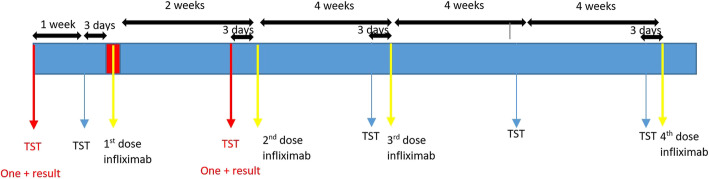
In this prospective study, patients with chronic rheumatologic diseases receiving anti-TNF-alpha agents were studied in a two-year period. TST was performed before treatment and those with positive results were excluded from the study. Thereafter, treatment with anti-TNF-alpha agents was initiated with the indicated dose. TST was repeated before administration of biologic treatment until TST became positive or 16 weeks after the initiation of treatment with anti-TNF-alpha.
A total of 51 cases were studied, of whom one patient (1.9%) was excluded due to positive TST before treatment. All participants received infliximab and the TST test became positive in one patient (2%) 2 weeks after receiving the first dose. Also, the results of further tests at weeks 6, 10, and 14 were all negative for the remaining patients.
Due to the possibility of TST conversion after administration of anti-TNF-alpha therapy, it is important to consider TB monitoring in patients under treatment with these agents using available methods such as TST.
尽管生物药物在慢性风湿性疾病患者中的临床疗效显著,但一些严重的不良反应,如感染,仍是一个主要关注点。在使用抗肿瘤坏死因子(TNF)α 药物治疗之前,需要进行结核(TB)再激活的筛查试验,这是由于治疗过程中存在 TB 再激活的可能性。然而,对于基线筛查试验为阴性的患者,不建议在治疗过程中进行筛查。本研究旨在评估在接受抗 TNF-α 治疗的慢性风湿性疾病患者中,在治疗前进行结核菌素皮肤试验(TST)的疗效,以及在治疗过程中重复该试验的必要性。
在这项前瞻性研究中,对两年内接受抗 TNF-α 药物治疗的慢性风湿性疾病患者进行了研究。在治疗前进行 TST,对结果阳性的患者排除在研究之外。此后,根据指示剂量开始使用抗 TNF-α 药物治疗。在开始使用生物制剂治疗前重复 TST,直至 TST 阳性或在开始抗 TNF-α 治疗后 16 周。
共研究了 51 例患者,其中 1 例(1.9%)因治疗前 TST 阳性而被排除。所有患者均接受英夫利昔单抗治疗,其中 1 例(2%)患者在接受首剂后 2 周 TST 阳性。此外,其余患者在第 6、10 和 14 周的进一步检测结果均为阴性。
由于在使用抗 TNF-α 治疗后 TST 可能发生转化,因此在使用这些药物治疗的患者中,需要考虑使用 TST 等现有方法监测 TB。