Institute of Evolutionary Ecology and Conservation Genomics, Ulm University, 89069, Ulm, Germany.
Smithsonian Tropical Research Institute, Balboa, Ancón, Republic of Panama.
Heredity (Edinb). 2020 Oct;125(4):184-199. doi: 10.1038/s41437-020-0331-y. Epub 2020 Jul 2.
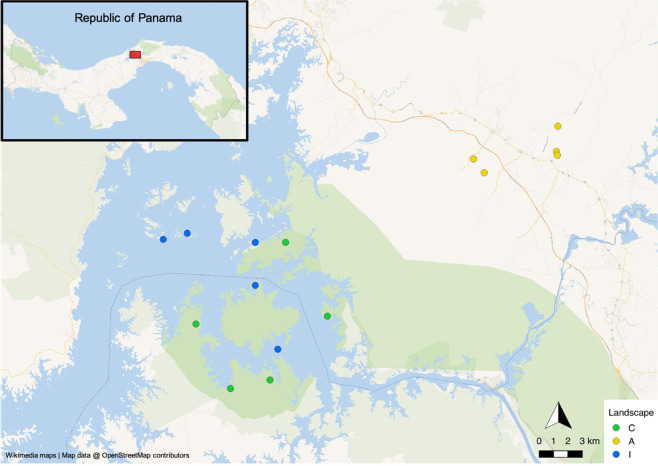
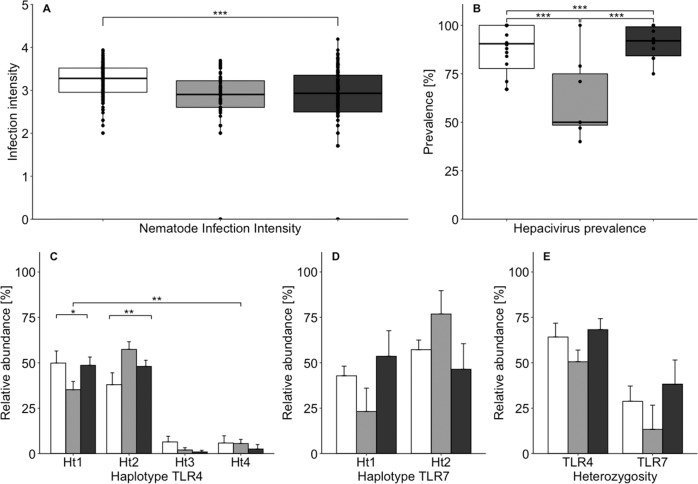
Toll-like receptors (TLRs) form part of the innate immune system and can recognize structurally conserved pathogen-associated molecular pattern (PAMP) molecules. Their functional importance in the resistance to pathogens has been documented in laboratory experimental settings and in humans. TLR diversity, however, has been rarely investigated in wildlife species. How the genetic diversity of TLRs is associated with various pathogens and how it is shaped by habitat disturbance are understudied. Therefore, we investigated the role of genetic diversity in the functionally important parts of TLR4 and TLR7 genes in resistance towards gastrointestinal nematodes and Hepacivirus infection. We chose a generalist study species, the rodent Proechimys semispinosus, because it is highly abundant in three Panamanian landscapes that differ in their degree of anthropogenic modification. We detected only two TLR7 haplotypes that differed by one synonymous single-nucleotide polymorphism (SNP) position. The TLR4 variability was higher, and we detected four TLR4 haplotypes that differed at one synonymous SNP and at three amino acid positions within the leucine-rich repeat region. Only TLR4 haplotypes had different frequencies in each landscape. Using generalized linear models, we found evidence that nematode loads and virus prevalence were influenced by both specific TLR4 haplotypes and landscape. Here, the variable "landscape" served as a surrogate for the important influential ecological factors distinguishing landscapes in our study, i.e. species diversity and host population density. Individuals carrying the common TLR4_Ht1 haplotype were less intensely infected by the most abundant strongyle nematode. Individuals carrying the rare TLR4_Ht3 haplotype were all Hepacivirus-positive, where those carrying the rare haplotype TLR4_Ht4 were less often infected by Hepacivirus than individuals with other haplotypes. Our study highlights the role of TLR diversity in pathogen resistance and the importance of considering immune genetic as well as ecological factors in order to understand the effects of anthropogenic changes on wildlife health.
Toll 样受体 (TLRs) 构成固有免疫系统的一部分,可以识别结构上保守的病原体相关分子模式 (PAMP) 分子。它们在抵抗病原体方面的功能重要性已在实验室实验环境和人类中得到证实。然而,TLRs 的多样性在野生动物物种中很少被研究。TLRs 的遗传多样性如何与各种病原体相关,以及它如何受到栖息地干扰的影响,这些都是研究不足的。因此,我们研究了 TLR4 和 TLR7 基因功能重要部分的遗传多样性在抵抗胃肠道线虫和 Hepacivirus 感染中的作用。我们选择了一种多面手研究物种,即啮齿动物 Proechimys semispinosus,因为它在巴拿马的三个景观中非常丰富,这些景观在人为干扰程度上有所不同。我们只检测到两种 TLR7 单倍型,它们在一个同义单核苷酸多态性 (SNP) 位置上有所不同。TLR4 的变异性更高,我们检测到四个 TLR4 单倍型,它们在一个同义 SNP 和富含亮氨酸重复区的三个氨基酸位置上有所不同。只有 TLR4 单倍型在每个景观中具有不同的频率。使用广义线性模型,我们发现线虫负荷和病毒流行率受到特定 TLR4 单倍型和景观的影响。在这里,“景观”这个变量是我们研究中区分景观的重要生态因素的替代物,即物种多样性和宿主种群密度。携带常见 TLR4_Ht1 单倍型的个体受到最丰富的强线虫感染的程度较低。携带罕见 TLR4_Ht3 单倍型的个体均为 Hepacivirus 阳性,而携带罕见单倍型 TLR4_Ht4 的个体感染 Hepacivirus 的频率低于携带其他单倍型的个体。我们的研究强调了 TLR 多样性在病原体抗性中的作用,以及考虑免疫遗传和生态因素对于理解人为变化对野生动物健康的影响的重要性。