Estrázulas Jaisson Agne, Bueno Lauro Sinval, Lombardi Luana Rocha de Oliveira, Estrázulas Jansen Atier, Fernandes Tiótrefis Gomes, Baltar Juliana Albuquerque
Faculdade de Educação Física e Fisioterapia, Universidade Federal do Amazonas (UFAM), Manaus, Brasil.
Bacharel em Fisioterapia, Manaus (AM), Brasil.
Rev Bras Ortop (Sao Paulo). 2020 Jun;55(3):293-297. doi: 10.1055/s-0039-1700832. Epub 2020 Feb 27.
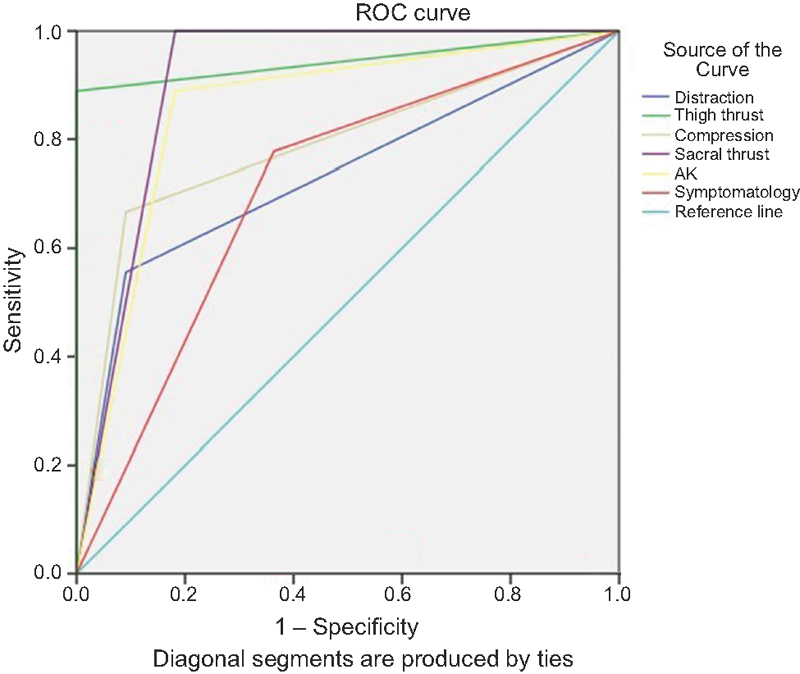
To investigate the accuracy of the applied kinesiology muscle strength test for sacroiliac dysfunction and compared it with four validated orthopedic tests. This is a cross-sectional accuracy survey developed at a private practice in the city of Manaus, Brazil, during February 2017. The sample consisted of 20 individuals, with a median age of 33.5 years. Four tests were applied: distraction, thigh thrust, compression and sacral thrust, and the diagnosis was confirmed when three of these tests were positive. Soon after, the applied kinesiology test was applied to the piriformis muscle. The prevalence of sacroiliac joint dysfunction was of 45%; the thigh thrust test had the highest specificity, and the sacral thrust test had the highest sensitivity. The applied kinesiology test presented good results (sensitivity: 0.89; specificity: 0.82; positive predictive value: 0.80; negative predictive value: 0.82; accuracy: 0.85; and area under the receiver operating characteristic [ROC] curve: 0.85). The applied kinesiology muscle strength test, which has great clinical feasibility, showed good accuracy in diagnosing sacroiliac joint dysfunction and greater discriminatory power for the existing dysfunction in comparison to other tests.
为研究应用运动机能学肌肉力量测试对骶髂关节功能障碍的准确性,并将其与四项经过验证的骨科测试进行比较。 这是一项于2017年2月在巴西马瑙斯市一家私人诊所开展的横断面准确性调查。样本包括20名个体,中位年龄为33.5岁。应用了四项测试:牵引、大腿推压、挤压和骶骨推压,当其中三项测试呈阳性时确诊。随后,对梨状肌进行了应用运动机能学测试。 骶髂关节功能障碍的患病率为45%;大腿推压测试具有最高的特异性,骶骨推压测试具有最高的敏感性。应用运动机能学测试结果良好(敏感性:0.89;特异性:0.82;阳性预测值:0.80;阴性预测值:0.82;准确性:0.85;受试者工作特征[ROC]曲线下面积:0.85)。 具有良好临床可行性的应用运动机能学肌肉力量测试,在诊断骶髂关节功能障碍方面显示出良好的准确性,并且与其他测试相比,对现有功能障碍具有更大的鉴别能力。