• 文献检索
  • 文档翻译
  • 深度研究
  • 学术资讯
  • Suppr Zotero 插件Zotero 插件
  • 邀请有礼
  • 套餐&价格
  • 历史记录
应用&插件
Suppr Zotero 插件Zotero 插件浏览器插件Mac 客户端Windows 客户端微信小程序
定价
高级版会员购买积分包购买API积分包
服务
文献检索文档翻译深度研究API 文档MCP 服务
关于我们
关于 Suppr公司介绍联系我们用户协议隐私条款
关注我们

Suppr 超能文献

核心技术专利:CN118964589B侵权必究
粤ICP备2023148730 号-1Suppr @ 2026

文献检索

告别复杂PubMed语法,用中文像聊天一样搜索,搜遍4000万医学文献。AI智能推荐,让科研检索更轻松。

立即免费搜索

文件翻译

保留排版,准确专业,支持PDF/Word/PPT等文件格式,支持 12+语言互译。

免费翻译文档

深度研究

AI帮你快速写综述,25分钟生成高质量综述,智能提取关键信息,辅助科研写作。

立即免费体验

对1641例典型不明原因发热病例的回顾性分析。

Retrospective analysis of 1,641 cases of classic fever of unknown origin.

作者信息

Zhou Guanyu, Zhou Ying, Zhong Cejun, Ye Hui, Liu Zhenzhen, Liu Yanbin, Tang Guangmin, Qu Junyan, Lv Xiaoju

机构信息

Center of Infectious Diseases, West China Hospital, Sichuan University, Chengdu, China.

出版信息

Ann Transl Med. 2020 Jun;8(11):690. doi: 10.21037/atm-20-3875.

DOI:10.21037/atm-20-3875
PMID:32617310
原文链接:https://pmc.ncbi.nlm.nih.gov/articles/PMC7327343/
Abstract

BACKGROUND

Fever of unknown origin (FUO) is commonly defined as fever higher than 38.3 °C on several occasions during at least 3 weeks with uncertain diagnosis after a number of obligatory investigations. It is a special type of fever and a common disease in internal medicine. However, due to its complex etiology, lack of characteristic clinical manifestations, and insufficient laboratory examination indicators, it often baffles clinicians in diagnosis. We herein present a study of the etiological factors and clinical features of classic fever of unknown origin (FUO) to provide help for related clinical diagnosis and treatment.

METHODS

A total of 1,641 cases of patients with classic FUO hospitalized in West China Hospital of Sichuan University between January 1, 2011 and December 31, 2017, were collected, and the etiological factors of classic FUO were analyzed. A special effort was made to explore and screen the laboratory indicators related to infectious diseases, and the above data were compared with the clinical features of tuberculosis and lymphoma, which are difficult to diagnose.

RESULTS

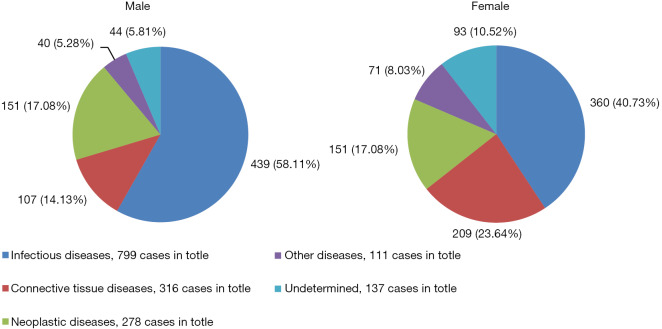
Among the 1,641 patients, 1,504 were finally diagnosed through various types of examination or diagnostic methods, and the diagnosis rate was 91.65%. Among all the causes of the 1,641 cases of FUO, 48.69% [799] were infectious diseases, of which tuberculosis was the most common, accounting for 19.50% [320]. Connective tissue diseases were responsible for 19.26% [316] of cases, of which adult-onset Still's disease (AOSD) was the most common, comprising 89 (5.42%) of the cases; 16.94% [278] were neoplastic diseases, and lymphoma (143, 8.71%) cases, was the most common malignant tumor; 6.76% [111] were other diseases; and in 8.35% [137] of cases, the cause was unclear. Through comparative analysis of tuberculosis and lymphoma, no significant differences were found between the symptoms, signs, and non-specific routine examination results of the two diseases. The diagnosis of these diseases was more dependent on tuberculosis-related examinations and pathological examinations.

CONCLUSIONS

Infectious diseases are the principal cause of classic FUO, in which tuberculosis accounts for a large proportion. Non-infectious diseases that cause FUO are mainly connective tissue diseases and malignant tumors. Of the various causes of classic FUO, tuberculosis and lymphoma are relatively difficult to diagnose. In most cases, the causes of classic FUO can be ascertained.

摘要

背景

不明原因发热(FUO)通常被定义为在至少3周内多次体温高于38.3°C,经过多项必要检查后诊断仍不明确。它是一种特殊类型的发热,也是内科的常见疾病。然而,由于其病因复杂,缺乏特征性临床表现,实验室检查指标不足,常常使临床医生在诊断时感到困惑。我们在此呈现一项关于经典不明原因发热(FUO)的病因及临床特征的研究,以为相关临床诊断和治疗提供帮助。

方法

收集了2011年1月1日至2017年12月31日期间在四川大学华西医院住院的1641例经典FUO患者,分析经典FUO的病因。特别致力于探索和筛选与传染病相关的实验室指标,并将上述数据与难以诊断的结核病和淋巴瘤的临床特征进行比较。

结果

1641例患者中,最终通过各种检查或诊断方法确诊1504例,诊断率为91.65%。在1641例FUO的所有病因中,48.69%(799例)为传染病,其中结核病最为常见,占19.50%(320例)。结缔组织病占病例的19.26%(316例),其中成人斯蒂尔病(AOSD)最为常见,占89例(5.42%);肿瘤性疾病占16.94%(278例),淋巴瘤(143例,8.71%)是最常见的恶性肿瘤;6.76%(111例)为其他疾病;8.35%(137例)病因不明。通过对结核病和淋巴瘤的对比分析,发现两种疾病的症状、体征及非特异性常规检查结果无显著差异。这些疾病的诊断更多地依赖于结核病相关检查和病理检查。

结论

传染病是经典FUO的主要病因,其中结核病占很大比例。导致FUO的非传染病主要是结缔组织病和恶性肿瘤。在经典FUO的各种病因中,结核病和淋巴瘤相对难以诊断。在大多数情况下,经典FUO的病因可以确定。
https://cdn.ncbi.nlm.nih.gov/pmc/blobs/47df/7327343/6f8667b1caef/atm-08-11-690-f1.jpg

相似文献

1
Retrospective analysis of 1,641 cases of classic fever of unknown origin.对1641例典型不明原因发热病例的回顾性分析。
Ann Transl Med. 2020 Jun;8(11):690. doi: 10.21037/atm-20-3875.
2
Application of Machine Learning for the Prediction of Etiological Types of Classic Fever of Unknown Origin.机器学习在不明原因经典热病因预测中的应用。
Front Public Health. 2021 Dec 24;9:800549. doi: 10.3389/fpubh.2021.800549. eCollection 2021.
3
Structured diagnostic scheme clinical experience sharing: a prospective study of 320 cases of fever of unknown origin in a tertiary hospital in North China.结构化诊断方案临床经验分享:华北地区一家三甲医院 320 例发热待查的前瞻性研究。
BMC Infect Dis. 2023 Jul 7;23(1):452. doi: 10.1186/s12879-023-08436-0.
4
Major causes of fever of unknown origin at Peking Union Medical College Hospital in the past 26 years.过去 26 年北京协和医院不明原因发热的主要病因。
Chin Med J (Engl). 2013 Mar;126(5):808-12.
5
[A clinical review of 449 cases with fever of unknown origin].449例不明原因发热的临床回顾
Zhonghua Nei Ke Za Zhi. 2004 Sep;43(9):682-5.
6
Clinical Features of Spontaneous Remission in the Classic Fever of Unknown Origin: A Retrospective Study.经典不明热自发缓解的临床特征:一项回顾性研究。
Chin Med Sci J. 2022 Jun 30;37(2):134-141. doi: 10.24920/003975.
7
Etiology and clinical features of fever of unknown origin.不明原因发热的病因及临床特征。
Zhongguo Yi Xue Ke Xue Yuan Xue Bao. 2011 Feb;33(1):83-7. doi: 10.3881/j.issn.1000-503X.2011.01.018.
8
Recurrent fever of unknown origin (FUO): aseptic meningitis, hepatosplenomegaly, pericarditis and a double quotidian fever due to juvenile rheumatoid arthritis (JRA).原因不明的反复发作性发热(FUO):无菌性脑膜炎、肝脾肿大、心包炎和由于幼年特发性关节炎(JRA)引起的双日热。
Heart Lung. 2012 Mar-Apr;41(2):177-80. doi: 10.1016/j.hrtlng.2011.01.002. Epub 2011 Mar 30.
9
Distribution of the causes of fever of unknown origin in China, 2013-2022.2013 - 2022年中国不明原因发热的病因分布
J Transl Int Med. 2024 Jul 27;12(3):299-307. doi: 10.2478/jtim-2024-0008. eCollection 2024 Jun.
10
[An analysis of etiologies of fever of unknown origin in 372 patients].[372例不明原因发热患者的病因分析]
Zhonghua Nei Ke Za Zhi. 2014 Apr;53(4):298-302.

引用本文的文献

1
Viral Fragments in the Urine Proteome: New Clues to the Cause of Fever.尿液蛋白质组中的病毒片段:发热原因的新线索
Biology (Basel). 2025 Mar 21;14(4):318. doi: 10.3390/biology14040318.
2
The value of metagenomic next-generation sequencing in the diagnosis of fever of unknown origin.宏基因组下一代测序在不明原因发热诊断中的价值
Sci Rep. 2025 Jan 14;15(1):1963. doi: 10.1038/s41598-025-86295-2.
3
Clinical characteristics of lymphoma patients presenting with fever of unknown origin misdiagnosed with connective tissue diseases.

本文引用的文献

1
Host-pathogen interactions in typhoid fever: the model is the message.伤寒热中的宿主-病原体相互作用:模式即信息。
Ann Transl Med. 2018 Nov;6(Suppl 1):S38. doi: 10.21037/atm.2018.09.52.
2
Long-term prognosis, treatment, and outcome of patients with fever of unknown origin in whom no diagnosis was made despite extensive investigation: A questionnaire based study.尽管进行了广泛检查仍未确诊的不明原因发热患者的长期预后、治疗及结局:一项基于问卷调查的研究
Medicine (Baltimore). 2018 Jun;97(25):e11241. doi: 10.1097/MD.0000000000011241.
3
Clinical analysis of 215 consecutive cases with fever of unknown origin: A cohort study.
以不明原因发热起病、被误诊为结缔组织病的淋巴瘤患者的临床特征。
Ann Hematol. 2025 Feb;104(2):1157-1164. doi: 10.1007/s00277-025-06188-2. Epub 2025 Jan 14.
4
Onco-mNGS facilitates rapid and precise identification of the etiology of fever of unknown origin: a single-centre prospective study in North China.肿瘤多基因下一代测序技术有助于快速准确地识别不明原因发热的病因:一项在中国北方开展的单中心前瞻性研究
BMC Infect Dis. 2024 Dec 28;24(1):1475. doi: 10.1186/s12879-024-10383-3.
5
Ovarian carcinosarcoma with lung metastasis characterized by persistent fever: A case report and literature review.卵巢癌肉瘤伴肺转移,以持续发热为特征:病例报告及文献复习。
Medicine (Baltimore). 2024 Oct 25;103(43):e40202. doi: 10.1097/MD.0000000000040202.
6
Unraveling the mystery of fever of unknown origin: a remarkable journey towards the diagnosis of peripheral T-cell lymphoma-T follicular helper type: A rare case report.揭开不明原因发热之谜:外周 T 细胞淋巴瘤-滤泡辅助 T 细胞型诊断之旅:罕见病例报告。
Medicine (Baltimore). 2024 Jan 19;103(3):e36974. doi: 10.1097/MD.0000000000036974.
7
Recent advances and evolving concepts in Still's disease.斯蒂尔病的最新进展和不断发展的概念。
Nat Rev Rheumatol. 2024 Feb;20(2):116-132. doi: 10.1038/s41584-023-01065-6. Epub 2024 Jan 11.
8
Structured diagnostic scheme clinical experience sharing: a prospective study of 320 cases of fever of unknown origin in a tertiary hospital in North China.结构化诊断方案临床经验分享:华北地区一家三甲医院 320 例发热待查的前瞻性研究。
BMC Infect Dis. 2023 Jul 7;23(1):452. doi: 10.1186/s12879-023-08436-0.
9
Classical fever of unknown origin in 21 countries with different economic development: an international ID-IRI study.21 个不同经济发展水平国家的不明原因发热的国际 ID-IRI 研究。
Eur J Clin Microbiol Infect Dis. 2023 Apr;42(4):387-398. doi: 10.1007/s10096-023-04561-5. Epub 2023 Feb 15.
10
Fever of Unknown Origin and Hepatitis as the Initial Presentation of Anti-MDA-5 Positive Dermatomyositis: A Case Report.以不明原因发热和肝炎为首发表现的抗MDA-5阳性皮肌炎:一例报告
Mediterr J Rheumatol. 2022 Sep 30;33(3):361-367. doi: 10.31138/mjr.33.3.361. eCollection 2022 Sep.
215例连续不明原因发热病例的临床分析:一项队列研究。
Medicine (Baltimore). 2018 Jun;97(24):e10986. doi: 10.1097/MD.0000000000010986.
4
Fever of unknown origin (FUO): CMV infectious mononucleosis or lymphoma?不明原因发热(FUO):巨细胞病毒传染性单核细胞增多症或淋巴瘤?
Eur J Clin Microbiol Infect Dis. 2018 Jul;37(7):1373-1376. doi: 10.1007/s10096-018-3262-2. Epub 2018 Apr 20.
5
Fever of Unknown Origin: the Value of FDG-PET/CT.不明原因发热:FDG-PET/CT 的价值。
Semin Nucl Med. 2018 Mar;48(2):100-107. doi: 10.1053/j.semnuclmed.2017.11.004. Epub 2017 Dec 8.
6
Symptomatic lower limb large vessel vasculitis presenting as fever of unknown origin diagnosed on FDG-PET/CT.表现为不明原因发热的有症状下肢大血管血管炎,通过氟代脱氧葡萄糖正电子发射断层显像/计算机断层扫描(FDG-PET/CT)得以诊断。
BMJ Case Rep. 2018 Jan 26;2018:bcr-2017-224019. doi: 10.1136/bcr-2017-224019.
7
An unusual cause of fever of unknown origin with enlarged lymph nodes-relapsing polychondritis: A case report.伴有淋巴结肿大的不明原因发热的罕见病因——复发性多软骨炎:一例报告
Medicine (Baltimore). 2017 Nov;96(46):e8734. doi: 10.1097/MD.0000000000008734.
8
Referral of patients with fever of unknown origin to an expertise center has high diagnostic and therapeutic value.将不明原因发热患者转诊至专业中心具有很高的诊断和治疗价值。
QJM. 2017 Dec 1;110(12):793-801. doi: 10.1093/qjmed/hcx158.
9
Analysis of 256 cases of classic fever of unknown origin.256例经典型不明原因发热病例分析。
Intern Med. 2014;53(21):2471-5. doi: 10.2169/internalmedicine.53.2218. Epub 2014 Nov 1.
10
Diagnostic workup for fever of unknown origin: a multicenter collaborative retrospective study.不明原因发热的诊断研究:一项多中心协作回顾性研究。
BMJ Open. 2013 Dec 20;3(12):e003971. doi: 10.1136/bmjopen-2013-003971.