Rafat Sonja, Tessma Mesfin, Klinge Björn, Borg Stefan, De Palma Patricia
Oral Health Prev Dent. 2020 Jul 4;18(2):229-237. doi: 10.3290/j.ohpd.a44032.
This study explored the oral health of individuals with substance use disorders and examined the relationship between oral health and type and number of years of substance use disorder.
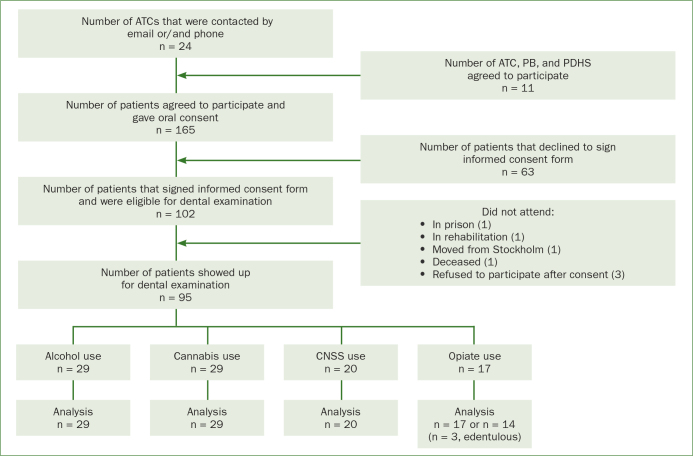
This comparative cross-sectional study comprised patients with one of four groups of substance use disorders - alcohol, cannabis, central nervous system stimulants (CNSS), and opiates. All participants underwent a dental examination and were included in the study based on their clinical findings.
Of 95 participants, 79 (83%) were male and 37 (39%) were homeless. Statistically significant difference between the groups was observed in 6-12-mm periodontal pocket depths (p <0.05), as were differences in oral mucosal changes (p <0.001). Statistically significantly lower proportions were observed in the cannabis group for Mob G:0 and Mob G:1 and Furcation G:1 compared to the CNSS and opiate groups; the proportion of Furcation G:0 was significantly lower in the alcohol group compared to the cannabis group. Analysis of variance (ANOVA) revealed statistically significant between-group differences in age, number of years of substance use disorder, number of teeth, and decayed, missing and filled teeth (DMFT). When controlling for age and gender, substance type was found to be a statistically significant predictor of number of teeth (B = -4.4; 95% CI: -8.1 to -0.38; p = 0.03) and DMFT (B = 2.1; 95% CI: 0.86 to 3.3; p = 0.001).
These results indicate poor oral health among individuals with substance use disorders. It seems that oral health problems are lower among abusers of cannabis than of CNSS, alcohol and opiates.
本研究探讨了物质使用障碍患者的口腔健康状况,并考察了口腔健康与物质使用障碍的类型及年限之间的关系。
这项比较性横断面研究纳入了患有四类物质使用障碍(酒精、大麻、中枢神经系统兴奋剂和阿片类药物)之一的患者。所有参与者均接受了牙科检查,并根据临床检查结果纳入研究。
95名参与者中,79名(83%)为男性,37名(39%)无家可归。在6 - 12毫米的牙周袋深度方面,各组之间存在统计学显著差异(p <0.05),口腔黏膜变化方面也存在差异(p <0.001)。与中枢神经系统兴奋剂和阿片类药物组相比,大麻组的Mob G:0、Mob G:1和根分叉病变G:1的比例在统计学上显著更低;与大麻组相比,酒精组的根分叉病变G:0比例显著更低。方差分析(ANOVA)显示,在年龄、物质使用障碍年限、牙齿数量以及龋失补牙数(DMFT)方面,组间存在统计学显著差异。在控制年龄和性别后,发现物质类型是牙齿数量(B = -4.4;95%置信区间:-8.1至-0.38;p = 0.03)和DMFT(B = 2.1;95%置信区间:0.86至3.3;p = 0.001)的统计学显著预测因素。
这些结果表明物质使用障碍患者的口腔健康状况较差。似乎大麻滥用者的口腔健康问题比中枢神经系统兴奋剂、酒精和阿片类药物滥用者的要少。