Iliadis Christos, Metze Clemens, Körber Maria Isabel, Baldus Stephan, Pfister Roman
Faculty of Medicine and University Hospital Cologne, Department III of Internal Medicine, Heart Center, University of Cologne, Cologne, Germany.
ESC Heart Fail. 2020 Oct;7(5):2379-2387. doi: 10.1002/ehf2.12778. Epub 2020 Jul 3.
Patients undergoing percutaneous mitral valve repair (PMVR) show a substantial heterogeneity of prognostic and symptomatic benefit. Iron deficiency and anaemia are associated with worse outcomes in heart failure patients. We investigated the impact of these comorbidities on functional and clinical outcome after PMVR.
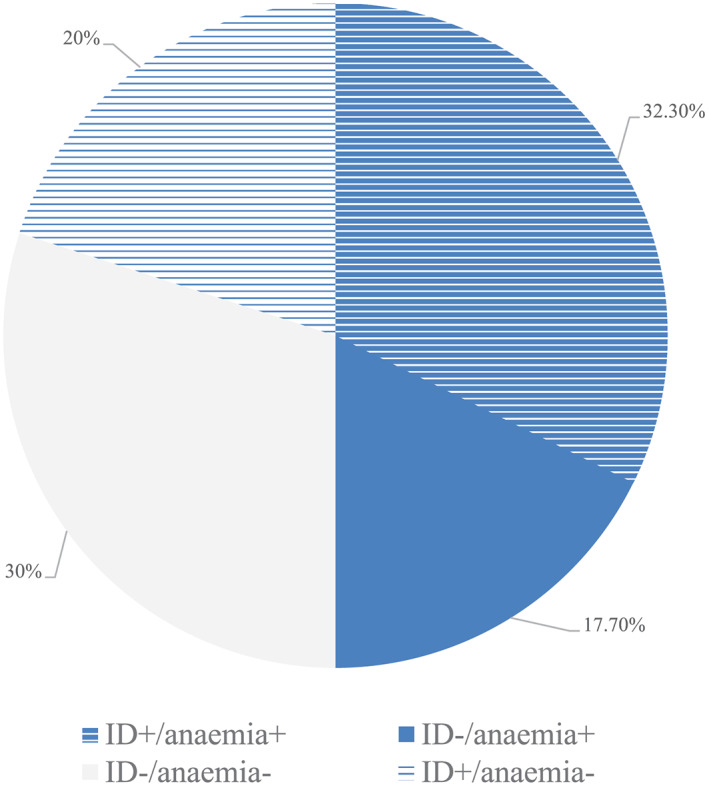
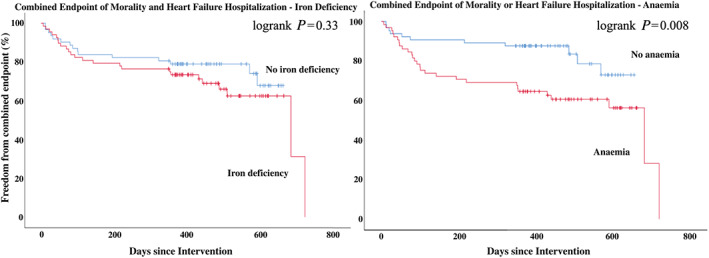
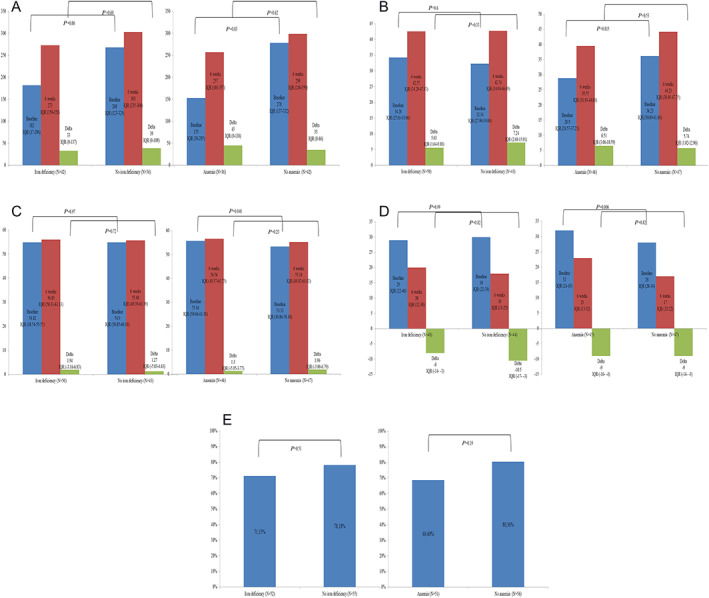
Iron deficiency and anaemia were prospectively assessed in 130 patients undergoing PMVR with MitraClip. Associations with functional outcomes at 6 weeks [6 min walking distance (6MWD), Short-Form-36 physical component score, and Minnesota Living with Heart Failure Questionnaire score, New York Heart Association class] and long-term clinical outcome were examined. Iron deficiency and anaemia were frequent with 52% and 50%, respectively. Patients with anaemia showed significant worse baseline functional measures, whereas patients with iron deficiency showed only a trend for lower baseline 6MWD. The benefit in functional outcomes after PMVR was notable and did not differ significantly by iron deficiency or anaemia status (range of median changes in 6MWD 35 to 45 m, physical component score 5.6 to 7.2, Minnesota Living with Heart Failure Questionnaire -8.0 to -10.5; improvement of ≥1 New York Heart Association class 69% to 80%). Anaemia was associated with higher risk for the combined endpoint of mortality and heart failure hospitalization (hazard ratio: 2.51; 95% confidence interval: 1.24-5.1; P = 0.01), whereas iron deficiency showed a trend towards more heart failure hospitalizations (hazard ratio: 2.94; 95% confidence interval: 0.94-9.03; P = 0.09).
The prevalence of iron deficiency and anaemia is high in patients undergoing MitraClip. Clinical baseline status and long-term outcome were worse particularly in patients with anaemia. However, the functional benefit of PMVR was equal in patients with and without iron deficiency and anaemia.
接受经皮二尖瓣修复术(PMVR)的患者在预后和症状改善方面存在显著异质性。缺铁和贫血与心力衰竭患者较差的预后相关。我们研究了这些合并症对PMVR术后功能和临床结局的影响。
对130例行MitraClip经皮二尖瓣修复术的患者进行缺铁和贫血的前瞻性评估。研究了其与6周时的功能结局[6分钟步行距离(6MWD)、简明健康调查量表身体成分得分、明尼苏达心力衰竭生活问卷得分、纽约心脏协会心功能分级]以及长期临床结局的相关性。缺铁和贫血的发生率分别为52%和50%。贫血患者的基线功能指标明显更差,而缺铁患者仅在基线6MWD方面有降低的趋势。PMVR术后功能结局的改善显著,且不因缺铁或贫血状态而有显著差异(6MWD中位数变化范围为35至45米,身体成分得分变化范围为5.6至7.2,明尼苏达心力衰竭生活问卷得分变化范围为-8.0至-10.5;纽约心脏协会心功能分级改善≥1级的比例为69%至80%)。贫血与死亡和心力衰竭住院复合终点的较高风险相关(风险比:2.51;95%置信区间:1.24 - 5.1;P = 0.01),而缺铁有导致更多心力衰竭住院的趋势(风险比:2.94;95%置信区间:0.94 - 9.03;P = 0.09)。
接受MitraClip治疗的患者中缺铁和贫血的患病率较高。临床基线状态和长期结局在贫血患者中尤其较差。然而,有无缺铁和贫血的患者PMVR的功能获益相当。