Institute of Diagnostic Virology Institute of Diagnostic Virology, Friedrich-Loeffler-Institut, Germany; Department of Birds and Rabbits Medicine, University of Sadat City, Monufia, Egypt.
Department of Birds and Rabbits Medicine, University of Sadat City, Monufia, Egypt.
Infect Genet Evol. 2020 Nov;85:104433. doi: 10.1016/j.meegid.2020.104433. Epub 2020 Jul 1.
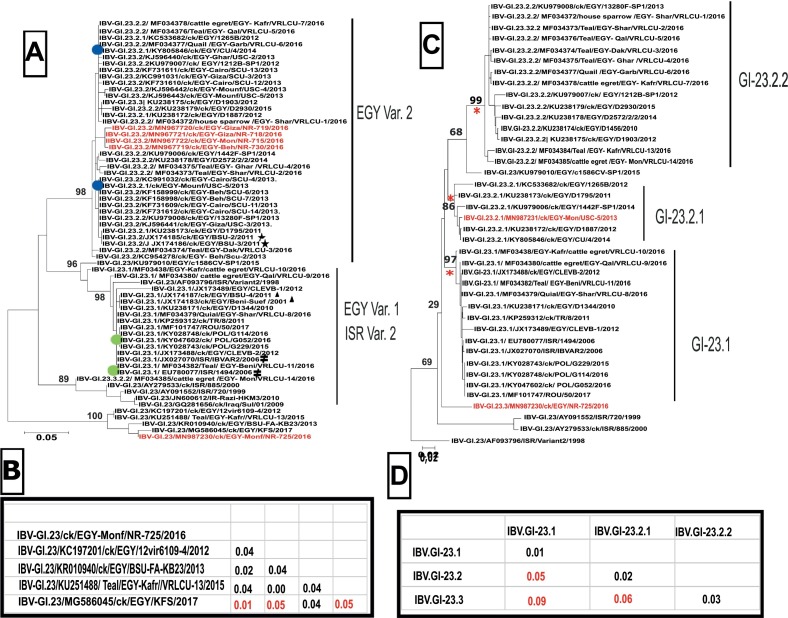
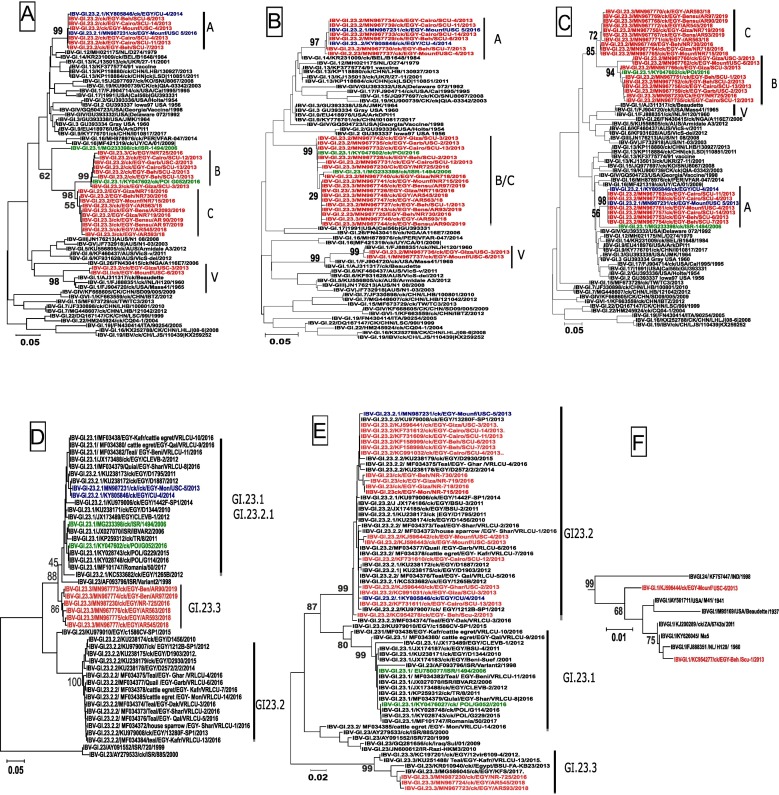
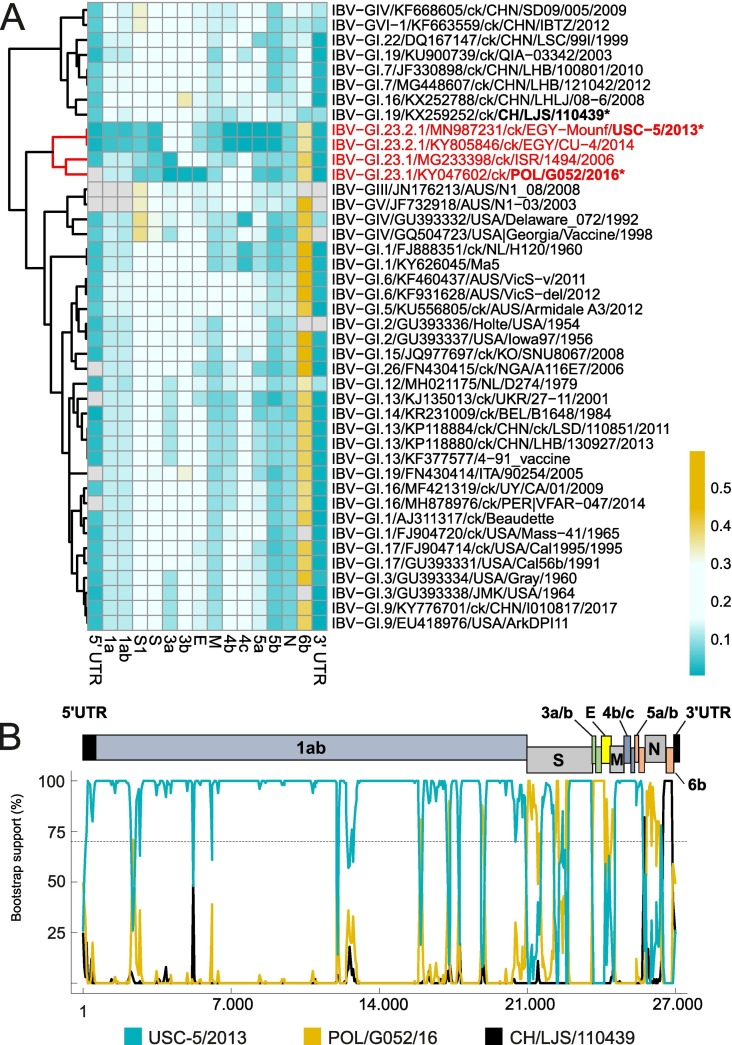
Infectious bronchitis virus (IBV), a gamma-coronavirus, causes infectious bronchitis (IB), a major respiratory disease of chicken. Its high mutation rate in conjunction with recombination of the RNA genome constantly creates IBV variants that are difficult to control by currently available vaccines. In this study, we addressed the question whether small-scale holdings might harbor IBV variants that serve as a reservoir for newly emerging variants. Egyptian IBV isolate EGY/NR725/2016 (NR725/16) from a small-scale broiler farm was assigned to genotype I, clade 23 (S1:GI-23), based on partial S1 gene sequences and corroborated by full genome sequencing. Analysis of the S1 gene established three subclades for historical IBV strains (S1:GI-23.1, S1:GI-23.2.1 and S1:GI-23.2.2) and confirmed NR725/16 as being part of a separate fourth subclade (S1:GI-23.3). Samples from the years 2018 and 2019 revealed that the new subclade prevails in Egypt, carrying fixed mutations within the hypervariable regions (HVR) 1-3 of the S1 protein that affect two neutralization sensitive epitopes at sites 294F, 297S and 306Y (48.2) and 329R (62.1). In addition, recombination was recognized in isolate NR 725/16, with intra-subtype mixing for the entire genes 3ab and E and inter-subtype mixing for the entire gene 6b with a close match to QX like viruses of genotype GI-19. Further analysis of gene 3ab detected the homologous gene pool to NR725/16 in samples from 2013 (3ab:C) and closely related 3ab genotypes in IBV Egyptian isolates from 2016, 2018 and 2019. These data prove a flourishing exchange between poultry holdings with a common gene pool. The continued circulation of viruses harboring genes S1:GI-23.3 and 3ab:C indicates an evolutionary advantage of this combination possibly by combining antigenic escape with modulated pathogenicity to facilitate IBV spread in the vaccinated poultry population in Egypt.
传染性支气管炎病毒(IBV)是一种γ冠状病毒,会引起鸡的传染性支气管炎(IB),这是一种主要的呼吸道疾病。其 RNA 基因组的高突变率与重组不断产生难以用现有疫苗控制的 IBV 变体。在这项研究中,我们探讨了小型养殖场是否可能存在作为新出现变体储备库的 IBV 变体。从一个小型肉鸡养殖场分离到的埃及 IBV 分离株 EGY/NR725/2016(NR725/16),根据部分 S1 基因序列和全基因组测序结果,被归为 I 基因型,23 群(S1:GI-23)。对 S1 基因的分析确定了历史 IBV 株的三个亚群(S1:GI-23.1、S1:GI-23.2.1 和 S1:GI-23.2.2),并证实 NR725/16 属于一个单独的第四个亚群(S1:GI-23.3)。2018 年和 2019 年的样本显示,新的亚群在埃及流行,S1 蛋白的高变区(HVR)1-3 内存在固定突变,影响两个中和敏感表位 294F、297S 和 306Y(48.2)和 329R(62.1)。此外,在分离株 NR 725/16 中发现了重组,整个 3ab 和 E 基因的同型内混合,整个 6b 基因的同型间混合,与 GI-19 基因型的 QX 样病毒密切匹配。对基因 3ab 的进一步分析检测到与 NR725/16 样本同源的基因库 2013 年(3ab:C)和 2016 年、2018 年和 2019 年埃及 IBV 分离株的密切相关的 3ab 基因型。这些数据证明了禽类养殖场之间存在着活跃的基因交换,具有共同的基因库。携带 S1:GI-23.3 和 3ab:C 基因的病毒的持续循环表明这种组合具有进化优势,可能通过结合抗原逃逸和调节致病性来促进 IBV 在埃及接种禽类中的传播。