Princess Margaret Cancer Centre, University Health Network, Toronto, ON, Canada.
Leukemia. 2020 Nov;34(11):2875-2886. doi: 10.1038/s41375-020-0958-y. Epub 2020 Jul 5.
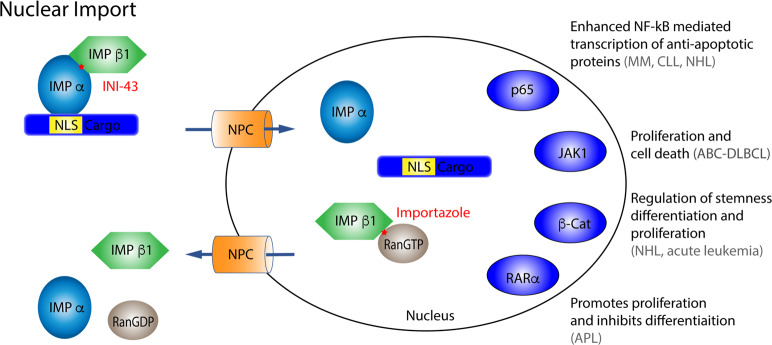
The transport of proteins across the nuclear membrane is a highly regulated process, essential for the cell function. This transport is actively mediated by members of the karyopherin family, termed importins, or exportins, depending on the direction of transport. These proteins play an active part in tumorigenesis, through aberrant localization of their cargoes, which include oncogenes, tumor-suppressor genes and mediators of key signal transduction pathways. Overexpression of importins and exportins is reported in many malignancies, with implications in cell growth and viability, differentiation, drug resistance, and tumor microenvironment. Given their broad significance across tumors and pathways, much effort is being put to develop specific inhibitors as a novel anticancer therapeutics. Already, selinexor, a specific inhibitor of exportin-1 (XPO1), is approved for clinical use. This review will focus on the role of importins and exportins in hematological malignancies. We will discuss current preclinical and clinical data on importins and exportins, and demonstrate how our growing understanding of their functions has identified new therapeutic targets.
蛋白质跨核膜运输是一个高度调控的过程,对细胞功能至关重要。这种运输是由核孔蛋白家族的成员主动介导的,根据运输的方向,这些蛋白被称为导入蛋白或输出蛋白。这些蛋白通过其货物(包括癌基因、肿瘤抑制基因和关键信号转导途径的介质)的异常定位,在肿瘤发生中发挥积极作用。在许多恶性肿瘤中都报道了导入蛋白和输出蛋白的过表达,这与细胞生长和活力、分化、耐药性和肿瘤微环境有关。鉴于它们在肿瘤和途径中的广泛意义,人们正在努力开发特异性抑制剂作为一种新的抗癌治疗方法。目前,特异性抑制输出蛋白 1(XPO1)的 selinexor 已被批准用于临床应用。本综述将重点关注导入蛋白和输出蛋白在血液系统恶性肿瘤中的作用。我们将讨论导入蛋白和输出蛋白的当前临床前和临床数据,并展示我们对其功能的不断深入理解如何确定新的治疗靶点。