Jeger Michael, Candresse Thierry, Chatzivassiliou Elisavet, Dehnen-Schmutz Katharina, Gilioli Gianni, Grégoire Jean-Claude, Jaques Miret Josep Anton, MacLeod Alan, Navajas Navarro Maria, Niere Björn, Parnell Stephen, Potting Roel, Rafoss Trond, Rossi Vittorio, Urek Gregor, Van Bruggen Ariena, Van der Werf Wopke, West Jonathan, Winter Stephan, Bragard Claude, Szurek Boris, Hollo Gabor, Caffier David
EFSA J. 2018 Jan 18;16(1):e05109. doi: 10.2903/j.efsa.2018.5109. eCollection 2018 Jan.
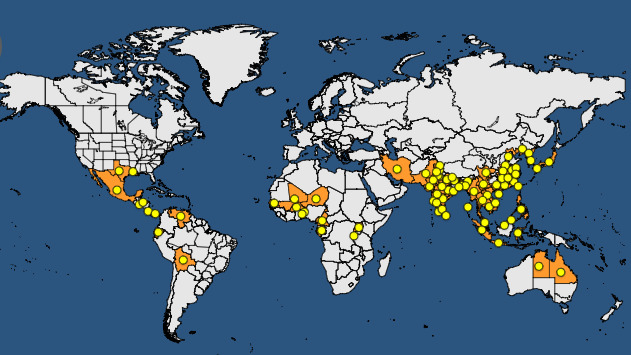
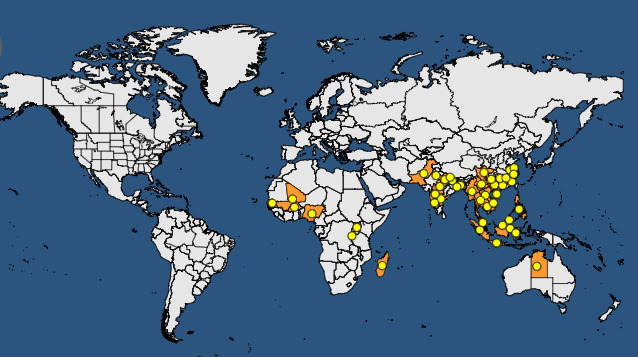
The EFSA Panel on Plant Health performed a pest categorisation for pathovars (Xoo) and (Xoc), the causal agents of the bacterial blight and the bacterial leaf streak of rice, respectively. These pathovars are widely distributed in Asia, Africa and Australia. Xoo is also reported in some states of the USA and in some other countries of America. The identity of both pathovars is well established and efficient identification methods are available. The major host is cultivated rice ( , but different spp. as well as Poaceae weeds are reported as alternative hosts, with some uncertainty concerning the actual host range. Both pathovars are seed associated, despite the fact that seed transmission is still controversial for Xoo. Both pathovars are already regulated in Directives 2000/29/EC, on harmful organisms for plants, and 66/402/EEC, on the marketing of cereal seeds. The main pathway for entry is seed. Should these pathovars enter into EU, they may establish and spread, and they may have an impact on the rice crops, with uncertainties. The knowledge gaps identified are (1) the quantity of EU importation of rice seeds, (2) the risk of introduction through unprocessed rice for consumption, (3) the suitability of the EU growing climate conditions for the bacteria to establish and spread, (4) role of seed transmission (Xoo), (5) the role of weeds in the epidemiology and especially in seed transmission and dispersal, (6) host range of weeds. As none of the pathovars is known to occur in the EU, they do not meet one of the criteria for being considered as Union regulated non-quarantine pests. Nevertheless, both pathovars meet the criteria assessed by EFSA for consideration as Union quarantine pest.
欧洲食品安全局植物健康小组对水稻白叶枯病菌(Xoo)和水稻细菌性条斑病菌(Xoc)进行了有害生物分类,它们分别是水稻白叶枯病和水稻细菌性条斑病的病原体。这些病原菌在亚洲、非洲和澳大利亚广泛分布。在美国的一些州以及美洲的其他一些国家也报道了水稻白叶枯病菌。两种病原菌的身份已得到充分确认,并且有有效的鉴定方法。主要寄主是栽培稻(Oryza sativa),但也报道了不同的稻属物种以及禾本科杂草作为替代寄主,不过实际寄主范围仍存在一些不确定性。两种病原菌都与种子有关,尽管水稻白叶枯病菌的种子传播仍存在争议。这两种病原菌已在关于植物有害生物的2000/29/EC指令和关于谷物种子销售的66/402/EEC指令中受到监管。进入的主要途径是种子。如果这些病原菌进入欧盟,它们可能会定殖和传播,并且可能会对水稻作物产生影响,存在不确定性。确定的知识空白包括:(1)欧盟水稻种子的进口量;(2)通过未加工的食用水稻引入的风险;(3)欧盟生长气候条件对细菌定殖和传播的适宜性;(4)种子传播(水稻白叶枯病菌)的作用;(5)杂草在流行病学中的作用,特别是在种子传播和扩散中的作用;(6)杂草的寄主范围。由于已知这两种病原菌在欧盟均未发生,因此它们不符合被视为欧盟管制的非检疫性有害生物的标准之一。然而,这两种病原菌均符合欧洲食品安全局评估的被视为欧盟检疫性有害生物的标准。