Wu Wei, Shang Yuqiang, Dai Shiling, Yu Chunjun, Wang Jie
Department of Cardiothoracic Surgery, The Central Hospital of Wuhan, Tongji Medical College, Huazhong University of Science and Technology, Wuhan, Hubei 430014, P.R. China.
Mol Med Rep. 2020 Apr 24;22(1):277-85. doi: 10.3892/mmr.2020.11093.
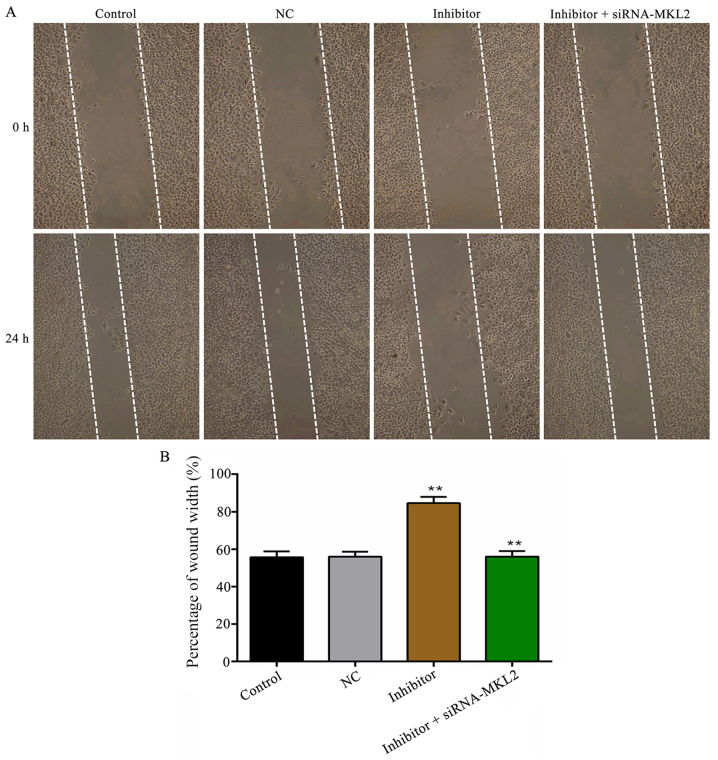
The increased proliferation and migration of vascular smooth muscle cells (VSMCs) are critical in the progression of atherosclerosis (AS). Platelet‑derived growth factor type BB (PDGF‑BB) may induce VSMC proliferation and migration. miR‑142‑5p plays a critical role in various biological processes, including tumorigenesis, angiogenesis and inflammation. However, whether miR‑142‑5p is involved in regulating the pathological process of arteriosclerosis remains to be elucidated. Therefore, in this study, the role of miR‑142‑5p in PDGF‑BB‑induced human aortic smooth muscle cell (HSAMC) proliferation and migration was investigated. The results revealed that the expression level of miR‑142‑5p was enhanced in the serum of patients with AS, while that of its target gene, myocardin‑like protein 2 (MKL2) was decreased, compared with that in healthy volunteers. Moreover, there was a negative correlation between miR‑142‑5p and MKL2 expression in the serum of patients with AS. Furthermore, the downregulation of miR‑142‑5p inhibited PDGF‑BB‑induced HASMC proliferation and migration; however, the inhibition of HASMC proliferation and migration was reversed by co‑transfection with small interfering RNA (siRNA) against MKL2 (siRNA‑MKL2). In addition, transfection with miR‑142‑5p inhibitor significantly increased the expression levels of MKL2, and decreased those of matrix metalloproteinase (MMP)2 and 9, and these effects were reversed by transfection with siRNA‑MKL2. Finally, MKL2 was proven to be a target of miR‑142‑5p. On the whole, the findings of the present study demonstrate that the downregulation of miR‑142‑5p inhibits human aortic smooth muscle cell (HSAMC) proliferation and migration possibly by targeting MKL2. Hence, miR‑142‑5p may prove to be a novel therapeutic target in the treatment of AS.
血管平滑肌细胞(VSMCs)增殖和迁移的增加在动脉粥样硬化(AS)进展中起关键作用。血小板衍生生长因子BB型(PDGF-BB)可诱导VSMC增殖和迁移。miR-142-5p在包括肿瘤发生、血管生成和炎症在内的各种生物学过程中起关键作用。然而,miR-142-5p是否参与调节动脉硬化的病理过程仍有待阐明。因此,在本研究中,研究了miR-142-5p在PDGF-BB诱导的人主动脉平滑肌细胞(HSAMC)增殖和迁移中的作用。结果显示,与健康志愿者相比,AS患者血清中miR-142-5p的表达水平升高,而其靶基因心肌样蛋白2(MKL2)的表达水平降低。此外,AS患者血清中miR-142-5p与MKL2表达之间存在负相关。此外,miR-142-5p的下调抑制了PDGF-BB诱导的HASMC增殖和迁移;然而,通过与针对MKL2的小干扰RNA(siRNA)(siRNA-MKL2)共转染可逆转对HASMC增殖和迁移的抑制作用。此外,用miR-142-5p抑制剂转染显著增加了MKL2的表达水平,并降低了基质金属蛋白酶(MMP)2和9的表达水平,而用siRNA-MKL2转染可逆转这些作用。最后,证实MKL2是miR-142-5p的靶标。总体而言,本研究结果表明,miR-142-5p的下调可能通过靶向MKL2来抑制人主动脉平滑肌细胞(HSAMC)的增殖和迁移。因此,miR-142-5p可能被证明是治疗AS的新治疗靶点。