Department of Genetics, Rutgers, State University of New Jersey, Piscataway, New Jersey.
Cancer Institute of New Jersey and Human Genetics Institute of New Jersey, Piscataway, New Jersey.
Am J Physiol Gastrointest Liver Physiol. 2020 Aug 1;319(2):G189-G196. doi: 10.1152/ajpgi.00084.2020. Epub 2020 Jul 6.
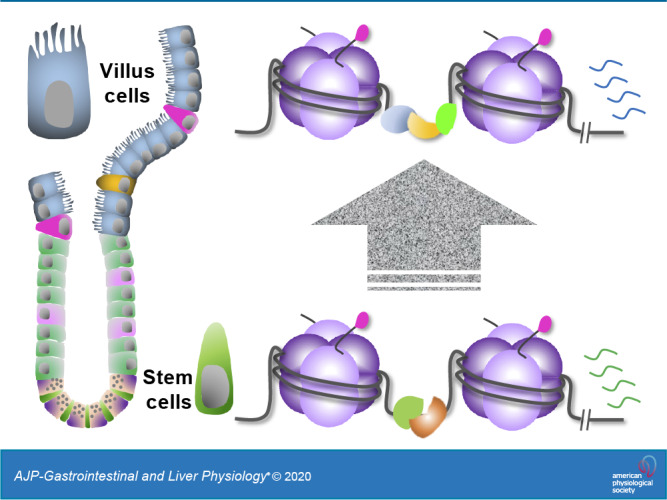
To fulfill the lifelong need to supply diverse epithelial cells, intestinal stem cells (ISCs) rely on executing accurate transcriptional programs. This review addresses the mechanisms that control those programs. Genes that define cell behaviors and identities are regulated principally through thousands of dispersed enhancers, each individually <1 kb long and positioned from a few to hundreds of kilobases away from transcription start sites, upstream or downstream from coding genes or within introns. Wnt, Notch, and other epithelial control signals feed into these -regulatory DNA elements, which are also common loci of polymorphisms and mutations that confer disease risk. Cell-specific gene activity requires promoters to interact with the correct combination of signal-responsive enhancers. We review the current state of knowledge in ISCs regarding active enhancers, the nucleosome modifications that may enable appropriate and hinder inappropriate enhancer-promoter contacts, and the roles of lineage-restricted transcription factors.
为了满足供应多样化上皮细胞的终身需求,肠干细胞 (ISCs) 依赖于执行精确的转录程序。本综述探讨了控制这些程序的机制。定义细胞行为和特征的基因主要通过数千个分散的增强子来调节,每个增强子单独 <1 kb 长,位于转录起始位点几到几百个千碱基之外,位于编码基因的上游或下游,或在内含子内。Wnt、Notch 和其他上皮控制信号传入这些 -调控 DNA 元件,这些元件也是多态性和突变的常见位置,这些多态性和突变赋予疾病风险。细胞特异性基因活性需要启动子与信号反应性增强子的正确组合相互作用。我们回顾了 ISCs 中关于活性增强子、可能使增强子 -启动子接触合适和阻碍不合适的核小体修饰,以及谱系限制转录因子的作用的最新知识状态。