University of Michigan Department of Neurology, Ann Arbor, MI 48109, USA; University of Michigan Institute for Healthcare Policy and Innovation, Ann Arbor, MI 48109, USA.
University of Michigan Institute for Healthcare Policy and Innovation, Ann Arbor, MI 48109, USA; Department of General Internal Medicine, Bern University Hospital, University of Bern, Bern, Switzerland; Institute of Primary Health Care (BIHAM), University of Bern, Bern, Switzerland; Center for Clinical Management Research, VA Ann Arbor Healthcare System, Ann Arbor, MI 48109, USA.
Epilepsy Behav. 2020 Oct;111:107261. doi: 10.1016/j.yebeh.2020.107261. Epub 2020 Jul 3.
The objective of the study was to characterize the prevalence of polypharmacy and central nervous system (CNS)-acting medications in patients with epilepsy, and particular types of medications.
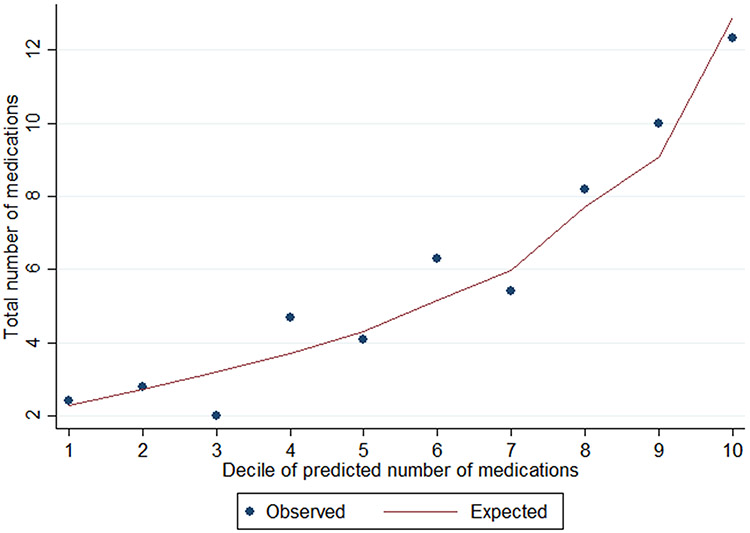
This was a retrospective cross-sectional study using data from the nationally representative National Health and Nutrition Examination Survey (NHANES). We included patients who reported taking at least one prescription medication in order to treat seizures or epilepsy during NHANES survey years 2013-2016. We assessed the number and types of drugs and predictors of total number of medications using a negative binomial regression. We then assessed prevalence of polypharmacy (≥5 medications), CNS polypharmacy (≥3 CNS-acting medications) and additional CNS-acting medications, and drugs that lower the seizure threshold (i.e., bupropion and tramadol), and extrapolated prevalence to estimated affected US population.
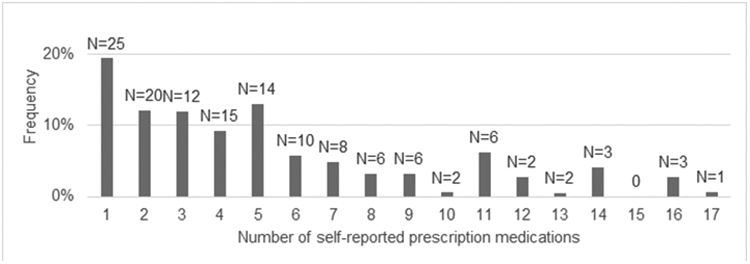
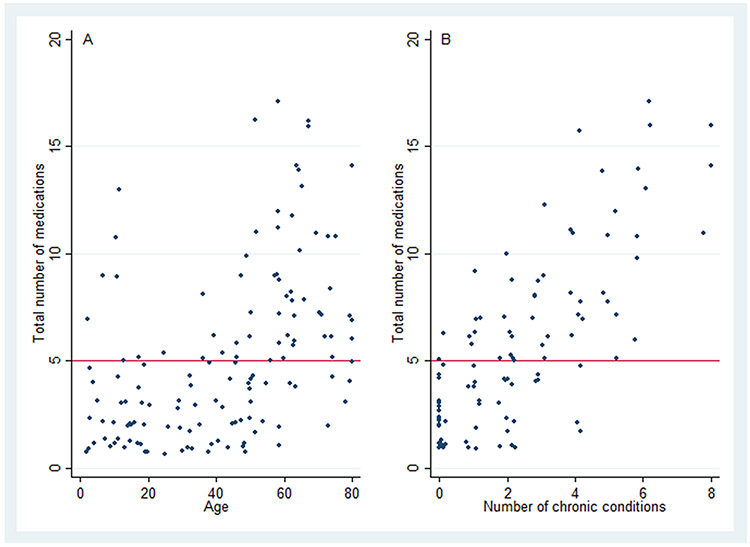
The NHANES contained 20,146 participants, of whom 135 reported taking ≥1 antiseizure medication (ASM) for seizures or epilepsy representing 2,399,520 US citizens using NHANES's sampling frame. Patients reported taking a mean 5.3 (95% confidence interval (CI): 4.3-6.3) prescription medications. Adjusting for race, sex, and uninsurance, both age and number of chronic conditions predicted increased number of medications (incident rate ratio (IRR) per decade: 1.16, 95% CI: 1.04-1.28; IRR per chronic condition: 1.19, 95% CI: 1.11-1.27). Polypharmacy was reported by 47% (95% CI: 38%-57%) of patients, CNS polypharmacy by 34% (23%-47%), benzodiazepine use by 21% (14%-30%), opioid use by 16% (11%-24%), benzodiazepine plus opioid use by 6% (3%-14%), and 6% (2%-15%) reported a drug that lowers the seizure threshold. Twelve percent (7%-20%) took an opioid with either a benzodiazepine or gabapentinoid.
Polypharmacy is common in patients with epilepsy. Patients taking ASMs frequently reported also taking other CNS-acting medications (i.e., opioids, benzodiazepines, seizure threshold-lowering medications), and medication combinations with black box warnings. Central nervous system polypharmacy poses health risks. Future research is needed to explore drivers of polypharmacy and strategies to help mitigate potentially harmful prescription use in this high-risk population.
本研究旨在描述癫痫患者中同时使用多种药物(polypharmacy)和作用于中枢神经系统(central nervous system,CNS)的药物的流行情况,并分析具体的药物类型。
本研究采用了回顾性的横断面研究方法,数据来源于具有全国代表性的国家健康与营养调查(National Health and Nutrition Examination Survey,NHANES)。我们纳入了在 NHANES 调查年份(2013-2016 年)中报告至少使用一种处方药物治疗癫痫或癫痫发作的患者。我们使用负二项回归评估了药物的种类和数量,以及药物总数的预测因素。然后,我们评估了同时使用 5 种及以上药物(polypharmacy)、3 种及以上作用于中枢神经系统的药物(CNS polypharmacy)以及其他作用于中枢神经系统的药物(包括降低癫痫发作阈值的药物,如安非他酮和曲马多)的流行情况,并将流行率外推至估计的美国受影响人群。
NHANES 共纳入了 20146 名参与者,其中 135 名报告使用了≥1 种抗癫痫药物(antiseizure medication,ASM)治疗癫痫或癫痫发作,代表了使用 NHANES 抽样框架的 2399520 名美国公民。患者报告平均使用 5.3 种(95%置信区间:4.3-6.3)处方药。在调整了种族、性别和无保险因素后,年龄和慢性疾病数量均与使用药物数量的增加相关(每十年的发病率比(incident rate ratio,IRR):1.16,95%置信区间:1.04-1.28;每增加一种慢性疾病的 IRR:1.19,95%置信区间:1.11-1.27)。47%(95%置信区间:38%-57%)的患者报告了同时使用多种药物,34%(23%-47%)的患者报告了同时使用作用于中枢神经系统的药物,21%(14%-30%)的患者报告了使用苯二氮䓬类药物,16%(11%-24%)的患者报告了使用阿片类药物,6%(3%-14%)的患者报告了使用降低癫痫发作阈值的药物,12%(7%-20%)的患者同时使用了阿片类药物和苯二氮䓬类药物或加巴喷丁类药物。
癫痫患者中同时使用多种药物很常见。服用 ASM 的患者经常还报告同时使用其他作用于中枢神经系统的药物(如阿片类药物、苯二氮䓬类药物、降低癫痫发作阈值的药物),以及存在黑框警告的药物联合治疗。中枢神经系统多药治疗存在健康风险。未来需要进一步研究多药治疗的驱动因素,并探索帮助减轻这一高危人群潜在有害处方药物使用的策略。