Yi Zhan-Miao, Li Ting-Ting, Tang Qi-Yu, Zhang Yuan, Willis Sarah, Zhai Suo-Di
Department of Pharmacy, Peking University Third Hospital.
Department of Pharmacy Administration and Clinical Pharmacy, Peking University School of Pharmaceutical Science.
Medicine (Baltimore). 2020 Jul 2;99(27):e20758. doi: 10.1097/MD.0000000000020758.
Medicines optimisation is important for the management of Parkinson's disease (PD). As many patients with PD have other long-term conditions, treatment is complex and risk of adverse events for these patients is high.
To explore the role of pharmacists and impact of pharmacy interventions for PD patients.
We comprehensively searched PubMed, Embase, the Cochrane Library and Chinese databases Sinomed, China National Knowledge Infrastructure to identify studies reporting pharmacist interventions and pharmacy services for PD patients using a predefined search strategy. The search period was from inception to March 2019. We also manually searched the reference list of included studies and ClinicalTrials.gov. We conducted meta-analyses to synthesize the evidence quantitatively.
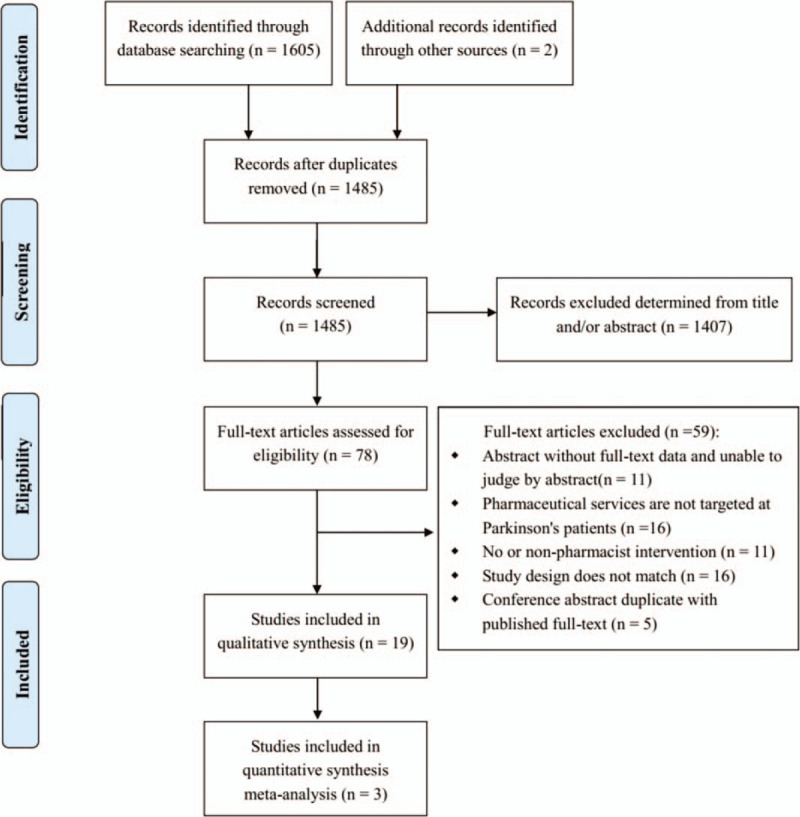
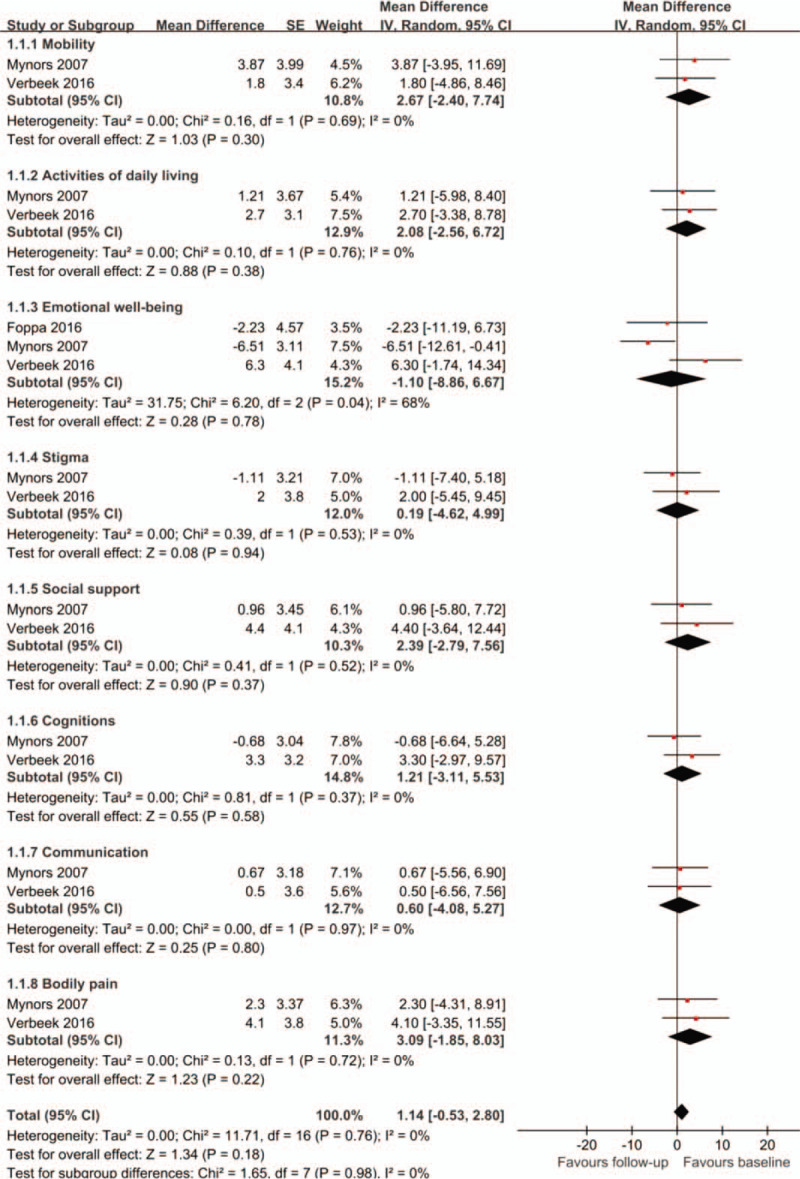
A total of 1607 studies were identified by applying the search criteria. After screening, 19 cross-sectional and case-controlled studies with 1458 PD patients from 9 countries were included. Pharmacist interventions for PD patients most commonly related to adverse drug reactions (ADRs) (13 studies), adherence assessment (12 studies), medication review (12 studies), identification of drug interactions (11 studies), monitoring response to medication therapy (11 studies), identification of inappropriate medication (11 studies), and patient education (10 studies). Most pharmacy services were provided in outpatient settings (13 studies). Reported impact measures included adherence (8 studies), quality of life (7 studies), and identification of drug-related problems (6 studies) such as ADRs (393 times out of 1760 times, 22.33%, 6 studies), inappropriate drug choice (349 times, 19.83%, 6 studies), inappropriate dosage (335 times, 19.03%, 6 studies), inappropriate drug use (257 times, 14.60%, 3 studies) and drug-drug interactions (146 times, 8.3%, 4 studies). Pooled results from 3 studies indicated no statistically significant impact of pharmacy services on all subscales of PD Questionnaire-39.
ADRs were the most widely reported drug-related problems for PD patients; pharmacy services may have a role to play in medication adherence but were not found to impact on quality of life.
药物优化对于帕金森病(PD)的管理至关重要。由于许多PD患者还患有其他长期疾病,治疗较为复杂,这些患者发生不良事件的风险很高。
探讨药剂师的作用以及药学干预对PD患者的影响。
我们全面检索了PubMed、Embase、Cochrane图书馆以及中国数据库中国生物医学文献数据库(Sinomed)、中国知网(CNKI),使用预定义的检索策略识别报告针对PD患者的药剂师干预措施和药学服务的研究。检索期从建库至2019年3月。我们还手动检索了纳入研究的参考文献列表以及ClinicalTrials.gov。我们进行了荟萃分析以定量合成证据。
应用检索标准共识别出1607项研究。筛选后,纳入了来自9个国家的19项横断面研究和病例对照研究,共1458例PD患者。药剂师对PD患者的干预措施最常涉及药物不良反应(ADR)(13项研究)、依从性评估(12项研究)、用药审查(12项研究)、药物相互作用识别(11项研究)、监测药物治疗反应(11项研究)、识别不适当用药(11项研究)以及患者教育(10项研究)。大多数药学服务在门诊环境中提供(13项研究)。报告的影响指标包括依从性(8项研究)、生活质量(7项研究)以及识别药物相关问题(6项研究),如ADR(1760次中有393次,22.33%,6项研究)、药物选择不当(349次,19.83%,6项研究)、剂量不当(335次,19.03%,6项研究)、用药不当(257次,14.60%,3项研究)以及药物相互作用(146次,8.3%,4项研究)。3项研究的汇总结果表明,药学服务对帕金森病问卷-39的所有子量表均无统计学显著影响。
ADR是PD患者中报告最广泛的药物相关问题;药学服务可能在药物依从性方面发挥作用,但未发现对生活质量有影响。