
具有多孔聚合物层的智能微针用于葡萄糖响应性胰岛素递送
Smart Microneedles with Porous Polymer Layer for Glucose-Responsive Insulin Delivery.
作者信息
Ullah Asad, Choi Hye Jin, Jang Mijin, An Sanghyun, Kim Gyu Man
机构信息
School of Mechanical Engineering, Kyungpook National University, Daegu 41566, Korea.
Daegu Gyeongbuk Medical Innovation Foundation, Laboratory Animal Center, Daegu 41061, Korea.
出版信息
Pharmaceutics. 2020 Jun 30;12(7):606. doi: 10.3390/pharmaceutics12070606.
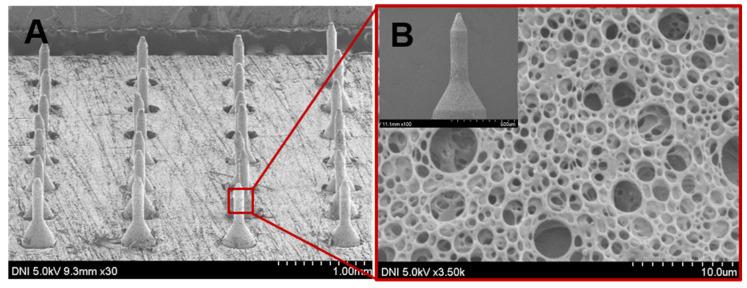
A closed-loop system imitating the function of pancreatic cells, connected to microneedles (MNs) that automatically "release" insulin in response to the blood glucose (BG) levels would be highly satisfactory for improving the quality of life and health for diabetes patients. This paper describes an easy, fast and simple technique of coating a porous polymer layer on stainless steel (SS) MNs that release insulin in a glucose-responsive fashion. It was fabricated by sealing insulin, sodium bicarbonate (a pH-sensitive element [NaHCOз]) and glucose oxidase (glucose-specific enzymes [GOx]) into the pores of a porous polymer coating. Glucose can passively diffuse into the pores and become oxidized to gluconic acid by GOx, thereby causing a decrease in local pH. The subsequent reaction of protons with NaHCOз forms carbon dioxide (CO) which creates pressure inside the pores, thereby rupturing the thin polymer film and releasing the encapsulated insulin. Field emission scanning electron microscopy (FE-SEM) images displayed that upon the exposure of MNs to glucose-free phosphate buffer saline (PBS) with pH 7.4, the pores of the porous MNs were closed, while in MNs exposed to a hyperglycemic glucose level, the pores were opened and the thin film burst. These MNs demonstrated both in vitro (in porcine skin and PBS) and in vivo (in diabetic rats) glucose-mediated insulin release under hyperglycemic conditions with rapid responsiveness. This study validated that the release of insulin from porous MNs was effectively correlated with glucose concentration.
一种模仿胰腺细胞功能的闭环系统,与微针(MNs)相连,可根据血糖(BG)水平自动“释放”胰岛素,这对于改善糖尿病患者的生活质量和健康状况将非常令人满意。本文描述了一种在不锈钢(SS)微针上涂覆多孔聚合物层的简便、快速且简单的技术,该微针能够以葡萄糖响应方式释放胰岛素。它是通过将胰岛素、碳酸氢钠(一种pH敏感元素[NaHCO₃])和葡萄糖氧化酶(葡萄糖特异性酶[GOx])密封到多孔聚合物涂层的孔隙中制成的。葡萄糖可以被动扩散到孔隙中,并被GOx氧化成葡萄糖酸,从而导致局部pH值下降。质子与NaHCO₃随后的反应形成二氧化碳(CO),在孔隙内产生压力,从而使薄聚合物膜破裂并释放封装的胰岛素。场发射扫描电子显微镜(FE-SEM)图像显示,当微针暴露于pH值为7.4的无葡萄糖磷酸盐缓冲盐水(PBS)中时,多孔微针的孔隙是关闭的,而在暴露于高血糖葡萄糖水平的微针中,孔隙打开且薄膜破裂。这些微针在高血糖条件下在体外(在猪皮肤和PBS中)和体内(在糖尿病大鼠中)均表现出葡萄糖介导的胰岛素释放,具有快速响应性。这项研究证实了多孔微针中胰岛素的释放与葡萄糖浓度有效相关。




 Zotero 插件