Doctoral Studies, Department of Geriatrics, Faculty of Health Sciences, Medical University of Bialystok, 15-471 Białystok, Poland.
Department of Geriatrics, Hospital of the Ministry of Interior and Administration in Bialystok, 15-471 Bialystok, Poland.
Int J Environ Res Public Health. 2020 Jul 2;17(13):4768. doi: 10.3390/ijerph17134768.
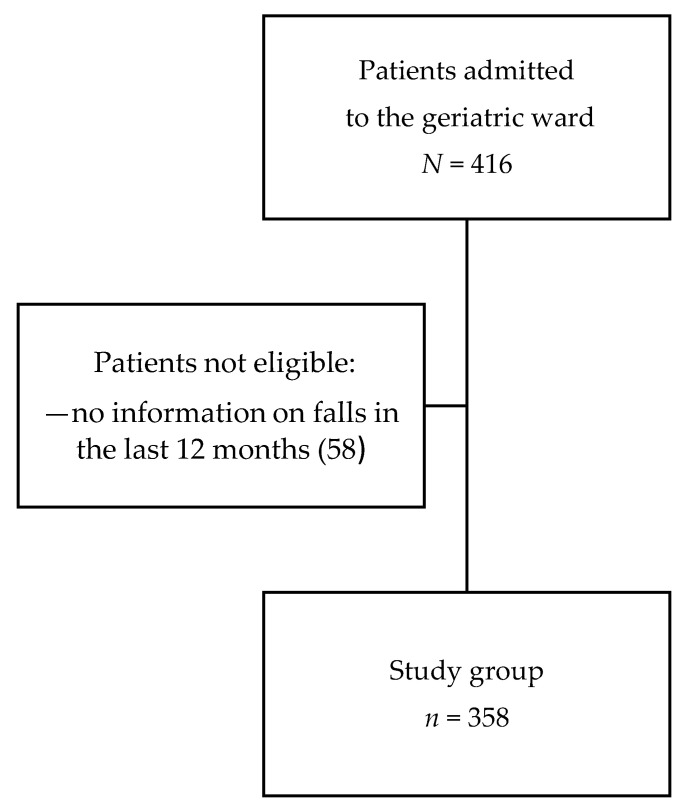
Falls are a serious health problem in older adults. A limited number of studies assessed their multifactorial nature in geriatric ward patients. The aim of this study is to explore health, functional and nutritional correlates of experiencing fall(s) in the previous year by older inpatients. A cross-sectional study of patients admitted to the department of geriatrics was conducted. A "faller status" was defined based on positive history of falls in the previous 12 months. Health, functional and nutritional factors associated with falls were evaluated, and multivariable logistic regression analysis models were built. A total of 358 patients (median age 82 (IQR 76-86) years, 77.9% women) were recruited, 43.9% of whom reported falls. The "fallers" presented with a significantly higher number of chronic diseases, higher prevalence of Parkinson's disease, peripheral arterial disease, chronic osteoarthritis, more frequently reported urinary incontinence and were dependent on others for daily living activities. They had significantly worse results for the assessment of gait, balance and frailty status. The Mini Nutritional Assessment-Short Form scores and the mean value of serum albumin were significantly lower in the fallers' group. Parkinson's disease (OR = 2.82, CI-1.07-7.45; = 0.04) and osteoarthritis (OR = 2.08, CI-1.02-4.23; = 0.04) were the main variables for the outcome prediction, according to the direct multivariable logistic regression analysis. Our findings suggest that Parkinson's disease and osteoarthritis are the main predictors independently associated with a history of falls in patients admitted to the geriatric ward, although the influence of some factors may be underestimated due to the tendency of not taking the history of falls in very frail, functionally dependent and bedridden individuals.
老年人中,跌倒属于严重的健康问题。少数研究评估了老年病房患者跌倒的多因素性质。本研究旨在探究过去 1 年经历过跌倒的老年住院患者的健康、功能和营养相关情况。本研究为一项针对老年科住院患者的横断面研究。根据过去 12 个月的跌倒史,定义了“跌倒者”状态。评估了与跌倒相关的健康、功能和营养因素,并构建了多变量逻辑回归分析模型。共纳入 358 名患者(中位数年龄 82(IQR 76-86)岁,77.9%为女性),其中 43.9%报告有跌倒。“跌倒者”患有更多的慢性疾病,帕金森病、外周动脉疾病、慢性骨关节炎的患病率更高,更常报告有尿失禁,并依赖他人进行日常生活活动。他们的步态、平衡和虚弱状态评估结果明显更差。“跌倒者”组的 Mini 营养评估-短表评分和血清白蛋白平均值明显更低。根据直接多变量逻辑回归分析,帕金森病(OR = 2.82,CI-1.07-7.45; = 0.04)和骨关节炎(OR = 2.08,CI-1.02-4.23; = 0.04)是该结局的主要预测变量。我们的研究结果表明,帕金森病和骨关节炎是与老年病房患者跌倒史独立相关的主要预测因素,尽管由于非常虚弱、功能依赖和卧床不起的个体可能倾向于不报告跌倒史,一些因素的影响可能被低估。