International Collaboration on Repair Discoveries (ICORD), Faculty of Medicine, University of British Columbia, Vancouver, British Columbia, Canada.
MD Undergraduate Program, Faculty of Medicine, University of British Columbia, Vancouver, British Columbia, Canada.
J Neurotrauma. 2020 Sep 15;37(18):2023-2027. doi: 10.1089/neu.2020.7115. Epub 2020 Jul 23.
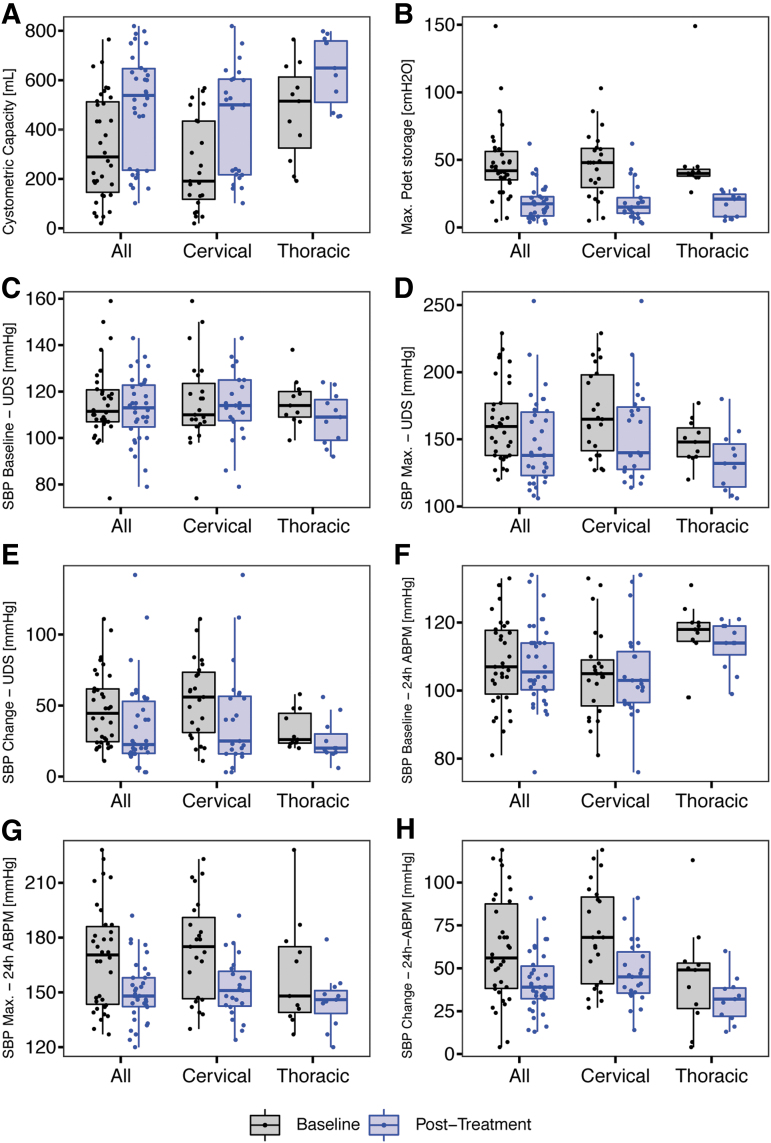
Pilot data of our phase IV clinical trial (pre/post study design) highlighted a beneficial effect of intradetrusor onabotulinumtoxinA (200 IU) injections to reduce autonomic dysreflexia (AD) in individuals with chronic spinal cord injury (SCI) at T6 or above. After trial completion, we assessed whether our primary expectation (i.e., decrease of AD severity in 50% of participants during urodynamics [UDS]) was met. Secondary outcome measures were reduction of spontaneous AD in daily life as well as amelioration of AD-related and urinary incontinence-related quality of life (QoL). In addition, we conducted injury-level-dependent analysis-i.e., cervical and upper thoracic-to explore group-specific treatment efficacy. Post-treatment, AD severity decreased in 82% (28/34) of all participants during UDS and in 74% (25/34) in daily life assessed with 24-h ambulatory blood pressure monitoring. In addition, urinary incontinence-related QoL was improved, cystometric capacity was increased, and maximum detrusor pressure during storage was reduced (all < 0.001). Further, the treatment was well tolerated, with only minor complications (grade I [ = 7] and II [ = 7]) in accordance with the Clavien-Dindo classification recorded in 11 individuals (cervical = 9, upper thoracic = 2). Injury-level-dependent analysis revealed lower incidence (cervical = 15/23, upper thoracic = 6/11) and lesser severity (cervical = 0.009; upper thoracic = 0.06 [Pearson = -0.6, i.e., large effect size]) of AD during UDS. Further, reduced AD severity in daily life, improved urinary incontinence-related QoL, greater cystometric capacity, and lower maximum detrusor pressure during storage (all < 0.05) were found in both groups post-treatment. Intradetrusor onabotulinumtoxinA injections are an effective and safe second-line treatment option that ameliorates AD while improving lower urinary tract function and urinary incontinence-related QoL in individuals with cervical and upper thoracic SCI.
我们的 IV 期临床试验(前后研究设计)的初步数据强调了经尿道内注射肉毒毒素 A(200IU)对 T6 及以上慢性脊髓损伤(SCI)患者自主神经反射障碍(AD)的有益作用。试验完成后,我们评估了我们的主要预期(即在尿动力学检查期间 50%的参与者 AD 严重程度降低)是否得到满足。次要结果测量是日常生活中 AD 的自发减少以及 AD 相关和尿失禁相关生活质量(QoL)的改善。此外,我们进行了基于损伤水平的分析,即颈段和上胸段,以探索特定于组的治疗效果。治疗后,所有参与者的 UDS 期间 AD 严重程度降低 82%(28/34),24 小时动态血压监测评估日常生活中 AD 降低 74%(25/34)。此外,尿失禁相关 QoL 得到改善,膀胱容量增加,储存期间最大逼尿肌压力降低(均 <0.001)。此外,该治疗具有良好的耐受性,只有 11 名患者(颈段 9 名,上胸段 2 名)记录到轻微并发症(Clavien-Dindo 分级 I [ = 7] 和 II [ = 7])。基于损伤水平的分析显示,UDS 期间 AD 的发生率较低(颈段 15/23,上胸段 6/11),严重程度较低(颈段 0.009;上胸段 0.06 [Pearson = -0.6,即大效应量])。进一步,两组患者治疗后日常生活中 AD 严重程度降低,尿失禁相关 QoL 改善,膀胱容量增加,储存期间最大逼尿肌压力降低(均 <0.05)。经尿道内注射肉毒毒素 A 是一种有效且安全的二线治疗选择,可改善 AD,同时改善颈段和上胸段 SCI 患者的下尿路功能和尿失禁相关 QoL。